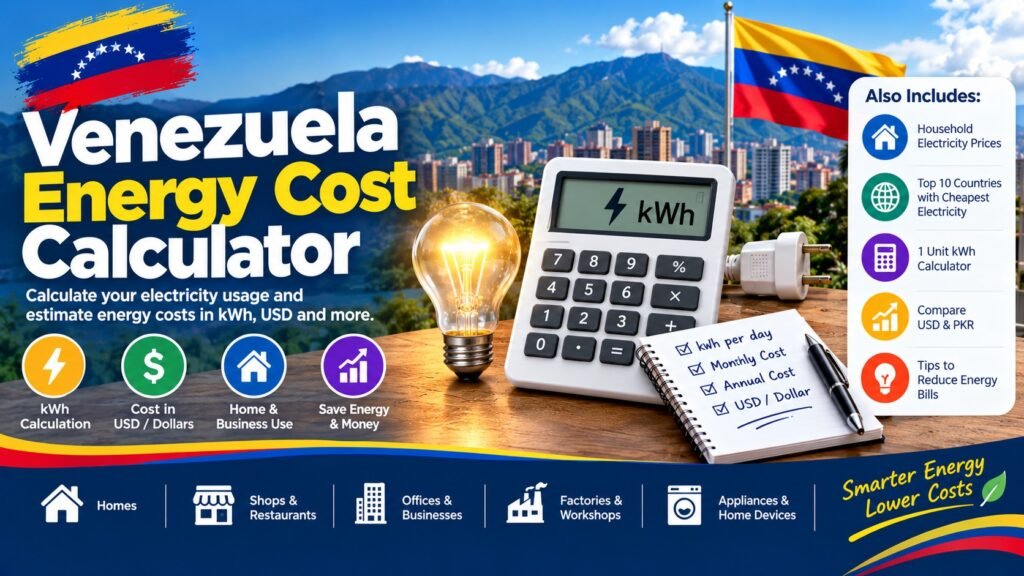
Venezuela Energy Cost Calculator
Calculate electricity usage and estimated energy costs from appliance power,
daily usage, number of days, and your own electricity price per kWh.
Energy Cost Results
0 kWh
0 kWh
$0.00
$0.00
$0.00
$0.00
0 W
$0.00/kWh
How it is calculated:
Daily kWh = Watts ÷ 1,000 × Hours per day
Monthly kWh = Daily kWh × Days per month
Daily Cost = Daily kWh × Electricity Rate
Monthly Cost = Monthly kWh × Electricity Rate
Annual Cost = Monthly Cost × 12
Important:
This is an estimate based on the values you enter.
The electricity rate is a manual input and is not a live Venezuela electricity tariff.
Actual electricity bills may also include taxes, fixed charges, different tariff tiers,
or changing rates.
The Venezuela Energy Cost Calculator helps you estimate how much electricity an appliance, machine, home device, office system, or other electrical load may cost to operate. You can enter your electricity price in dollars per kilowatt-hour, the power of your appliance in watts, the number of hours you use it each day, and the number of days you want to calculate.
The calculator converts watts into kilowatt-hours, calculates daily electricity use, and then estimates monthly and yearly energy costs.
This makes it useful for households, businesses, students, travelers, property owners, workshops, restaurants, offices, and anyone who wants to understand electricity use in Venezuela.
The calculator is designed to be simple. You do not need an account, special software, or an electricity company connection. You only need the numbers you want to calculate.
Important: The calculator uses the electricity rate you enter. It does not claim to provide a live Venezuelan electricity tariff.
What Is the Venezuela Energy Cost Calculator?
The Venezuela Energy Cost Calculator is an online tool for estimating electricity consumption and electricity costs.
Electricity is commonly measured in kilowatt-hours, written as kWh.
Your electricity bill may use kWh to measure how much electrical energy you consume during a billing period.
For example, if a 1,000-watt appliance operates for five hours:
1,000 watts ÷ 1,000 = 1 kilowatt
Then:
1 kilowatt × 5 hours = 5 kWh
So the appliance uses approximately 5 kWh during those five hours.
If your electricity rate is $0.10 per kWh:
5 kWh × $0.10 = $0.50
The estimated electricity cost would therefore be $0.50 for those five hours.
This simple formula is the foundation of the calculator.
Venezuela Energy Cost Calculator kWh
The most important unit in an electricity cost calculation is the kilowatt-hour, or kWh.
A watt measures electrical power. A kilowatt is 1,000 watts.
A kilowatt-hour measures energy used over time.
For example:
- 100 watts used for 10 hours = 1 kWh
- 500 watts used for 2 hours = 1 kWh
- 1,000 watts used for 1 hour = 1 kWh
- 2,000 watts used for 30 minutes = 1 kWh
This is why the Venezuela energy cost calculator kWh calculation needs both appliance power and operating time.
Basic kWh Formula
The formula is:
kWh = Watts ÷ 1,000 × Hours
For example:
A 2,000-watt water heater operates for 3 hours.
2,000 ÷ 1,000 = 2 kW
Then:
2 × 3 = 6 kWh
The water heater uses approximately 6 kWh during those three hours.
Venezuela Energy Cost Calculator USD
The calculator can work with electricity prices entered in USD per kWh.
This is useful because energy prices may be discussed in different currencies. Using USD can make international comparisons easier.
For example, suppose you enter:
- Electricity rate: $0.10/kWh
- Appliance power: 1,000 W
- Usage: 5 hours per day
- Days: 30
First calculate daily energy:
1,000 ÷ 1,000 × 5 = 5 kWh
Then calculate monthly energy:
5 × 30 = 150 kWh
Then calculate the monthly cost:
150 × $0.10 = $15
The estimated monthly electricity cost is therefore:
$15
This is an example only. The user should enter the electricity rate they want to use.
Venezuela Energy Cost Calculator in Dollars
A Venezuela energy cost calculator in dollars can be useful when comparing energy expenses between Venezuela and other countries.
The calculator does not automatically assume that a particular dollar rate is the current Venezuelan tariff.
Instead, you enter the rate yourself.
For example, you might enter:
$0.05/kWh
or:
$0.10/kWh
or:
$0.20/kWh
The calculator then uses your selected rate.
This approach is useful because electricity pricing can vary by customer type, consumption level, tariff structure, location, taxes, fixed charges, subsidies, and other factors.
Electricity prices also differ between residential and business users in many countries. Global electricity datasets show substantial differences between household and business rates.
How Do I Calculate My Energy Cost?
A common question is:
How do I calculate my energy cost?
You need four basic numbers:
- Electricity price per kWh
- Appliance power in watts
- Hours of use per day
- Number of days
Then follow these steps.
Step 1: Convert watts to kilowatts
Divide watts by 1,000.
For a 1,500-watt appliance:
1,500 ÷ 1,000 = 1.5 kW
Step 2: Calculate daily energy use
Multiply the kilowatts by hours used.
If the appliance runs for 4 hours:
1.5 × 4 = 6 kWh
Step 3: Calculate monthly energy use
If the appliance operates every day for 30 days:
6 × 30 = 180 kWh
Step 4: Calculate monthly cost
If electricity costs $0.10/kWh:
180 × $0.10 = $18
The estimated monthly electricity cost is:
$18
The same method can be used for refrigerators, air conditioners, fans, televisions, computers, pumps, heaters, washing machines, kitchen appliances, lighting, and many other devices.
How Do I Calculate My Energy Cost in kWh?
Another common question is:
How do I calculate my energy cost in kWh?
First, calculate energy consumption.
Use:
Energy = Power × Time
Because electricity calculators normally use kilowatts and hours:
kWh = Watts ÷ 1,000 × Hours
For example, a 750-watt appliance running for 8 hours:
750 ÷ 1,000 = 0.75 kW
Then:
0.75 × 8 = 6 kWh
So the appliance uses approximately 6 kWh.
If your electricity price is $0.15 per kWh:
6 × $0.15 = $0.90
The estimated energy cost is $0.90.
Electricity Cost Calculator kWh
An electricity cost calculator kWh tool is useful because manual calculations can become difficult when you have many appliances.
Imagine a home with:
- Refrigerator
- Air conditioner
- Ceiling fans
- Television
- Computer
- Water heater
- Washing machine
- Lights
- Kitchen appliances
Each device has a different wattage and different operating time.
You can calculate each device separately and then add the results.
For example:
| Appliance | Power | Daily Use |
|---|---|---|
| Fan | 75 W | 8 hours |
| TV | 120 W | 5 hours |
| Computer | 200 W | 6 hours |
| Refrigerator | 150 W | 10 equivalent hours |
| Water heater | 2,000 W | 2 hours |
The important point is that the actual energy use of some appliances, such as refrigerators, may vary because compressors cycle on and off rather than running continuously.
Therefore, a simple wattage calculation is an estimate.
1 Unit kWh Calculator
Many people ask about a 1 unit kWh calculator.
In common electricity billing language, one unit of electricity generally means one kilowatt-hour (1 kWh).
So:
1 unit = 1 kWh
If your electricity rate is $0.10 per kWh:
1 unit × $0.10 = $0.10
If the rate is $0.15:
1 unit × $0.15 = $0.15
The price of one unit therefore depends on the electricity rate.
This is why a universal answer for the cost of one electricity unit does not work for every location or customer.
How Much Does 1 kWh Cost?
The answer depends on the electricity tariff being used.
Global electricity data shows that household electricity prices vary significantly between countries. A Q2 2026 dataset gives a world residential average of about $0.176 per kWh.
The same dataset lists a 2023–2026 average residential rate for Venezuela of approximately:
$0.069/kWh
This is a published comparison average, not a statement that every Venezuelan household currently pays exactly $0.069/kWh. Tariffs and billing structures can change, and country-level comparison datasets use their own methodologies.
For your calculator, it is better to enter the rate that applies to the calculation you want to make.
Venezuela Electricity Price in USD
Electricity prices can be shown in Venezuelan currency or converted into USD.
A USD calculation is especially useful when comparing Venezuela with another country.
For example:
100 kWh × $0.069 = $6.90
This is simply a mathematical example using the published multi-year comparison value.
It should not be interpreted as an exact household bill.
Actual bills can depend on:
- Consumption
- Customer category
- Tariff structure
- Fixed charges
- Taxes
- Subsidies
- Location
- Billing period
- Exchange-rate treatment
- Utility rules
The U.S. Energy Information Administration also notes that electricity prices are affected by generation costs, fuel costs, transmission and distribution, demand, regulations, and other factors.
Household Electricity Prices by Country
Household electricity prices can be very different around the world.
A country with large domestic energy resources may have a very different electricity price from an island nation that needs to import fuel.
According to GlobalPetrolPrices’ 2023–2026 average dataset, some of the lower residential electricity rates include the following:
| Country | Residential electricity average, USD/kWh |
|---|---|
| Ethiopia | $0.006 |
| Bhutan | $0.015 |
| Kyrgyzstan | $0.015 |
| Iraq | $0.015 |
| Angola | $0.016 |
| Sudan | $0.017 |
| Egypt | $0.023 |
| Zambia | $0.023 |
| Myanmar | $0.025 |
| Oman | $0.030 |
For comparison, the same dataset lists:
- Qatar: $0.032/kWh
- Kuwait: $0.040/kWh
- Saudi Arabia: $0.052/kWh
- Pakistan: $0.063/kWh
- Venezuela: $0.069/kWh
- India: $0.077/kWh
- China: $0.076/kWh
- United States: $0.188/kWh
These are 2023–2026 comparison averages, not live prices.
Why Can Electricity Prices Be So Different?
Electricity prices are influenced by many factors.
These include:
- Fuel costs
- Natural gas prices
- Oil prices
- Hydropower availability
- Solar generation
- Wind generation
- Power plant costs
- Transmission costs
- Distribution costs
- Taxes
- Subsidies
- Government regulation
- Currency exchange rates
- Local electricity demand
The cost of generating and delivering electricity is therefore more complicated than simply looking at the price of fuel.
Top 10 Countries With Cheapest Electricity
People often search for the top 10 countries with cheapest electricity.
Using the 2023–2026 residential averages published by GlobalPetrolPrices, the ten lowest figures in the displayed country dataset are:
- Ethiopia — about $0.006/kWh
- Bhutan — about $0.015/kWh
- Kyrgyzstan — about $0.015/kWh
- Iraq — about $0.015/kWh
- Angola — about $0.016/kWh
- Sudan — about $0.017/kWh
- Egypt — about $0.023/kWh
- Zambia — about $0.023/kWh
- Myanmar — about $0.025/kWh
- Oman — about $0.030/kWh
The figures should be treated as a comparison list rather than a live ranking. The source describes its figures as residential rates and uses a multi-year average to reduce short-term volatility.
This distinction is important because electricity prices can change, and different sources can use different consumption assumptions and methodologies.
Why Venezuela Has Low Electricity Cost in Some International Comparisons
The published 2023–2026 average for Venezuela is about $0.069/kWh for residential electricity.
A low reported electricity price does not automatically mean that electricity is inexpensive to produce.
A country’s electricity system can have low consumer prices because of:
- Subsidies
- Regulated tariffs
- Domestic energy resources
- Government pricing policies
- Hydropower
- Currency effects
- Different billing structures
It is therefore useful to separate the price paid by the customer from the full economic cost of producing and delivering electricity.
How to Calculate kWh Cost Per Month
The easiest way to calculate monthly electricity cost is:
Monthly kWh = Watts ÷ 1,000 × Hours per day × Days per month
Then:
Monthly cost = Monthly kWh × Price per kWh
Example
Suppose you have a:
1,000 W appliance
You use it:
5 hours per day
For:
30 days
And your selected electricity price is:
$0.10/kWh
Calculate power:
1,000 ÷ 1,000 = 1 kW
Daily consumption:
1 × 5 = 5 kWh
Monthly consumption:
5 × 30 = 150 kWh
Monthly cost:
150 × $0.10 = $15
Therefore:
Monthly energy use = 150 kWh
Estimated monthly cost = $15
How Much Electricity Does a 1,000-Watt Appliance Use?
A 1,000-watt appliance uses:
1 kWh per hour
if it actually consumes its full rated 1,000 watts continuously.
For example:
- 1 hour = 1 kWh
- 2 hours = 2 kWh
- 5 hours = 5 kWh
- 10 hours = 10 kWh
- 24 hours = 24 kWh
At a rate of $0.10/kWh:
- 1 hour = $0.10
- 5 hours = $0.50
- 10 hours = $1.00
- 24 hours = $2.40
This is a simple calculation and does not account for appliances that cycle on and off.
Air Conditioner Energy Cost
Air conditioners can use significant electricity because their power requirements are often much higher than those of small electronic devices.
Suppose an air conditioner has a rated power of 1,500 watts.
If it operates for 6 hours per day:
1,500 ÷ 1,000 × 6 = 9 kWh/day
For 30 days:
9 × 30 = 270 kWh/month
At $0.10/kWh:
270 × $0.10 = $27/month
However, the real energy use can be different because an air conditioner may cycle, change output, or operate under different conditions.
Refrigerator Energy Cost
A refrigerator is another appliance that needs careful treatment.
A refrigerator may have a rated power of 100 or 150 watts, but its compressor does not necessarily run at full power continuously.
If you simply multiply the nameplate wattage by 24 hours, you may overestimate actual energy use.
For a better estimate, use:
- Manufacturer energy information
- A plug-in energy meter
- Actual monthly kWh data
- A realistic estimated operating cycle
The calculator is still useful for a rough calculation, but real-world appliance behavior matters.
Fan Energy Cost
Fans usually have relatively low power consumption.
Suppose a fan uses 75 watts and runs for 8 hours each day.
Daily energy:
75 ÷ 1,000 × 8 = 0.6 kWh
Monthly energy:
0.6 × 30 = 18 kWh
At $0.10/kWh:
18 × $0.10 = $1.80
This shows why wattage and operating time are both important.
Water Heater Energy Cost
Water heaters can consume substantial electricity.
Suppose a water heater is rated at 2,000 watts and operates for 2 hours per day.
Daily consumption:
2,000 ÷ 1,000 × 2 = 4 kWh
Monthly consumption:
4 × 30 = 120 kWh
At $0.10/kWh:
120 × $0.10 = $12
Again, this is a simple estimate based on the entered operating time.
Business Energy Cost
The Venezuela Energy Cost Calculator can also help businesses estimate energy expenses.
Examples include:
- Restaurants
- Shops
- Offices
- Workshops
- Warehouses
- Small factories
- Hotels
- Food businesses
- Computer rooms
- Refrigeration businesses
Businesses may operate many machines simultaneously.
A business can estimate each major load separately and then combine the results.
For example:
Monthly cost = Appliance 1 cost + Appliance 2 cost + Appliance 3 cost + …
For large facilities, actual electricity bills should be used whenever possible because commercial and industrial tariffs may have additional structures.
Generator Energy Cost
A generator does not create free energy.
It converts fuel into electrical energy.
If you want to estimate the total cost of electricity from a generator, you should consider:
- Fuel consumption
- Fuel price
- Generator efficiency
- Generator load
- Maintenance
- Runtime
- Electricity output
This is different from a simple grid electricity calculation.
The electricity calculator is mainly designed for calculating energy cost when you already know the electricity rate per kWh.
Solar Power and Energy Cost
Solar panels can reduce the amount of electricity purchased from the grid.
For solar calculations, additional information is needed, such as:
- Solar panel capacity
- Number of panels
- Sun hours
- System efficiency
- Battery losses
- Inverter efficiency
- Weather
- Orientation
- Shading
A basic electricity cost calculator can show how much electricity a load would consume, while a solar calculator can estimate how much of that demand may be supplied by solar generation.
Venezuela Energy Cost Calculator for Homes
For a home, the easiest approach is to list the major appliances.
For example:
| Device | Example Power | Example Hours/Day |
|---|---|---|
| Fan | 75 W | 8 |
| TV | 120 W | 5 |
| Computer | 200 W | 6 |
| Lights | 100 W total | 6 |
| Refrigerator | Variable | Variable |
| Water heater | 2,000 W | 2 |
| Air conditioner | 1,500 W | 6 |
You can calculate each load separately.
Then add the monthly kWh figures.
This gives you a rough estimate of total energy consumption.
Venezuela Energy Cost Calculator From Pakistan
The calculator can also be useful for someone researching Venezuela from Pakistan.
For example, someone in Pakistan may want to compare:
- Venezuela electricity costs
- Pakistan electricity costs
- USD energy costs
- kWh consumption
- Household appliance costs
- Fuel costs
- Natural gas costs
- International electricity prices
A USD-based calculation makes the mathematical comparison easier.
However, electricity prices should not be compared without considering taxes, subsidies, income, exchange rates, reliability, and tariff structures.
A low price per kWh does not tell the complete story about the cost or quality of an electricity system.
Venezuela Energy Cost Calculator USD vs PKR
The calculator itself uses USD per kWh.
If you want to convert the result into Pakistani rupees, you can use:
USD cost × USD/PKR exchange rate = PKR cost
For example, if a calculation produces:
$15
and the exchange rate used for your example is:
1 USD = 300 PKR
then:
15 × 300 = 4,500 PKR
So the example cost would be:
4,500 PKR
The exchange rate should be updated separately because currency rates change.
How Much Does Gas Cost in Venezuela?
The word gas can mean different things.
It may refer to:
- Gasoline/petrol
- Natural gas
- LPG
- Vehicle gas
These are different energy products.
For example, a current GlobalPetrolPrices listing dated September 21, 2026 shows Venezuela’s official octane-95 gasoline price at about $0.035 per liter, while also describing a separate subsidized price structure for eligible purchases and higher pricing above the subsidized monthly amount.
That is a gasoline price, not an electricity price.
It should not be entered into the electricity calculator.
For LPG, current international datasets can have limitations for Venezuela; one current GlobalPetrolPrices LPG page displays zero values rather than a usable market price. Therefore, a manual LPG calculator is safer than presenting that zero as a real consumer price.
Electricity vs Gasoline
Electricity and gasoline should not be confused.
Electricity is normally measured in:
kWh
Gasoline is normally measured in:
liters or gallons
For example:
Electricity: $0.10/kWh
Gasoline: $0.50/liter
These numbers cannot be compared directly because they measure different forms of energy and use different units.
The same applies to natural gas and LPG.
Electricity Cost and Natural Gas
Natural gas is another energy source.
It may be used for:
- Cooking
- Heating
- Industrial processes
- Electricity generation
- Commercial applications
Natural gas can be priced using units such as:
- Cubic meters
- Cubic feet
- MMBtu
Electricity is normally calculated in kWh.
A natural gas calculator and electricity calculator therefore use different units and formulas.
Why Electricity Prices Change
Electricity prices can change for many reasons.
Fuel costs are one factor.
Other factors include:
- Demand
- Weather
- Generation capacity
- Transmission
- Distribution
- Taxes
- Regulation
- Fuel availability
- Hydropower output
- Solar and wind generation
- Exchange rates
The U.S. Energy Information Administration explains that electricity prices can be affected by fuel costs, power plant costs, transmission and distribution systems, weather, demand, and regulations.
This is why an electricity calculator should allow users to enter their own electricity rate instead of assuming that one number applies to everyone.
Why Use a Manual Electricity Rate?
The calculator uses a manual rate for a simple reason.
Electricity tariffs can change, and a website should not present an old number as a live price.
With a manual input, you can enter:
$0.05/kWh
or:
$0.069/kWh
or:
$0.10/kWh
or any other rate you want to study.
This also makes the calculator useful for international comparisons.
Example: $0.069 per kWh
Suppose you want to use $0.069/kWh as a comparison value.
For 100 kWh:
100 × $0.069 = $6.90
For 250 kWh:
250 × $0.069 = $17.25
For 500 kWh:
500 × $0.069 = $34.50
These are mathematical examples using the selected rate.
They are not statements about an individual’s actual electricity bill.
Example: $0.10 per kWh
At $0.10/kWh:
| Monthly Usage | Estimated Cost |
|---|---|
| 50 kWh | $5 |
| 100 kWh | $10 |
| 150 kWh | $15 |
| 200 kWh | $20 |
| 300 kWh | $30 |
| 500 kWh | $50 |
| 1,000 kWh | $100 |
This simple table shows how the electricity rate and consumption work together.
How to Reduce Electricity Costs
The calculator can also help identify expensive appliances.
If one device uses a large amount of electricity, reducing its operating time may reduce the total cost.
Common ideas include:
Use efficient lighting
LED lighting normally uses less electricity than older incandescent lighting for a similar amount of light.
Reduce unnecessary air-conditioning use
Air conditioning can be a major electrical load.
Using a suitable temperature setting, improving insulation, and avoiding unnecessary operation can reduce consumption.
Turn off unused equipment
Computers, televisions, chargers, and other devices can consume electricity when left on or in standby.
Check high-power appliances
Water heaters, ovens, electric heaters, pumps, and air conditioners can use much more electricity than small electronics.
Measure actual consumption
A plug-in energy meter can provide better information for individual appliances than a simple nameplate calculation.
Limitations of the Venezuela Energy Cost Calculator
No calculator can perfectly predict every electricity bill.
The calculator is designed for estimates.
Actual costs can differ because of:
- Variable appliance power
- Standby consumption
- Compressor cycling
- Thermostats
- Voltage changes
- Different tariff levels
- Fixed utility charges
- Taxes
- Subsidies
- Billing rules
- Different customer categories
- Changes in electricity prices
For an accurate bill, use the actual electricity rate and consumption information provided by your electricity provider.
Frequently Asked Questions
How do I calculate my energy cost?
Convert appliance watts into kilowatts, multiply by hours of use, and then multiply by the electricity rate.
Cost = Watts ÷ 1,000 × Hours × Price per kWh
For monthly costs, multiply daily usage by the number of days.
How do I calculate my energy cost in kWh?
Use:
kWh = Watts ÷ 1,000 × Hours
For example, a 1,000-watt appliance running for 5 hours uses approximately 5 kWh.
What is 1 unit of electricity?
One electricity unit commonly means:
1 kWh
The monetary value of that unit depends on the electricity rate.
How do I calculate kWh cost per month?
Use:
Monthly kWh = Watts ÷ 1,000 × Hours per day × Days
Then:
Monthly cost = Monthly kWh × Price per kWh
What is the Venezuela Energy Cost Calculator in USD?
It is an online calculation tool that lets you enter an electricity rate in USD per kWh and estimate the cost of electricity use.
Can I use the calculator in dollars?
Yes. Enter the electricity rate in USD per kWh.
Does the calculator provide a live Venezuelan electricity price?
No. The calculator uses the rate entered by the user.
This avoids presenting an example or comparison rate as a live tariff.
How much does gas cost in Venezuela?
It depends on what you mean by gas.
If you mean gasoline, a GlobalPetrolPrices listing dated September 21, 2026 reports an official octane-95 price of about $0.035 per liter and describes separate subsidized and higher-price structures.
Gasoline, LPG, and natural gas are different products and should be calculated separately.
Which country has the cheapest electricity in the world?
There is no single permanent answer because prices change and sources use different methodologies.
In the GlobalPetrolPrices 2023–2026 residential comparison dataset, Ethiopia has the lowest listed average at about $0.006/kWh, followed by several countries with rates around $0.015–$0.017/kWh.
What are the top 10 countries with the cheapest electricity?
Using that published 2023–2026 residential comparison dataset, the lowest ten listed values are Ethiopia, Bhutan, Kyrgyzstan, Iraq, Angola, Sudan, Egypt, Zambia, Myanmar, and Oman.
These are comparison averages, not guaranteed current household tariffs.
Is Venezuela’s electricity cheap compared with other countries?
The published 2023–2026 residential average for Venezuela is approximately $0.069/kWh. That is below the reported world Q2 2026 residential average of $0.176/kWh, but a country-level average should not be treated as an exact price paid by every household.
Can I calculate electricity cost for an appliance?
Yes.
Enter:
- Appliance watts
- Hours per day
- Days per month
- Electricity price per kWh
The calculator will estimate energy consumption and cost.
Can I calculate a yearly electricity cost?
Yes.
The calculator calculates monthly cost and multiplies it by 12 to estimate annual cost.
Can I use this calculator for a business?
Yes. It can be used for basic estimates for shops, offices, restaurants, workshops, and other businesses.
For complex commercial tariffs, use the actual tariff structure from the electricity provider.
The Venezuela Energy Cost Calculator is designed to make electricity calculations simple.
Instead of trying to calculate everything manually, you can enter four basic values:
Electricity rate
Appliance power
Hours per day
Days per month
The calculator then shows:
- Daily kWh
- Monthly kWh
- Daily electricity cost
- Monthly electricity cost
- Annual electricity cost
- Cost per hour
The most important formula to remember is:
kWh = Watts ÷ 1,000 × Hours
And the basic cost formula is:
Electricity Cost = kWh × Price per kWh
For example, a 1,000-watt appliance used for five hours per day consumes approximately 5 kWh per day. At $0.10 per kWh, that is an estimated $0.50 per day.
International electricity prices can be very different. Published 2023–2026 comparison data shows Venezuela at approximately $0.069/kWh on a residential average basis, while the Q2 2026 world residential average is about $0.176/kWh.
These numbers are useful for comparison, but users should enter the electricity rate that applies to their own calculation.
Whether you are checking a home appliance, estimating a monthly bill, comparing Venezuela with Pakistan, researching USD electricity costs, or learning how one kWh works, the calculator provides a straightforward way to estimate energy consumption and cost.