What Venezuela Crude Oil Carries Beyond Barrels and Price
When people talk about Venezuela crude oil, the conversation often begins with barrels and price. How much oil does Venezuela have? How much can one barrel sell for? How much can the country produce? These are important questions, but they describe only part of the story. A barrel of crude oil also carries chemical properties, geological information, processing requirements, transportation challenges, and clues about the kind of products a refinery may be able to produce.
This matters greatly in Venezuela because a large share of the country’s petroleum resources consists of heavy and extra-heavy crude. The U.S. Energy Information Administration reported that Venezuela had about 303 billion barrels of proved crude oil reserves in 2023, the world’s largest proved crude oil reserve base at that time. Most of those proved reserves were extra-heavy crude from the Orinoco Belt. Yet the size of the reserve base does not automatically mean that every barrel is easy or cheap to produce, transport, upgrade, or refine.
The U.S. Geological Survey has also shown the enormous scale of the Orinoco resource. Its assessment of the Orinoco Oil Belt found more than 1 trillion barrels of heavy oil in place and estimated a mean of 513 billion barrels of technically recoverable heavy oil, with a range of 380 billion to 652 billion barrels. These figures are a geological and technical resource assessment, not a statement that all of those barrels are proved reserves or can be produced economically today.
The deeper story of Venezuela crude oil begins with the oil itself. Crude is not one uniform liquid. Its density, sulfur content, viscosity, metals, water, salts, resins, asphaltenes, aromatics, saturates, and distillation characteristics can vary widely. Those differences affect what happens after the oil leaves the reservoir. They influence pipelines, storage, blending, upgrading, refinery equipment, operating costs, product yields, and ultimately the value of the crude.
What Venezuela Crude Oil Carries Inside a Barrel
A barrel of crude oil is a complex mixture of hydrocarbons and other compounds. The hydrocarbons can range from relatively small molecules to very large and complex structures. Crude also contains compounds that include sulfur, nitrogen, oxygen, and trace metals. Water, salts, sediments, and other materials can also be present in produced crude before it is properly treated.
This means that the word “oil” hides a great deal of information.
Two barrels can contain the same volume of liquid but behave very differently during production and refining. One may be relatively light and flow easily. Another may be extremely heavy and viscous. One may contain relatively little sulfur, while another may contain much more. One may contain higher concentrations of metals or asphaltenes that create additional refinery challenges.
Research into Venezuelan petroleum shows this variation clearly. A study covering 189 Venezuelan oil samples reported API gravities ranging from 6.4° to 32.8° API. Using API gravity and SARA composition, the researchers identified extra-heavy, heavy, medium, and light crude oils among the samples.
The study is useful because it demonstrates why Venezuela crude oil should not be treated as a single chemical product. Venezuelan petroleum comes from different basins and fields, and its properties reflect different geological histories.
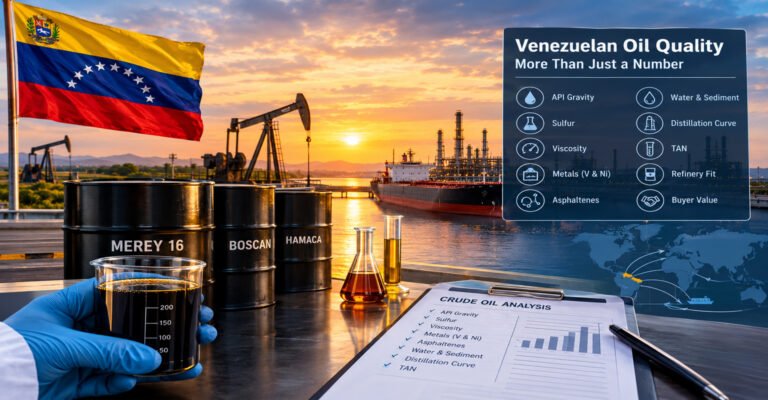
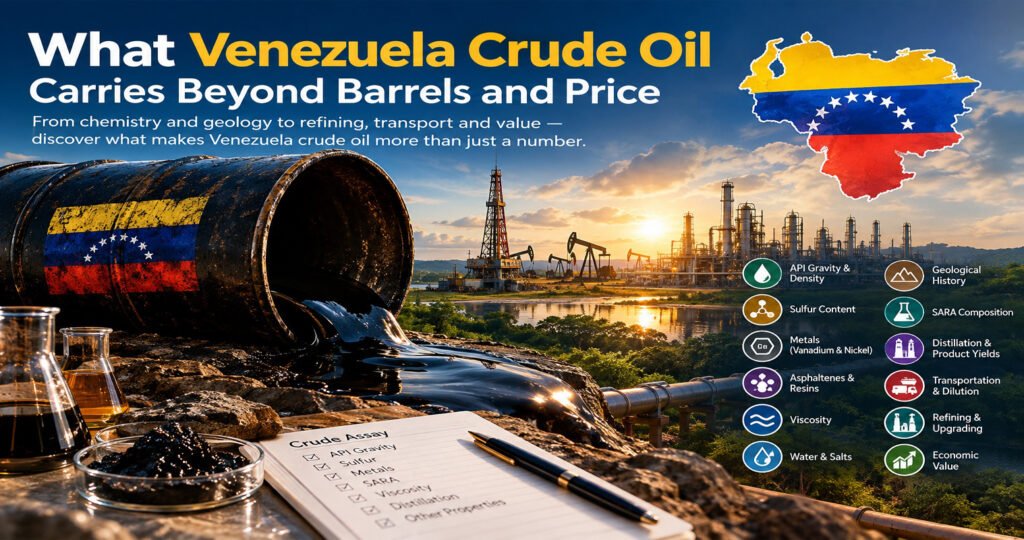
A crude assay is therefore much more informative than a country label alone. A refinery or trader can examine an assay to understand the characteristics of a particular crude stream and determine how it may fit into a refinery system.
Venezuela Crude Oil and API Gravity
API gravity is one of the most common measurements used to describe crude oil.
It indicates how dense a petroleum liquid is compared with water. Higher API gravity generally indicates lighter crude, while lower API gravity indicates heavier crude.
The standard relationship is:
API gravity = (141.5 / specific gravity at 60°F) – 131.5
The lower the API number, the denser the crude tends to be.
This measurement is particularly important when discussing Venezuela crude oil because some Venezuelan petroleum is extremely heavy. In the Venezuelan crude study covering 189 samples, oils with API gravity from 6.4° to 9.9° were classified as extra-heavy, while samples from 10.0° to 21.6° were classified as heavy. Medium and light samples were also present.
API gravity, however, does not tell a refinery everything it needs to know.
Two crudes can have similar API gravity but very different sulfur, metals, viscosity, SARA composition, acidity, and distillation characteristics. For that reason, refiners use several measurements together when evaluating a crude.
A useful crude assay can therefore answer much more than the question “Is this oil heavy or light?”
It can help show:
- How dense the crude is.
- How much sulfur it contains.
- How much water and salt are present.
- How much material boils at different temperatures.
- How much residue remains after distillation.
- How much vanadium and nickel are present.
- How much of the crude consists of saturates, aromatics, resins, and asphaltenes.
- How difficult the crude may be to process.
For Venezuela crude oil, these measurements are particularly important because heavy and extra-heavy streams can require more complex handling and conversion than lighter crude.
Why Venezuela Crude Oil Can Be Heavy
Heavy crude is not simply “bad oil.” It is crude with physical and chemical characteristics that make it different from lighter petroleum.
Heavy crude generally contains a greater proportion of high-molecular-weight compounds. Resins and asphaltenes can make up important portions of the oil. These compounds can contribute to high viscosity and can influence how the oil behaves during production, transportation, storage, and refining.
The Orinoco Oil Belt is the best-known example in Venezuela. The USGS describes the belt as covering approximately 50,000 square kilometers of the East Venezuela Basin Province and being underlain by more than 1 trillion barrels of heavy oil in place.
The physical behavior of very heavy oil can create major engineering challenges. A heavy crude can resist flow much more strongly than a light crude. This can affect well production, pipeline movement, pumping requirements, storage, and blending.
Research on heavy oil from the Eastern Venezuela Basin provides an example of how extreme these properties can become. One study described oil with an average API gravity of about 7.8° and an average subsurface viscosity of about 5,516 centipoise. These are study-specific values and should not be treated as an average for all Venezuelan crude.
The important lesson is that the physical properties of the crude influence the entire supply chain.
Venezuela Crude Oil and Viscosity
Viscosity describes a fluid’s resistance to flow.
For crude oil, viscosity can be one of the most important practical properties because it affects how easily the oil can move from the reservoir to production equipment and then through pipelines.
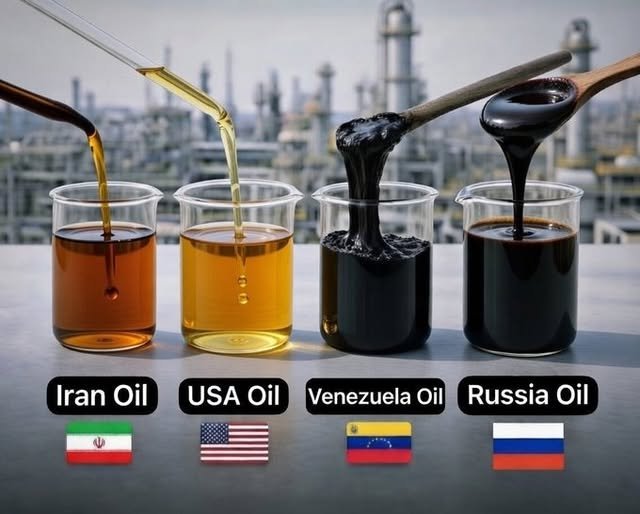
A light crude may flow relatively easily under suitable conditions. An extremely heavy crude can behave much more like a thick liquid and may require special production or transportation methods.
Temperature can also make a major difference. Many heavy oils become less viscous as temperature increases. This relationship is one reason heating and other thermal methods can be important in some heavy-oil operations.
Dilution can also change flow behavior. A producer may blend heavy crude with a lighter hydrocarbon or another suitable diluent to reduce viscosity and make transportation easier.
The precise method depends on the crude, infrastructure, economics, and operating conditions. There is no single solution for every Venezuelan oil field.
For Venezuela crude oil, viscosity therefore has both technical and commercial importance. A crude that requires more energy, dilution, equipment, or handling to move can have different economics from a lighter crude even when the headline price per barrel looks similar.
Venezuela Crude Oil Carries Sulfur
Sulfur is another major part of crude oil quality.
Crude oil contains sulfur in many different chemical forms. During refining, sulfur compounds may need to be removed so that finished fuels can meet applicable product specifications.
Crude with relatively high sulfur content is commonly described as sour crude, while crude with lower sulfur content is commonly described as sweet crude.
Some Venezuelan crude streams contain significant sulfur. A study of six Venezuelan crude oils illustrates the wide range that can exist among different samples. The selected oils had sulfur contents ranging from 0.55% to 11.4% by weight. The study included oils from the Maracaibo Basin, Barinas sub-basin, and Orinoco Oil Belt.
These numbers are important, but they must be interpreted correctly. They are measurements from selected research samples, not a national average for Venezuela.
The same study found major differences in API gravity and SARA composition. For example, the Alturitas sample had an API gravity of 30° and 67% saturates, while the Boscan sample had an API gravity of 11°, 11.4% sulfur, 38% resins, and 14% asphaltenes. The Junín sample had an API gravity of 8°, 4.7% sulfur, 37% resins, and 22% asphaltenes.
This is a useful reminder that Venezuela crude oil can vary significantly between fields and crude streams.
Why Sulfur Matters to Refineries
Sulfur matters because refining it out requires processing.
When sulfur-containing crude enters a refinery, the refinery may need to use hydrotreating and other processes to reduce sulfur in intermediate and finished products. These processes require equipment, hydrogen, energy, catalysts, and careful operating control.
The cost and complexity depend on the crude and the refinery.
A refinery designed to process relatively light and low-sulfur crude may not be configured in the same way as a refinery designed to process heavy, high-sulfur crude. This is one reason refinery configuration and crude compatibility are so important in petroleum markets.
The crude itself can therefore influence the commercial relationship between a producer and a refinery.
A buyer does not simply ask:
“What is the price of a barrel?”
The buyer may also need to ask:
- What is the API gravity?
- What is the sulfur content?
- How much residue does the crude produce?
- How much water and salt must be removed?
- What metals are present?
- How much conversion is needed?
- What products can the refinery realistically produce?
- What additional operating costs may result?
These questions help explain why two crude oils can sell at different prices even when global benchmark prices are moving in the same direction.
Metals in Venezuela Crude Oil
Some of the most important minor components in Venezuela crude oil are metals.
Vanadium and nickel receive particular attention in Venezuelan petroleum research. These metals can occur in association with complex organic molecules, especially in the heavier fractions of crude.
Research on Venezuelan crude has examined the distribution of nickel and vanadium in asphaltene fractions. One study found that the A1 asphaltene fraction contained higher nickel and vanadium concentrations than the A2 fraction in both stable and unstable Venezuelan crude oils examined.
This is important because metals can affect refinery processing.
Certain metals can contaminate or deactivate catalysts. Catalysts are essential in many modern refinery processes, and their performance can affect operating efficiency and product quality.
Metals also have geological importance.
Researchers can study vanadium, nickel, sulfur, biomarkers, and other properties to investigate the origin and history of crude oils. The combination of chemical measurements can help distinguish petroleum families and connect oils to their source rocks and geological environments.
This means that vanadium and nickel can tell two stories at once. They can help explain how the crude may behave during processing, and they can also provide information about where the petroleum came from.
Venezuela Crude Oil and Asphaltenes
Asphaltenes are among the most important components of heavy crude.
They are not a single chemical compound. Instead, the term describes a complex group of high-molecular-weight petroleum materials defined through their solubility behavior.
Asphaltenes can influence viscosity, stability, precipitation, deposits, and refinery residue.
They can also interact with metals and other compounds. Research on Venezuelan crude has shown that vanadium and nickel can be strongly associated with asphaltene fractions.
The amount of asphaltene can vary considerably between crude oils.
The six-sample Venezuelan study showed asphaltene contents ranging from 1% in the Alturitas sample to 22% in the Junín sample. The Ayacucho sample contained 17%, while the Boscan sample contained 14%.
Again, these values should not be treated as a national average. They show how different individual Venezuelan crude streams can be.
High asphaltene content can be particularly important when a refinery needs to convert heavy material into lighter products. Refineries with suitable conversion units may be able to process such crude, but the configuration and operating strategy matter.
What SARA Analysis Tells Us About Venezuela Crude Oil
One useful laboratory method for understanding crude oil is SARA analysis.
SARA stands for:
- Saturates
- Aromatics
- Resins
- Asphaltenes
These four groups provide a simplified picture of the major classes of organic material in crude.
Saturates include many of the relatively less complex hydrocarbon molecules. Aromatics contain aromatic structures. Resins are more polar and complex components, while asphaltenes represent a particularly heavy and complex fraction.
SARA analysis does not provide a complete description of crude quality, but it is valuable for comparing oils and understanding their behavior.
The Venezuelan research sample set demonstrates why this matters. Alturitas oil had 67% saturates and only 1% asphaltenes, while Boscan oil had 12% saturates, 36% aromatics, 38% resins, and 14% asphaltenes. The Junín and Ayacucho samples were also dominated by heavier fractions.
These differences help explain why Venezuela crude oil cannot be described accurately with one simple number.
API gravity provides one measurement.
Sulfur provides another.
SARA provides another.
Metals provide another.
Viscosity provides another.
Together, these measurements create a much clearer picture.
Venezuela Crude Oil and Water
Water is another part of the crude oil production story.
Oil reservoirs can contain formation water, and produced fluids can bring water to the surface along with hydrocarbons. Additional water may also enter during production and handling.
Water itself is not the valuable part of the crude stream, but it affects production, transportation, storage, measurement, and processing.
Refineries generally want crude feedstock that has been properly treated before it enters the main refining process. Water and salts can create corrosion and operating problems if they are not adequately controlled.
The amount of water associated with produced crude can change over the life of a field. Mature fields may experience different water production characteristics from newer wells.
For heavy Venezuela crude oil, separating and handling water can be particularly important because the crude may already require special treatment because of its viscosity and chemical composition.
Venezuela Crude Oil and Salts
Salts are closely connected to water in produced crude.
Formation water can contain dissolved salts, including chloride compounds. If these salts enter refinery equipment, they can contribute to corrosion and other problems.
Crude oil therefore commonly undergoes desalting before entering important refinery units.
A desalter uses controlled mixing and separation to remove water-soluble salts and other contaminants from the crude. The exact design depends on the refinery and crude feed.
This is another example of something that is easy to overlook when looking only at the barrel price.
The value of a crude stream depends partly on what must be done to make it suitable for processing.
Venezuela Crude Oil and Distillation
Crude oil does not enter a refinery as one undivided material.
One of the first major refinery steps is atmospheric distillation. The crude is heated and separated into fractions according to their boiling ranges.
These fractions can include gases, naphtha, kerosene-range material, diesel-range material, gas oils, and heavier residues.
The exact yield pattern depends on the crude.
A lighter crude may naturally produce a larger share of lighter fractions. A heavier crude can produce more residual material that requires additional conversion.
This is why a crude assay includes distillation information. Refiners want to understand how much material may fall into different boiling ranges and what additional processing will be required.
For Venezuela crude oil, especially heavy and extra-heavy streams, the amount and nature of residual material can be a major part of the refinery challenge.
Venezuela Crude Oil and Refinery Complexity
Not every refinery can process every crude in the same way.
Refineries are built with different combinations of equipment. Some are relatively simple and focus on basic separation. Others include advanced conversion units designed to turn heavy fractions into lighter and more valuable products.
Important conversion processes can include:
- Fluid catalytic cracking.
- Hydrocracking.
- Coking.
- Visbreaking.
- Hydrotreating.
The exact configuration differs from refinery to refinery.
A refinery with strong conversion capability may be better equipped to handle heavy crude because it can convert more of the bottom-of-the-barrel material into lighter products.
A refinery without sufficient conversion capacity may face a greater penalty when processing heavy crude.
This is why crude quality and refinery design are closely connected.
Venezuela Crude Oil and Coking
Coking is particularly relevant when discussing very heavy crude.
A delayed coker or similar conversion process can process heavy residual material and produce lighter hydrocarbon products along with petroleum coke.
The process does not magically turn every component into gasoline or diesel. Instead, it changes the distribution of products by breaking down heavier molecules and separating useful products from carbon-rich material.
For a refinery that regularly processes heavy crude, coking capacity can therefore be an important part of the economic equation.
This helps explain why heavy Venezuela crude oil can have a natural market with refineries designed or modified to process heavy, sour feedstocks.
The refinery is not simply buying oil.
It is buying a particular feedstock for a particular processing system.
Venezuela Crude Oil and Product Yields
The final value of crude is partly connected to what a refinery can make from it.
Crude oil can be converted into products such as:
- Gasoline.
- Diesel.
- Jet fuel.
- Marine fuels.
- Asphalt-related materials.
- Petrochemical feedstocks.
- Lubricant-related streams.
- Petroleum coke and other refinery by-products.
The actual yield depends on the crude and refinery configuration.
A crude with more light fractions may require less conversion to produce certain fuels. A heavier crude may require additional processing before comparable products can be obtained.
This is one reason crude quality can influence the price differential between crude streams.
A refinery considers the expected value of the products it can make, then subtracts the costs and risks of processing the crude.
Venezuela Crude Oil and Dilution
Extra-heavy crude can create transportation problems because of its viscosity.
One approach is dilution.
A diluent is a lighter hydrocarbon material that can be mixed with heavy crude to improve its flow characteristics.
The exact diluent and required ratio depend on the crude and transportation system.
Dilution creates an additional economic consideration because the producer must obtain, transport, mix, and eventually account for the diluent.
The final mixture may therefore be easier to transport, but it is not simply the same thing as undiluted crude.
For Venezuela crude oil, especially extra-heavy oil from the Orinoco region, the ability to move crude from production areas to upgrading or export facilities can be a major part of the overall value chain.
Venezuela Crude Oil and Upgrading
Upgrading is another important part of heavy-oil development.
An upgrader can transform heavy crude into a lighter and more refinery-friendly synthetic crude or other intermediate products.
The process may involve removing carbon-rich material, adding hydrogen, or using other conversion methods.
Upgrading can change several important properties of the feedstock, including density and the distribution of hydrocarbon molecules.
However, upgrading requires capital, energy, equipment, skilled workers, maintenance, and reliable supporting infrastructure.
The existence of a huge heavy-oil resource does not eliminate these requirements.
This is one reason the size of the Orinoco resource should not be confused with immediately available production capacity. The USGS resource assessment measures technically recoverable heavy oil, while EIA reserve figures and actual production represent different concepts.
Venezuela Crude Oil and Transportation
Transportation is one of the places where crude quality becomes a practical engineering issue.
Pipelines are designed to move fluids within specific operating conditions. Heavy crude may require more pumping power or viscosity management than lighter crude.
Storage also matters. Heavy crude may behave differently during long periods of storage, especially when temperature changes or when the crude contains substantial quantities of asphaltenes and other heavy components.
Ports and loading facilities must also be compatible with the crude and its handling requirements.
The transportation chain can therefore influence the final economics of a barrel.
A crude with a strong headline price may still generate less net value if it requires expensive handling, blending, dilution, freight, or additional processing.
Venezuela Crude Oil and Freight Economics
The price of crude at the production site is not the same as the value delivered to a refinery.
Transportation introduces costs.
These can include:
- Pipeline charges.
- Diluent costs.
- Storage costs.
- Terminal charges.
- Tanker freight.
- Insurance.
- Handling costs.
- Quality adjustments.
- Losses and operational costs.
The distance between the producer and buyer also matters.
This means that the market value of Venezuela crude oil depends not only on global benchmark prices but also on the characteristics of the particular crude and the cost of moving it to the buyer.
The same principle applies to many commodities. The product has one value at the source and another value after transportation and processing costs are considered.
Venezuela Crude Oil Carries Geological History
One of the most interesting aspects of crude oil is that its chemistry can preserve evidence of geological history.
Petroleum originates from organic material that was deposited in ancient environments. Over very long periods, burial, heat, pressure, and chemical processes transformed that organic material into hydrocarbons.
The resulting petroleum can then migrate through geological formations and accumulate in reservoirs.
The chemical composition of the oil can preserve clues about these processes.
Researchers can use biomarkers, sulfur, vanadium, nickel, isotopes, API gravity, and SARA composition to investigate petroleum systems.
Research covering Venezuelan basins has linked oil characteristics with source rocks and geological environments. The study of 189 oils and 50 rock samples examined vanadium, nickel, sulfur, biomarkers, and other parameters to investigate the origin of Venezuelan crude oils.
That means a barrel of crude can carry information about a geological system that existed millions of years ago.
Venezuela Crude Oil and Biodegradation
Biodegradation is another geological process that can change crude oil.
Microorganisms can alter certain petroleum compounds under suitable underground conditions. Some lighter and more easily degraded compounds may be removed or changed, leaving behind a heavier and more complex oil.
This can influence API gravity, viscosity, sulfur-related characteristics, and the distribution of different hydrocarbon groups.
Research on Venezuelan petroleum has identified heavy and extra-heavy oils that researchers associate with biodegradation.
This is another reason why two oils from different fields can have very different properties even when both formed from petroleum source rocks within the same broad country.
Geology therefore remains part of the quality story long after petroleum has been discovered.
Venezuela Crude Oil Can Differ From One Field to Another
It is easy to say “Venezuelan oil” as though the country produces one standardized grade.
The scientific evidence shows otherwise.
Venezuelan basins contain different petroleum systems and crude characteristics. The 189-sample study identified API gravities from 6.4° to 32.8° and classified the oils into extra-heavy, heavy, medium, and light categories. The researchers also identified different SARA-based oil types.
The six-sample study provides another clear example.
The selected oils came from Alturitas, Boscan, Guafita, Silvestre, Junín, and Ayacucho. Their API gravities ranged from 8° to 30°, while sulfur and SARA composition also differed significantly.
So when someone asks about Venezuela crude oil quality, the next question should be:
Which crude stream?
That question matters because quality is not simply a country-level label.
Venezuela Crude Oil and Crude Assays
A crude assay is one of the most useful tools for answering the “which crude?” question.
An assay is a detailed laboratory analysis of a crude oil sample. It can contain many measurements used by refiners, traders, producers, engineers, and analysts.
Depending on the assay, information can include:
- API gravity.
- Density.
- Sulfur.
- Nitrogen.
- Metals.
- Water and sediment.
- Salt.
- Viscosity.
- Acidity.
- Distillation curves.
- SARA composition.
- Carbon residue.
- Pour point.
- Flash point.
- Product yield estimates.
The exact list varies by laboratory and crude.
A refinery can use assay data to model how the crude may perform in its units.
This is especially important for heavy Venezuela crude oil because small differences in composition can influence operating conditions and product yields.
How Venezuela Crude Oil Is Tested
Testing crude requires laboratory equipment and controlled procedures.
Different measurements use different methods.
API gravity can be determined using standardized density-related procedures. Sulfur can be measured with specialized analytical instruments. Metals can be measured using techniques such as inductively coupled plasma analysis. SARA components can be separated through laboratory procedures designed to characterize the different fractions.
Modern petroleum laboratories may combine several analytical techniques to build a detailed picture of a crude sample.
Research on Venezuelan crude has used techniques such as inductively coupled plasma methods to examine nickel and vanadium in asphaltene fractions.
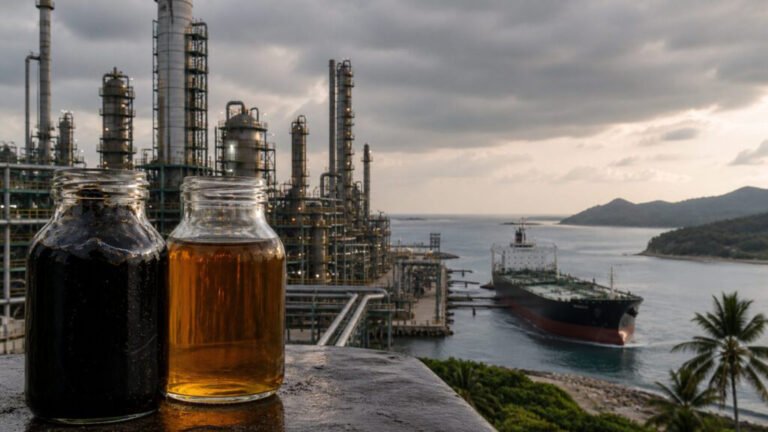
This level of testing shows why crude quality cannot be judged accurately by looking at color or thickness alone.
A dark, thick crude may be heavy, but laboratory measurements are needed to determine exactly what it contains.
Venezuela Crude Oil and Refinery Compatibility
Crude quality becomes economically important when it meets refinery design.
A refinery has a specific set of units, capacities, catalysts, operating limits, and product targets.
If the crude fits the refinery well, the refinery may be able to process it efficiently.
If the crude does not fit, the refinery may need to change its operating conditions, blend it with other crudes, reduce the processing rate, or accept higher costs.
For example, a refinery designed for heavy and sour crude may have strong conversion and hydrotreating capacity. A simpler refinery may be more dependent on lighter crude.
This creates an important relationship between crude quality and market access.
A barrel is not equally valuable to every refinery.
Venezuela Crude Oil and Blending
Blending can help manage crude quality.
A heavy crude may be blended with a lighter crude or another compatible stream to achieve desired transportation or refinery properties.
Blending does not eliminate the underlying characteristics of the original crude. It changes the overall mixture.
A refinery or trader can use blending to create a feedstock that better matches a particular processing system.
This can make crude trading more flexible, but it also adds another layer of logistics and quality control.
The final product must be measured and managed so that its properties remain within the expected range.
Venezuela Crude Oil and Product Quality
The characteristics of crude can influence the characteristics of refinery products.
Refineries are designed to convert crude into products that meet specific quality requirements. The refinery process removes unwanted components, changes molecular structures, and separates products into different streams.
Sulfur is one example.
A refinery may need to remove sulfur to produce fuels that meet applicable specifications.
Heavy metals provide another example because they can affect catalysts and processing units.
Residue provides another example because heavy crude can require more conversion before it becomes lighter products.
The relationship is not simple enough to say that one crude always produces one fixed amount of gasoline or diesel. Refinery configuration, operating conditions, blending, and market targets all influence the final product slate.
Venezuela Crude Oil and Economic Value
The value of crude oil is more complicated than its international benchmark price.
A simplified commercial calculation might begin with a benchmark crude price and then adjust for quality and transportation.
A heavy, high-sulfur crude may trade at a different differential from a light, low-sulfur crude because the buyer may face different processing costs.
The actual differential can change with market conditions, refinery demand, freight costs, supply availability, and other factors.
For Venezuela crude oil, the physical properties of the crude are therefore directly connected to its commercial value.
This is why crude assays matter to trading.
The assay tells the buyer what is actually inside the barrel.
Venezuela Crude Oil and the People Behind the Barrel
Oil is often discussed as though the barrel moves directly from a reservoir to a tanker.
In reality, a large workforce supports every stage.
Geologists study reservoirs and source rocks. Engineers design wells and production systems. Operators manage equipment. Laboratory specialists analyze crude. Pipeline workers maintain transportation systems. Refinery workers operate complex processing units. Maritime workers support loading and transportation. Maintenance teams keep facilities operating.
The quality of the crude affects many of these jobs.
A heavy-oil system may require specialized engineering knowledge for production and transportation. A refinery processing heavy crude may need workers trained in complex conversion and treatment units.
The economic value of Venezuela crude oil therefore extends beyond the value of the liquid itself.
It can support an entire industrial chain when infrastructure, investment, skills, and markets are available.
Venezuela Crude Oil and Infrastructure
Large oil resources require infrastructure.
Wells need gathering systems.
Gathering systems connect production to processing facilities.
Processing facilities remove unwanted materials and prepare the crude for transportation.
Pipelines and terminals move the crude.
Upgraders can change heavy oil into more transportable or refinery-compatible feedstock.
Refineries convert crude into useful products.
Every stage requires investment and maintenance.
This is particularly important for very large heavy-oil resources such as the Orinoco Belt. The existence of oil underground does not automatically provide the equipment required to turn that resource into marketable production.
The EIA has noted that Venezuela’s extra-heavy crude requires a high level of technical expertise and that constraints involving investment, technical personnel, and other factors have affected oil and natural gas development.
Venezuela Crude Oil and Resource Size
It is useful to separate three different ideas:
Oil in place means petroleum estimated to exist in a geological formation.
Technically recoverable resources are volumes that could potentially be recovered using existing technology and under specified assumptions.
Proved reserves are quantities that geological and engineering information indicates can be recovered with reasonable certainty under existing economic and operating conditions.
These categories should not be mixed.
The USGS estimated more than 1 trillion barrels of heavy oil in place beneath the Orinoco Oil Belt assessment area and a mean of 513 billion barrels of technically recoverable heavy oil.
The EIA reported about 303 billion barrels of proved crude oil reserves for Venezuela in 2023.
Those numbers answer different questions.
The first describes the scale of oil in the geological system.
The second describes a technical resource assessment.
The third describes proved reserves under reserve definitions.
Understanding those differences prevents exaggerated claims about how much oil can actually be produced.
What Makes Venezuela Crude Oil Different?
There is no single characteristic that makes every Venezuelan crude stream the same.
Instead, several characteristics can appear together.
Heavy or extra-heavy crude may have low API gravity and high viscosity. It may also contain substantial quantities of resins and asphaltenes. Some Venezuelan crude samples contain significant sulfur, while others are much lower in sulfur. Vanadium and nickel can be important trace metals. Water and salts must be controlled during production and refining.
These properties interact.
A heavy crude may require dilution because of viscosity.
High sulfur may require more hydrotreating.
High metals can create catalyst concerns.
High asphaltenes can affect stability and residue processing.
High residue levels may increase the importance of conversion units.
The result is a crude stream that carries a complete set of technical characteristics rather than one simple quality score.
What a Buyer Really Needs to Know About Venezuela Crude Oil
A serious crude buyer needs more than a headline price.
Before purchasing a crude stream, the buyer may want to understand:
- API gravity and density.
- Total sulfur.
- Metals such as nickel and vanadium.
- Water and sediment.
- Salt content.
- Viscosity.
- Acidity.
- SARA composition.
- Distillation behavior.
- Residue and carbon-forming tendency.
- Expected refinery yields.
- Transportation requirements.
- Available diluent.
- Freight and terminal costs.
The exact information required depends on the refinery and commercial arrangement.
The central idea is simple: Venezuela crude oil must be understood as a specific feedstock rather than a generic national product.
Why Venezuela Crude Oil Quality Matters for Refining
Refining is essentially the process of turning crude into products.
But not all crude enters the refinery with the same starting point.
A light crude can contain more naturally occurring lighter fractions. A heavy crude can contain more material that requires conversion.
A high-sulfur crude requires stronger sulfur management.
A crude with significant metals may place more pressure on catalyst systems.
A crude with high asphaltene content may create additional challenges in residue handling and conversion.
Therefore, refinery complexity can determine which crude streams are attractive.
This is particularly relevant for Venezuela because its enormous resource base includes a large amount of extra-heavy oil. The EIA identifies most of Venezuela’s proved reserves as extra-heavy crude from the Orinoco Belt.
Venezuela Crude Oil Is More Than a Commodity
It is easy to see oil as a simple commodity because it is traded in barrels.
But a barrel is a measurement of volume, not a complete description of the material inside.
One barrel can contain a different mixture of hydrocarbons and impurities from another barrel.
One crude can be light.
Another can be heavy.
One can have low sulfur.
Another can have high sulfur.
One can flow easily.
Another can require dilution.
One refinery can process a crude efficiently.
Another refinery may need significant changes to process it.
This is why crude quality matters.
Frequently Asked Questions About Venezuela Crude Oil
What type of oil does Venezuela have?
Venezuela has several types of crude oil, including extra-heavy, heavy, medium, and light crude. Much of the country’s proved reserves consist of extra-heavy crude from the Orinoco Belt. Research across Venezuelan basins has also documented API gravities ranging from 6.4° to 32.8° among studied samples.
Why is Venezuela crude oil considered heavy?
A large portion of Venezuela’s petroleum resource, especially in the Orinoco Belt, is heavy or extra-heavy. Heavy crude has relatively low API gravity and often contains more high-molecular-weight components such as resins and asphaltenes. These characteristics can also contribute to higher viscosity.
Is all Venezuela crude oil the same?
No. Venezuelan crude varies between basins, fields, wells, and crude streams. Research has identified significant differences in API gravity, sulfur, SARA composition, metals, and other properties among Venezuelan oils.
What is the API gravity of Venezuela crude oil?
There is no single API gravity for all Venezuelan crude. A study of 189 Venezuelan oil samples reported values from 6.4° to 32.8° API, covering extra-heavy through light crude categories.
Does Venezuela crude oil contain a lot of sulfur?
Some Venezuelan crude streams contain significant sulfur, but sulfur content varies widely. In one study of six selected Venezuelan oils, sulfur ranged from 0.55% to 11.4% by weight. Those values describe the specific samples studied, not a national average.
What metals are found in Venezuela crude oil?
Vanadium and nickel are important metals studied in Venezuelan crude. Research has found these metals associated with heavy organic fractions, including asphaltenes.
Why are asphaltenes important in Venezuela crude oil?
Asphaltenes are complex heavy petroleum components that can influence viscosity, stability, deposits, residue processing, and metal distribution. Some Venezuelan heavy crude samples contain substantial asphaltene fractions.
What does SARA mean in crude oil testing?
SARA stands for saturates, aromatics, resins, and asphaltenes. SARA analysis helps describe the major chemical fractions of crude oil and can be useful when comparing crude types.
Why does viscosity matter?
Viscosity describes resistance to flow. Very heavy Venezuelan crude can have high viscosity, which can make production and transportation more difficult and may require special handling, heating, dilution, or other techniques.
Why does refinery compatibility matter?
Refineries have different equipment and processing capabilities. A refinery designed to process heavy and sour crude may be better suited to certain Venezuelan crude streams than a simpler refinery designed around lighter feedstocks.
What is a crude assay?
A crude assay is a laboratory analysis that describes the physical and chemical characteristics of a crude oil. It can include API gravity, sulfur, metals, viscosity, distillation data, water, salt, SARA composition, and other measurements.
Does Venezuela have the world’s largest oil reserves?
The EIA reported that Venezuela had approximately 303 billion barrels of proved crude oil reserves in 2023, making it the country with the world’s largest proved crude oil reserve base at that time. Most of those reserves were extra-heavy crude from the Orinoco Belt.
How much oil is in the Orinoco Belt?
The USGS estimated that the Orinoco Oil Belt assessment area was underlain by more than 1 trillion barrels of heavy oil in place. It estimated a mean of 513 billion barrels of technically recoverable heavy oil, with a range of 380 billion to 652 billion barrels.
Are all the Orinoco barrels economically recoverable?
No. Technically recoverable resources, proved reserves, and economically producible oil are different concepts. A resource can exist underground without being immediately profitable or practical to produce.
Why can heavy crude sell for less than a benchmark crude?
Heavy crude may require more transportation, blending, upgrading, and refinery conversion. Buyers may therefore adjust the price to account for expected processing and logistics costs. The actual differential depends on market conditions and the specific crude stream.
People Also Ask About Venezuela Crude Oil
What is special about Venezuelan crude oil?
A major feature of Venezuelan petroleum is the enormous amount of heavy and extra-heavy crude associated with the Orinoco Belt. Venezuelan crude also varies considerably between fields, with differences in API gravity, sulfur, SARA composition, metals, and other properties.
Is Venezuela crude oil good quality?
Crude quality depends on the specific crude and the refinery evaluating it. There is no single quality level for all Venezuelan oil. A refinery may value a particular crude based on its properties, processing configuration, product yields, transportation costs, and market conditions.
Why is Venezuelan oil so thick?
Some Venezuelan petroleum, particularly Orinoco heavy oil, contains a high proportion of heavy hydrocarbon components. Low API gravity and high concentrations of resins and asphaltenes can contribute to high density and viscosity.
Can Venezuela crude oil be refined into gasoline?
Yes. Venezuelan crude can be refined into gasoline and other petroleum products, but the amount and quality of gasoline produced depend on the crude characteristics and refinery configuration. Heavy crude generally requires more conversion than light crude to produce a similar mix of lighter products.
What is the difference between Venezuela crude oil and Brent?
Brent is a benchmark crude used for pricing and market reference, while Venezuelan crude refers to physical crude streams produced in Venezuela. Individual Venezuelan crude streams can trade at premiums or discounts relative to benchmarks because of differences in quality, transportation, refinery compatibility, and market conditions.
People Also Search For
People researching Venezuela crude oil may also look for:
- Venezuela crude oil quality
- Venezuelan heavy crude oil
- Orinoco heavy oil
- Venezuela oil API gravity
- Venezuela crude oil sulfur content
- Venezuela crude oil viscosity
- Venezuela crude oil assay
- Venezuelan crude oil grades
- Venezuela heavy oil refining
- Orinoco Belt crude oil
- Venezuelan crude oil composition
- Venezuela oil reserves
- Venezuela extra-heavy crude
- Venezuela crude oil refining
- Venezuela crude oil production
- Venezuela oil quality and sulfur
- Venezuela crude oil metals
- Venezuela crude oil asphaltenes
Key Takeaways About Venezuela Crude Oil
The biggest lesson is that a barrel of Venezuela crude oil carries much more information than its volume.
It carries a chemical composition that influences how the crude behaves. It carries geological clues that can help researchers understand its source and history. It carries physical properties that affect production and transportation. It carries sulfur and metals that can influence refinery processing. It carries heavy fractions such as resins and asphaltenes that can affect viscosity and conversion requirements.
For buyers and refiners, the important information is therefore not simply the number of barrels available.
The useful questions are more specific:
- What is the API gravity?
- How much sulfur is present?
- How viscous is the crude?
- How much water and salt must be removed?
- How much residue will remain after distillation?
- What metals are present?
- What is the SARA composition?
- What refinery can process it efficiently?
- How much will transportation and dilution cost?
- What products can be produced from it?
These questions turn a simple barrel count into a much more useful picture of petroleum value.
Venezuela’s petroleum story is often told through the enormous size of its reserves. That story is important, but it becomes much more meaningful when the physical nature of the oil is understood.
The Orinoco Belt contains an enormous heavy-oil resource, and the EIA identifies extra-heavy crude as the dominant component of Venezuela’s proved reserves. The USGS has also documented the exceptional scale of technically recoverable heavy oil in the Orinoco assessment area.
But the value of that resource depends on much more than what is underground.
Venezuela crude oil carries density, viscosity, sulfur, metals, resins, asphaltenes, water, salts, and many other characteristics. It carries information about the rocks and geological processes that created and changed the petroleum. It also carries practical requirements that determine how the oil can be produced, transported, upgraded, and refined.
That is why crude oil quality matters.
A barrel is a unit of volume, but it is not a complete description of the product.
To understand Venezuela crude oil, you have to look inside the barrel.