Venezuela is known for having some of the world’s largest petroleum resources, but its oil is not one single type of crude. A barrel produced from one Venezuelan field can have very different properties from a barrel produced in another field. The difference can be seen in API gravity, sulfur content, viscosity, metals, asphaltenes, resins, wax, acidity, and the amount of lighter hydrocarbons. These differences are not random. They are the result of the long geological history of each petroleum system, from the original source rock to migration, trapping, reservoir conditions, biodegradation, and later production.
Understanding Venezuelan Oil Characteristics is therefore about much more than deciding whether an oil is light or heavy. A crude oil’s properties tell part of the story of where it came from and what happened to it underground. They also tell refiners what they may need to do with that crude after it reaches a refinery. A heavy, high-sulfur crude can require a very different processing path from a lighter, lower-sulfur crude. That is why crude assays are important: they turn a general description of an oil into a detailed set of measurements.
Scientific studies show just how wide the range can be. One major study examined 189 Venezuelan crude oils and reported API gravities from 6.4° to 32.8° API. The samples covered the Maracaibo Basin, Eastern Basin, and Barinas sub-basin and included oils from fields such as Boscán, Mara, Lagunillas, Socororo, Junín, Ayacucho, Carabobo, Guafita, Silvestre, and others. The study also found differences in sulfur, vanadium, nickel, SARA composition, biomarkers, source-rock properties, maturity, and biodegradation. These findings make clear that Venezuelan Oil Characteristics cannot be represented by one national number.
This article explains why those differences occur, how geologists and engineers measure them, and why they matter from the reservoir all the way to the refinery. The goal is not to label one crude as universally better than another. Different crude properties create different technical and commercial requirements. The useful question is not simply, “Which oil is best?” It is, “What are the properties of this particular oil, why does it have them, and what does that mean for producing, moving, blending, and refining it?”
What Venezuelan Oil Characteristics Actually Mean
The term Venezuelan Oil Characteristics covers a group of physical, chemical, and geological properties. No single measurement can describe a crude oil completely. API gravity tells us about density, but it does not tell us sulfur content. Sulfur tells us about one important part of the crude’s chemistry, but it does not tell us viscosity. Viscosity describes resistance to flow, but it does not tell us the full boiling range or the amount of asphaltenes.
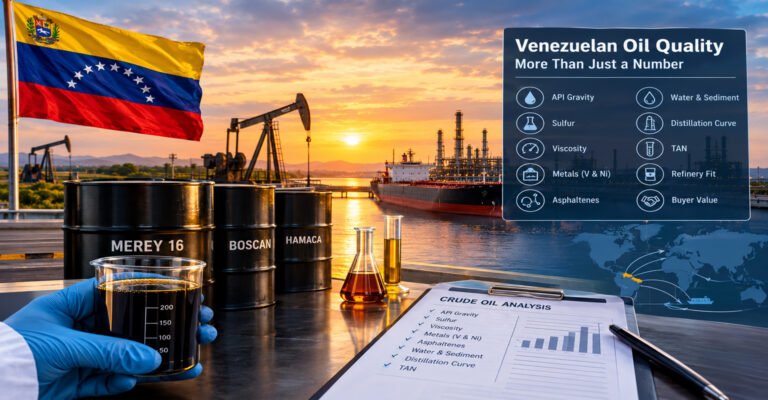
A crude assay brings these different measurements together. Refiners can use the assay to understand how a crude may behave during distillation, conversion, treating, blending, and other refinery operations. Intertek describes crude assays as detailed evaluations that can include API gravity, sulfur, nitrogen, metals, viscosity, distillation, cold properties, vapor pressure, and SARA composition. Standardized laboratory methods are used for many of these measurements.
For Venezuelan producers and refiners, the most important Venezuelan Oil Characteristics often include:
- API gravity
- Sulfur content
- Viscosity
- SARA composition
- Vanadium
- Nickel
- Nitrogen
- Acidity
- Water and sediment
- Wax content
- Pour point
- Distillation range
- Asphaltene content
- Resin content
These properties interact with one another. A crude with low API gravity may also have high viscosity, but that is not a rule that works perfectly for every crude. Two oils can have similar API gravity and still behave differently because one contains more sulfur, metals, resins, or asphaltenes.
That is why a serious discussion of Venezuelan Oil Characteristics needs several measurements rather than one simple label.
The Geological Story Behind Venezuelan Oil Characteristics
The first major reason Venezuelan Oil Characteristics vary is geology. Petroleum forms through a long chain of events that can begin with organic matter deposited millions of years ago. That organic matter becomes buried by sediments. Increasing temperature and pressure transform it over geological time. Hydrocarbons are generated, migrate through rocks, and eventually accumulate in reservoirs.
Every step can change the final oil.
The source rock may have contained mostly marine organic matter, mostly terrestrial material, or a mixture. It may have been deposited under oxygen-rich or oxygen-poor conditions. It may have reached early, moderate, or advanced thermal maturity. The oil may have migrated a short distance or traveled much farther. Once it reached the reservoir, bacteria, water, temperature, and other processes could alter it.
This means that Venezuelan Oil Characteristics are a record of many geological processes acting together.
A 2017 study of Venezuelan oils and source rocks found that vanadium, nickel, sulfur, biomarkers, and related ratios could be used to investigate source-rock conditions, organic matter input, lithology, maturity, and biodegradation. The researchers identified different oil groups linked to differences in paleo-redox conditions and source-rock characteristics.
The same research also points to an important limitation: even when the main source rocks are known, their properties can change laterally and vertically. That means one part of a source-rock system does not necessarily have exactly the same characteristics as another part.
Source Rock Sets the Starting Point
Source rock is one of the most important controls on Venezuelan Oil Characteristics. It contains the organic matter that can generate petroleum after sufficient burial and heating.
Different source rocks contain different types of organic material. The environment in which that material was deposited matters. Marine settings can produce organic-rich rocks with different characteristics from rocks formed with stronger terrestrial input. The amount of oxygen available during deposition also matters because it affects how organic matter is preserved.
Several Venezuelan source-rock units are important to the country’s petroleum systems. In the Maracaibo Basin, the La Luna Formation is a major source rock. In the Eastern Basin, Querecual and San Antonio formations are important source units. Research has connected these source rocks with different depositional conditions, organic matter types, lithologies, and maturity levels.
The result is that Venezuelan Oil Characteristics can begin to diverge before the oil has even moved into a reservoir.
Marine Source Rocks and Oil Composition
Marine source rocks can generate oils with strong marine geochemical signatures. These signatures can be identified using biomarkers and other chemical measurements.
For example, studies of Venezuelan oils have used biomarker compounds to identify relationships between crude oils and their source rocks. The results can help scientists determine whether oils came from related source systems and whether they experienced later alteration.
The important point is that the original organic matter does not disappear from the geological record simply because it becomes petroleum. Chemical clues remain in the oil.
These clues help explain Venezuelan Oil Characteristics long after the original source rock has been buried.
Terrestrial Organic Matter Can Create Different Results
Terrestrial organic matter can also contribute to petroleum systems. It comes from land plants and other organic material transported into depositional environments.
A source system with strong terrestrial influence can generate petroleum with different molecular characteristics from petroleum dominated by marine organic matter. In some Venezuelan source-rock studies, organic matter has been identified as mixed marine and terrigenous material.
This is another reason why Venezuelan Oil Characteristics cannot be explained simply by saying that all Venezuelan oil comes from the same type of source.
Thermal Maturity Changes Venezuelan Oil Characteristics
Thermal maturity describes how far organic matter has progressed through the temperature-driven stages of petroleum generation.
When source rocks are buried deeply enough and heated over geological time, their organic matter begins generating hydrocarbons. The type and amount of hydrocarbons can change as maturity increases.
A source rock that is immature may not have generated much liquid petroleum. A mature source rock may be actively generating oil. A more advanced system can generate different hydrocarbon products and show different molecular signatures.
This means maturity is another major control on Venezuelan Oil Characteristics.
Geochemical studies use biomarkers, Rock-Eval measurements, molecular ratios, and other tools to estimate maturity. The Venezuelan crude-oil study that examined vanadium, nickel, sulfur, and biomarkers included source rocks with maturity levels ranging from early mature to post-mature.
Why Maturity Matters to Crude Properties
Maturity can affect several features of an oil:
- Hydrocarbon distribution
- Biomarker patterns
- Gas-to-oil relationships
- Wax behavior
- Aromatic composition
- Density
- Molecular structure
Maturity should not be treated as the only explanation for a crude’s properties. Two oils can have similar maturity but different source environments or levels of biodegradation. Still, maturity is an important part of the explanation.
For Venezuelan Oil Characteristics, the key idea is simple: petroleum generated under different thermal histories does not have to produce the same chemical fingerprint.
Migration Helps Explain Differences Between Fields
Oil must often move after it is generated. This movement is called migration.
Primary migration describes movement out of the source rock. Secondary migration occurs as petroleum moves through carrier beds and other permeable rocks toward a trap.
During migration, oil can encounter different temperatures, pressures, minerals, water, and other fluids. It can also mix with oil generated at another time.
The Eastern Venezuelan Basin provides an especially useful example. Research into the Maturín Subbasin has identified long-distance migration pathways and relationships between Cretaceous source rocks and younger reservoirs. Some studies have described lateral migration over distances of roughly 150–300 kilometers in parts of the basin.
This long journey matters because the final crude can reflect more than the conditions at its source.
Migration therefore adds another layer to Venezuelan Oil Characteristics.
Secondary Charging Can Mix Different Oils
A reservoir may receive petroleum more than once.
An earlier oil charge may enter a reservoir and remain there. A later charge may follow the same or a different pathway. If the two oils have different properties, they can mix.
The Maturín Subbasin research describes oils that were mixed with highly altered residues from previously accumulated petroleum. The study connected these processes with migration and biodegradation.
This shows why Venezuelan Oil Characteristics can sometimes be complicated even inside a single reservoir.
A laboratory sample may not represent one perfectly uniform oil family. It may contain evidence of several petroleum events.
Reservoir Conditions Can Transform Venezuelan Oil Characteristics
The reservoir is not just a storage container. It can change the petroleum inside it.
Temperature is important because microorganisms that degrade oil have limits. Water is important because it can provide an environment in which microorganisms and chemical reactions operate. Reservoir depth, permeability, pressure, and fluid movement can also influence how petroleum changes over time.
One of the most important alteration processes in Venezuelan petroleum is biodegradation.
Biodegradation happens when microorganisms consume or alter selected hydrocarbon compounds. The process does not affect every molecule equally. More easily degraded compounds may disappear first, leaving a residual oil richer in heavier compounds.
As biodegradation advances, Venezuelan Oil Characteristics can shift toward lower API gravity and higher viscosity. The remaining crude may also show higher relative concentrations of resins and asphaltenes.
The 2017 Venezuelan study notes that biodegradation can enrich residual oil in sulfur, vanadium, nickel, and asphaltenes while lowering API gravity.
Biodegradation Is a Major Reason Venezuelan Oils Can Become Heavy
Heavy oil does not always begin its geological history as extremely heavy oil.
In some reservoirs, biodegradation can remove lighter hydrocarbon components and leave behind a heavier residual oil. This is one reason the geological history of a reservoir matters when explaining Venezuelan Oil Characteristics.
Research on Venezuelan extra-heavy oils in the Eastern Basin found biodegradation in both near-surface and subsurface settings. The study also found evidence of mixed crude oils, showing that more than one process can operate within the petroleum system.
The Orinoco region provides a major example of very heavy petroleum. The U.S. Geological Survey has assessed the Orinoco Oil Belt as an enormous heavy-oil resource, while EIA reports that most of Venezuela’s proved crude reserves are extra-heavy oil from the Orinoco Belt.
But “Orinoco oil” still does not mean every crude stream has identical properties.
Different areas, reservoirs, depths, charging histories, and alteration levels can create different Venezuelan Oil Characteristics within the wider belt.
Tia Juana Shows That Variation Can Happen Inside One Field
The idea that crude differs from field to field is important, but the variation can be even more detailed.
Research from the Tia Juana Field in the Maracaibo Basin examined 22 oils taken from different depths in the Lower Lagunillas Member. The researchers found differences in biodegradation related to depth. Oils toward the top of the studied sequence had API gravities of about 10.6–11.2°, while oils toward the base were extra heavy at about 8.2–8.7° API.
This is a powerful example because all of those samples came from the same field and the same broad stratigraphic unit.
It shows that Venezuelan Oil Characteristics can change vertically within a reservoir system.
The difference was connected to biodegradation and depth, showing that crude properties do not depend only on the name of the field.
API Gravity Is a Key Venezuelan Oil Characteristic
API gravity is one of the most widely used ways to describe crude density.
A higher API gravity means a lower-density oil. A lower API gravity means a higher-density oil. ASTM provides standardized methods for measuring density and API gravity in petroleum liquids, helping laboratories produce comparable results.
For Venezuela, API gravity is especially useful because the country’s petroleum includes light, medium, heavy, and extra-heavy oils.
The study of 189 Venezuelan oils reported samples ranging from 6.4° to 32.8° API. The researchers classified the studied samples as extra heavy at 6.4–9.9° API, heavy at 10.0–21.6° API, medium at 22.4–29.4° API, and light at 31.6–32.8° API.
These numbers describe the study’s analyzed samples, not every Venezuelan crude.
Still, the range demonstrates why Venezuelan Oil Characteristics cannot be reduced to a single API value.
Why API Gravity Matters to Refiners
API gravity affects the amount and type of processing a refinery may need.
Lighter crude generally contains a greater share of lighter hydrocarbon fractions. Heavier crude contains more high-boiling material and often needs more conversion to produce large amounts of lighter products.
EIA explains that crude density and sulfur content are important factors in determining refinery processing requirements. Heavier oils generally require more complex processing to produce high-value products than lighter oils.
This makes API gravity one of the first numbers a refinery looks at when evaluating Venezuelan Oil Characteristics.
Sulfur Creates Another Important Difference
Sulfur is another major part of Venezuelan Oil Characteristics.
Crude oil contains sulfur in many different chemical forms. The total sulfur content gives refiners an important indication of how much sulfur management may be required during processing.
Crude with lower sulfur is commonly called sweet, while crude with higher sulfur is commonly called sour.
But sulfur is not simply a label. Its chemical form and distribution through the crude can also matter.
Why Sulfur Matters in Refining
Sulfur compounds can create challenges in refinery operations and must be managed to meet fuel specifications and environmental requirements.
Refineries may use hydrotreating and other processes to reduce sulfur in products. The amount of treatment required depends on the crude and the refinery configuration.
That means two oils with similar API gravity may still have different processing requirements because their sulfur contents differ.
This is a key reason why Venezuelan Oil Characteristics need to be considered as a group rather than one measurement at a time.
Venezuelan Oils Can Have Very Different Sulfur Levels
Published Venezuelan oil studies show large differences in sulfur among individual samples.
One study comparing selected Venezuelan oils reported an Alturitas sample at 30° API and a Guafita sample at 29° API, while a Boscán sample was 11° API and had 11.4% sulfur in that specific sample. The same study reported Silvestre at 21° API and 1.28% sulfur.
These values are laboratory results for specific samples and should not be treated as universal specifications for every barrel from those fields.
That distinction is important when discussing Venezuelan Oil Characteristics. A field can contain different wells and reservoir intervals, and commercial crude streams can be blended before sale.
Still, the examples show how dramatically crude composition can vary within Venezuelan petroleum systems.
Viscosity Is Critical for Heavy Venezuelan Oil
Viscosity describes a fluid’s resistance to flow.
A low-viscosity crude can move relatively easily under reservoir and pipeline conditions. A high-viscosity crude can be much harder to produce and transport.
For heavy and extra-heavy Venezuelan oils, viscosity can be one of the most important operating properties.
A crude may have a low API gravity and a very high viscosity because it contains a large proportion of heavy molecular compounds. That can affect how the oil moves through the reservoir, how it enters the well, and how it can be transported after production.
Therefore, Venezuelan Oil Characteristics are directly connected to production engineering.
Why Heavy Oil Needs More Attention
Heavy crude can create several technical challenges:
- Lower natural flow
- Higher pumping requirements
- Greater pressure losses
- Difficult pipeline movement
- Need for heating in some systems
- Possible need for blending
- Higher upgrading requirements
The exact solution depends on the crude, field, infrastructure, temperature, and transportation system.
There is no single method that applies to every Venezuelan heavy-oil field.
Diluent Can Help Move Extra-Heavy Oil
Extra-heavy crude can be difficult to transport because of its high viscosity.
One approach is to mix it with a lighter hydrocarbon stream, often called diluent. Adding a lighter material can reduce the mixture’s viscosity and improve its flow properties.
This is particularly relevant to very heavy petroleum from the Orinoco region.
However, the amount and type of diluent needed depend on the crude and transportation system. A general historical ratio should not be treated as a universal current rule.
This is another reason why detailed Venezuelan Oil Characteristics matter before designing a transportation plan.
SARA Analysis Shows What Is Inside the Crude
SARA stands for:
- Saturates
- Aromatics
- Resins
- Asphaltenes
SARA analysis separates crude oil into these broad chemical groups.
It is useful because API gravity alone cannot show the balance between lighter hydrocarbons and heavy polar fractions.
A crude with a high proportion of saturates may behave very differently from one containing much larger proportions of resins and asphaltenes.
Research on Venezuelan oils has used SARA composition to classify oils and investigate biodegradation.
For this reason, SARA is an important part of understanding Venezuelan Oil Characteristics.
Saturates
Saturates include many of the more hydrogen-rich hydrocarbon molecules.
They can include paraffinic and cycloparaffinic compounds. The exact distribution depends on the crude.
A higher saturate fraction can be associated with different flow and refining behavior than a crude dominated by heavy polar compounds.
Aromatics
Aromatic hydrocarbons contain one or more aromatic ring structures.
They are a normal part of crude oil, but their proportion and molecular structure vary among crude types.
Aromatics can also provide information about petroleum maturity and alteration when examined with other geochemical measurements.
Resins
Resins are heavier polar compounds.
They help stabilize asphaltenes in crude oil and can affect viscosity and other physical properties.
Changes in the resin fraction can therefore be important when studying Venezuelan Oil Characteristics.
Asphaltenes
Asphaltenes are among the heaviest and most complex fractions of crude oil.
High asphaltene content can contribute to high viscosity and can create production, transport, and refining challenges.
Some Venezuelan heavy oils contain substantial amounts of resins and asphaltenes. Studies of selected Venezuelan crude samples have demonstrated large differences in SARA composition between fields.
Vanadium and Nickel Add More Information
Venezuelan petroleum is also known for containing significant amounts of metals such as vanadium and nickel.
These metals are not just laboratory curiosities. They can affect refinery operations, catalyst performance, deposits, and the economics of processing.
More importantly for petroleum geochemistry, vanadium and nickel can provide clues about the source and history of an oil.
The 2017 study of Venezuelan crude oils used vanadium, nickel, sulfur, V/Ni ratios, and biomarkers to distinguish oil groups and investigate source-rock conditions, lithology, organic matter, maturity, and biodegradation.
This makes trace metals a useful part of the larger picture of Venezuelan Oil Characteristics.
Why Vanadium Matters
Vanadium is commonly associated with heavy petroleum fractions and can occur in complex organic structures such as porphyrins.
High vanadium levels can create refinery challenges because metals can deactivate or foul catalysts used in conversion processes.
The actual impact depends on the crude and the refinery’s equipment and operating conditions.
Why Nickel Matters
Nickel is another trace metal found in crude oil.
Like vanadium, nickel can be associated with heavy fractions and can provide geochemical information.
The ratio between vanadium and nickel can sometimes help petroleum scientists investigate depositional conditions and oil families when combined with other evidence.
It should not be used alone.
Nitrogen Also Matters
Nitrogen compounds occur naturally in crude oil.
Some nitrogen-containing molecules can interfere with refining catalysts and affect hydrotreating requirements. Like sulfur, nitrogen can therefore influence refinery processing.
Nitrogen is also useful in petroleum geochemistry because its distribution can provide clues about crude composition.
A detailed assay can therefore include nitrogen alongside the other Venezuelan Oil Characteristics used to evaluate a crude.
Total Acid Number Can Matter
Total acid number, or TAN, measures the amount of acidic compounds in crude oil.
Some acidic crude oils can create corrosion concerns, especially under particular refinery conditions.
TAN is therefore another measurement that may appear in a crude assay.
It is not enough to know API gravity and sulfur alone. A crude with moderate API gravity can still present specific challenges because of acidity, metals, viscosity, or other properties.
This is another example of why Venezuelan Oil Characteristics should be viewed as a complete profile.
Water and Sediment Are Different From the Oil Itself
Produced crude often contains some water and sediment.
These materials are not part of the desired hydrocarbon stream, but they matter greatly during production and transportation.
Water can contribute to corrosion and emulsions. Sediment can contribute to equipment problems and handling costs.
Before crude enters a refinery, it commonly passes through desalting and related preparation steps.
A crude assay may therefore include water and sediment measurements alongside the chemical properties that define Venezuelan Oil Characteristics.
Wax Can Affect Field and Pipeline Behavior
Some crude oils contain significant wax-forming hydrocarbons.
When temperature falls, wax can begin to crystallize. This can affect flow and pipeline operation.
Wax behavior depends on crude composition, temperature, pressure, and other conditions.
This is another reason that crude behavior cannot be predicted from API gravity alone.
A detailed understanding of Venezuelan Oil Characteristics can help engineers evaluate whether temperature control, insulation, heating, or other measures may be needed.
Reservoir Depth Can Change Venezuelan Oil Characteristics
Depth can be important because it often correlates with temperature and pressure.
But depth alone does not determine crude quality.
The Tia Juana study is a good example. Researchers found different biodegradation levels at different depths and corresponding differences in API gravity.
This means the vertical position of an oil accumulation can affect Venezuelan Oil Characteristics when it changes the conditions under which the petroleum is preserved or altered.
Temperature and Microbial Activity
Biodegrading microorganisms have temperature limits.
At sufficiently high temperatures, the microbial processes responsible for many forms of biodegradation become less effective.
At cooler reservoir conditions, biodegradation may be more important.
This helps explain why shallow and deeper petroleum accumulations can have different properties.
Research on Venezuelan extra-heavy oils identified both near-surface and subsurface biodegradation patterns.
Reservoir Water Can Affect Oil Alteration
Water is another important part of reservoir conditions.
Water can provide the environment needed for microbial activity. It can also influence chemical interactions between petroleum and reservoir rock.
Water washing can remove some water-soluble compounds from crude oil. This process can alter the chemical profile of the remaining petroleum.
The Tia Juana research specifically identified biodegradation, evaporative fractionation, and water washing as processes that can modify crude composition after accumulation.
Therefore, Venezuelan Oil Characteristics can reflect not only the source and maturity of the oil but also what happened after accumulation.
Different Venezuelan Basins Have Different Petroleum Histories
Venezuela’s petroleum geography is not uniform.
The Maracaibo Basin, Eastern Basin, and Barinas sub-basin have different geological histories and petroleum systems.
The major 2017 Venezuelan oil study examined all three and found multiple oil groups with different chemical and geochemical properties.
This basin-level diversity helps explain why Venezuelan Oil Characteristics vary across the country.
Maracaibo Basin
The Maracaibo Basin is one of Venezuela’s most important petroleum provinces.
Its petroleum system includes the La Luna Formation as a major source rock. The basin contains many well-known producing areas and crude streams.
Studies of Maracaibo oils have found differences in API gravity, sulfur, metals, SARA composition, biodegradation, and other properties.
Boscán and Tia Juana are useful examples of how heavy-oil properties can differ even within the same broad basin.
Eastern Venezuelan Basin
The Eastern Basin contains important petroleum accumulations, including the giant Orinoco heavy-oil province.
Its petroleum system includes Cretaceous source rocks such as Querecual and San Antonio, along with younger reservoir systems.
Research has documented mature marine oils, biodegraded oils, mixed crudes, and long-distance migration within parts of the basin.
These processes help explain the wide range of Venezuelan Oil Characteristics found in the region.
Barinas Sub-Basin
The Barinas area also contains important petroleum accumulations.
Studies of Venezuelan crude oils have included fields such as Guafita and Silvestre in the Barinas sub-basin. These samples show that crude properties can differ strongly even when fields are located within the same general petroleum province.
Boscán and Guafita Show Why One Number Is Not Enough
A comparison of selected crude samples illustrates this point.
One published study reported a Boscán sample at 11° API with 11.4% sulfur, while a Guafita sample was 29° API with 0.55% sulfur. The Boscán sample had 12% saturates, 36% aromatics, 38% resins, and 14% asphaltenes. The Guafita sample had 53% saturates, 32% aromatics, 7% resins, and 8% asphaltenes.
Again, these are measurements of individual samples, not universal specifications for every barrel produced from those fields.
But they demonstrate how different Venezuelan Oil Characteristics can be.
The differences involve density, sulfur, and the balance of light and heavy chemical fractions at the same time.
Alturitas Provides a Different Example
Research on thirty wells from the Alturitas Field in western Venezuela found that the crude oils belonged to a single non-biodegraded oil family. The study linked them to a single pulse of hydrocarbon generation, migration, and accumulation from the thermally mature La Luna source rock.
This is useful because not every field shows extreme internal variation.
Some fields can contain oils that are relatively consistent because their wells tap a connected petroleum system with a shared source and similar alteration history.
This reminds us that Venezuelan Oil Characteristics should be investigated rather than assumed.
A field name can provide context, but a laboratory assay provides the actual measurement.
Crude Oil Assays Measure Venezuelan Oil Characteristics
A crude assay is one of the best ways to turn a broad petroleum description into measurable information.
An assay can include:
- API gravity
- Sulfur
- Nitrogen
- Metals
- Viscosity
- Distillation
- SARA
- Pour point
- Wax
- Acidity
- Water and sediment
- Vapor pressure
The exact test package depends on the purpose of the analysis.
A refinery may want a detailed distillation curve and metal profile. A producer may focus on viscosity, water, sediment, and transport properties. A geochemist may place greater emphasis on biomarkers, isotopes, SARA composition, and trace elements.
This means the meaning of Venezuelan Oil Characteristics depends partly on the question being asked.
Why Distillation Matters
Crude oil is a mixture of hydrocarbons with different boiling points.
A distillation test separates fractions according to their boiling behavior.
The resulting curve helps refiners estimate how much material falls into different boiling ranges.
Two crude oils can have similar API gravity but different distillation curves. That means they may produce different amounts of light, middle, and heavy fractions during primary separation.
Distillation therefore adds another layer to Venezuelan Oil Characteristics.
Light Fractions
Light fractions can include materials useful for gasoline and other products after appropriate refinery processing.
The exact product yield depends on the crude and refinery configuration.
Middle Fractions
Middle-distillate ranges are important for products such as diesel and jet fuel after the required refining and treating steps.
Heavy Fractions
Heavy fractions contain high-boiling material.
Very heavy crude can produce a large amount of atmospheric and vacuum residue.
Refineries may use conversion processes such as coking or other upgrading methods to convert part of this material into lighter products.
Refinery Configuration Changes the Meaning of Venezuelan Oil Characteristics
A crude is not processed in isolation.
The same crude can be handled differently at two refineries because the refineries have different equipment.
One refinery may have extensive conversion capacity. Another may be designed to process a different range of crude.
EIA notes that refinery processing requirements depend on crude characteristics such as density and sulfur and on the types of processing units available.
This means Venezuelan Oil Characteristics matter in relation to refinery design.
A crude that is difficult for one refinery may fit another refinery’s configuration more naturally.
Heavy Crude Often Requires More Conversion
Heavy crude contains more high-boiling material.
A simple distillation unit can separate this material, but it cannot turn all of it into lighter products.
Conversion units are needed when a refinery wants to break large hydrocarbon molecules into smaller ones.
Processes can include:
- Fluid catalytic cracking
- Hydrocracking
- Coking
- Visbreaking
- Hydrotreating
The exact process depends on the refinery.
This is why API gravity and other Venezuelan Oil Characteristics have direct economic and technical importance.
Sulfur Treatment Can Increase Processing Requirements
High-sulfur crude can require more hydrotreating.
Hydrotreating uses hydrogen and catalysts to remove sulfur and other unwanted compounds from refinery streams.
High sulfur can therefore increase hydrogen demand, catalyst requirements, and other operating needs.
Again, the effect depends on refinery design.
A refinery equipped to process sour heavy crude may be built around those properties.
This is why crude value should not be judged from one property alone.
Metals Can Affect Refinery Catalysts
Vanadium and nickel can become particularly important when processing heavy crude.
These metals can concentrate in heavy fractions and may affect catalysts used in refinery conversion processes.
A refinery processing a crude with high metal content needs to consider the impact on catalyst life and operating conditions.
This is another reason why Venezuelan Oil Characteristics need to be measured before a crude stream is assigned to a refinery.
Crude Blending Can Change the Final Product
A commercial crude stream does not always come directly from one well.
Multiple production streams can be blended.
Blending can be used to meet transport specifications, improve flow, adjust density, or create a crude feed suitable for a refinery.
When different oils are mixed, their combined Venezuelan Oil Characteristics can change.
For example, a heavier crude may be mixed with a lighter stream to reduce viscosity and improve transport.
But blending must be carefully controlled because some crude components can behave differently when combined.
Compatibility Matters
Not every crude blend behaves perfectly.
Asphaltene stability can be an important issue. When incompatible oils are mixed, asphaltenes may precipitate.
That can create deposits and handling problems.
A detailed crude assay and compatibility testing can therefore be important before large-scale blending.
This shows another reason why Venezuelan Oil Characteristics have practical importance beyond geology.
Why Oil From the Same Field Can Still Differ
It is tempting to think that one field produces one fixed crude.
Real petroleum systems can be more complicated.
A field may contain:
- Multiple reservoirs
- Different reservoir depths
- Separate compartments
- Different oil columns
- Multiple charging events
- Different water contacts
- Different biodegradation levels
- Different production histories
The Tia Juana study demonstrates that oil composition and API gravity can change with depth inside one field.
Therefore, Venezuelan Oil Characteristics should not automatically be treated as uniform across a field.
Reservoir Compartmentalization Can Matter
A reservoir can contain barriers that reduce fluid communication.
Faults, changes in rock type, cementation, or other geological features can separate one part of a reservoir from another.
If separate compartments were charged at different times or experienced different alteration histories, their crude properties can differ.
This can create production differences that are not obvious from a simple field-wide average.
For engineers, identifying these differences can be important for well planning and reservoir management.
Production Can Also Change the Sample
The crude collected at the surface is not always identical to the fluid originally present in the reservoir.
Pressure changes can cause dissolved gas to separate. Water can enter the produced stream. Production can also mix fluids from several zones.
Surface handling and storage can further affect the final sample.
For this reason, a laboratory result is meaningful only when the sampling and testing procedures are understood.
Good data are part of good petroleum analysis.
Why Sampling Matters
A crude sample should represent the stream being studied.
If the sample is contaminated with water, sediment, another crude, or a storage material, the laboratory result may not accurately describe the intended oil.
Sampling procedures therefore matter as much as laboratory equipment.
When comparing Venezuelan Oil Characteristics, analysts should ask:
- Where was the sample taken?
- From which well?
- At what depth?
- From which reservoir?
- When was it collected?
- Was it stabilized?
- Was water removed?
- Was it a well sample or export blend?
- Which laboratory method was used?
These questions protect against false comparisons.
Why Averages Can Be Misleading
A field average can be useful, but it can hide important variation.
Imagine a field with several wells producing crude from different reservoir intervals. One zone may produce 10° API oil while another produces 15° API oil. A field average could fall somewhere in between.
That average is useful for some planning purposes, but it does not describe every well.
This is why detailed Venezuelan Oil Characteristics should be connected to the right sampling level.
A national average can be useful for broad analysis. A field average can help with production planning. A well sample can provide information about a specific reservoir interval.
They answer different questions.
Geological Age Can Affect Venezuelan Oil Characteristics
Reservoir age can also provide useful context.
Venezuelan petroleum occurs in reservoirs ranging from older rocks to much younger formations. Different reservoir ages can have different burial histories, temperatures, structures, and relationships with source rocks.
In the Eastern Venezuelan Basin, studies have described petroleum in Cretaceous, Eocene, Oligocene, Miocene, and Pliocene reservoirs.
The reservoir’s age alone does not determine crude properties.
However, it helps geologists reconstruct the path from generation to accumulation.
That reconstruction can explain why Venezuelan Oil Characteristics differ between petroleum accumulations.
Structural Geology Can Influence Oil Distribution
Faults and folds can create traps and migration pathways.
A structural trap may collect petroleum migrating through the subsurface. A fault may also act as a barrier or conduit depending on its properties.
The structural history of the basin can therefore influence where petroleum moves and where it accumulates.
In parts of the Eastern Venezuelan Basin, thrusting and basin development influenced the timing and direction of migration. Research has documented long-distance migration related to these geological structures.
These processes form part of the geological explanation for Venezuelan Oil Characteristics.
Organic Geochemistry Helps Connect Oil to Its Source
Organic geochemistry is one of the most powerful tools for understanding petroleum.
Scientists can analyze biomarkers and other molecular compounds to determine relationships between oils and source rocks.
Biomarkers are molecules that retain structural information related to biological precursors.
When combined with maturity indicators, trace metals, sulfur, isotopes, and other measurements, they can help reconstruct petroleum history.
This is why Venezuelan Oil Characteristics are useful not only for refinery planning but also for petroleum exploration.
Biomarkers Can Reveal Alteration
Biomarkers can also show whether crude has experienced biodegradation.
Some molecules are more resistant to microbial attack than others.
As degradation advances, the relative distribution of biomarkers changes.
Research on Venezuelan extra-heavy crude oils has used steranes, triterpanes, aromatic steroids, phenanthrenes, and petroporphyrins to assess biodegradation.
These measurements provide information that cannot be obtained from API gravity alone.
Paleo-Redox Conditions Leave Chemical Clues
Redox conditions describe how oxidizing or reducing the environment was when sediments were deposited.
Source rocks deposited under strongly reducing conditions can preserve organic matter differently from those deposited under more oxygen-rich conditions.
Venezuelan studies have used vanadium, nickel, sulfur, V/Ni ratios, and biomarkers to investigate these ancient depositional conditions.
This is a good example of how modern crude can carry evidence of an environment that existed millions of years ago.
The chemical makeup of petroleum can therefore act like a geological record.
Why Boscán Crude Is Often Discussed Separately
Boscán is a well-known heavy-oil field in the Maracaibo Basin.
Published studies have reported very heavy Boscán samples with high sulfur and substantial resin and asphaltene fractions. One specific study sample was 11° API and contained 11.4% sulfur, 38% resins, and 14% asphaltenes.
These figures should not be treated as a universal Boscán specification.
The important lesson is that Boscán provides an example of how a heavy Venezuelan crude can have a chemical profile very different from a lighter oil elsewhere in the country.
Its properties help illustrate the broader range of Venezuelan Oil Characteristics.
Why Orinoco Oil Is So Heavy
The Orinoco Oil Belt contains enormous accumulations of heavy and extra-heavy petroleum.
Biodegradation is an important part of the explanation for some of these oils. Geological studies have also identified complex migration histories, including long-distance movement of petroleum into shallow reservoirs.
In shallow reservoirs, conditions can favor microbial alteration of petroleum.
The result can be an oil with very low API gravity and high concentrations of heavy components.
But the Orinoco Belt is a large geological region, not one uniform reservoir.
Therefore, Venezuelan Oil Characteristics can still vary across its different areas and reservoirs.
Heavy Oil Is Not Defined by API Alone
API gravity is useful, but it does not describe everything that makes an oil heavy.
Two oils with similar API values can have different viscosity, sulfur, metals, SARA composition, acidity, and distillation curves.
This is especially important when comparing Venezuelan crude streams.
An engineer may need viscosity data for transportation. A refinery may need sulfur and metals. A geochemist may need biomarkers and SARA. A trader may need a complete assay to understand expected refinery yields.
The same crude can therefore be described differently depending on the question.
Venezuelan Oil Characteristics and Refinery Product Yield
Refiners care about crude properties because those properties affect what the refinery can produce.
A lighter crude may naturally contain more material in lower boiling ranges.
A heavier crude may contain more vacuum residue and require conversion.
Sulfur, metals, nitrogen, and acidity can affect treating and catalyst requirements.
SARA composition can affect residue behavior and asphaltene stability.
These factors combine to determine the expected processing path.
That is why Venezuelan Oil Characteristics can influence the commercial value of a crude stream.
Oil Characteristics Do Not Mean Good or Bad
It is important to avoid describing crude oil as simply “good” or “bad.”
A light crude may be attractive for a refinery designed for light feedstock, while a heavy refinery may be specifically designed to process heavier crude.
A high-sulfur crude may require more treating, but a refinery equipped for sour crude can be designed around that requirement.
The technical value of a crude depends on its properties, the available infrastructure, refinery configuration, transportation costs, blending options, and market conditions.
This is why a factual discussion of Venezuelan Oil Characteristics should focus on measurable properties rather than simple labels.
How Refiners Compare Venezuelan Crude Streams
A refinery may compare crude streams using a combination of:
- API gravity
- Sulfur
- Distillation curve
- Metals
- Nitrogen
- TAN
- SARA
- Viscosity
- Residue yield
- Product yield
- Processing requirements
A complete assay helps the refinery model what may happen inside its units.
The goal is to understand how the crude will behave and what products can be produced.
This is more useful than comparing two crudes using only their API gravity.
Why Crude Assays Need Regular Updates
Crude quality can change over time.
Production may move into a different reservoir interval. Water cut can change. Wells can be recombined into a new blend. Different fields can contribute to an export stream.
As a result, an old assay may not perfectly describe a current commercial blend.
This is especially important when a crude stream changes because of field development or blending.
Updated Venezuelan Oil Characteristics data can therefore help refiners avoid surprises.
Production Decline Can Affect the Crude Stream
As a field matures, the mix of fluids reaching the surface can change.
Water production may increase. Different zones may contribute different amounts of oil. Gas behavior may change. New wells may be drilled into different reservoir intervals.
These changes can alter the properties of the combined production stream.
That does not mean the oil itself has suddenly changed at the molecular level in every reservoir.
It means the composition of the produced blend can change.
This distinction is important when monitoring Venezuelan Oil Characteristics over time.
Why Field Names Are Not Enough
A field name provides location and geological context.
It does not replace a crude assay.
Two wells in the same field can produce different oils. Two reservoir intervals can show different biodegradation. A pipeline stream can contain blended production from several wells.
Therefore, field names should be treated as identifiers, not complete chemical descriptions.
When comparing Venezuelan Oil Characteristics, always connect the name of the field to the sample, reservoir, date, and analytical method.
Common Mistakes When Comparing Venezuelan Oils
Several mistakes can make crude comparisons misleading.
Mistake 1: Using One API Number
API gravity is important, but it is only one measurement.
A better comparison includes sulfur, viscosity, SARA, metals, and distillation.
Mistake 2: Treating a Field Average as Universal
A field average may hide vertical and lateral variation.
The Tia Juana study demonstrates why depth can matter.
Mistake 3: Treating Historical Assay Data as Current
Crude streams can change through blending and production changes.
Old data should be clearly dated.
Mistake 4: Assuming Heavy Means High Sulfur
Heavy and sour are different classifications.
An oil can be heavy with relatively lower sulfur, or it can have both high density and high sulfur.
Mistake 5: Ignoring Biodegradation
Biodegradation can strongly change density, viscosity, SARA composition, sulfur, and metals.
Mistake 6: Comparing Different Test Methods Without Checking
Laboratory methods matter.
Results should be compared using compatible analytical methods whenever possible.
How to Read a Venezuelan Crude Assay
If you receive an assay for Venezuelan crude, start with the basic physical properties.
Look at API gravity first, but do not stop there.
Then review sulfur and viscosity. After that, examine SARA, metals, nitrogen, acidity, and the distillation curve.
A useful sequence is:
- Identify the sample.
- Check the sampling date.
- Check the field and reservoir.
- Review API gravity.
- Review sulfur.
- Review viscosity.
- Review SARA.
- Check metals.
- Review distillation.
- Compare with previous assays.
This approach gives a much more complete picture of Venezuelan Oil Characteristics.
What API Gravity Tells You
API gravity gives an indication of density.
A low API value usually points toward heavier crude.
But API does not tell you:
- Sulfur level
- Metal concentration
- Viscosity at a specific temperature
- Asphaltene content
- Distillation curve
- TAN
- Exact product yield
So API should be treated as the starting point, not the complete answer.
What Sulfur Tells You
Sulfur gives information about the crude’s sulfur burden.
It can help refiners estimate treating needs and product sulfur management.
But total sulfur does not describe every sulfur compound.
The chemical distribution of sulfur compounds can also matter.
This is why a complete assay is more useful than one sulfur number when evaluating Venezuelan Oil Characteristics.
What Viscosity Tells You
Viscosity tells you how strongly the oil resists flow at a stated temperature.
The temperature must always be considered.
A crude can become much more viscous as temperature falls.
This is particularly important for heavy Venezuelan crude.
Transport and production plans therefore need viscosity measurements at relevant operating temperatures.
What SARA Tells You
SARA provides a broad chemical picture.
High saturates, high aromatics, high resins, and high asphaltenes can lead to different crude behavior.
SARA can also help identify biodegradation and crude type when combined with other analyses.
The 2017 Venezuelan study used SARA along with API gravity and trace-element data to distinguish crude types.
What Metals Tell You
Vanadium and nickel can provide two kinds of information.
First, they can matter to refinery processing.
Second, they can provide clues about petroleum origin and depositional history.
The V/Ni relationship has been used in Venezuelan petroleum research as a correlation and classification tool.
But metals should always be interpreted alongside biomarkers and other evidence.
What Biodegradation Tells You
Biodegradation tells you that petroleum has been altered after accumulation.
It can explain why an oil is heavier than expected from its source and maturity alone.
It can also explain changes in biomarkers, SARA composition, viscosity, sulfur, and metal concentrations.
This makes biodegradation one of the most important concepts for understanding Venezuelan Oil Characteristics.
People Also Ask About Venezuelan Oil Characteristics
Why do Venezuelan oil characteristics vary from field to field?
They vary because Venezuelan fields have different source rocks, thermal histories, migration pathways, reservoir conditions, biodegradation levels, and charging histories. Different combinations of these processes can produce different API gravity, sulfur, viscosity, metals, and SARA composition. Studies of Venezuelan oils have documented these differences across the Maracaibo Basin, Eastern Basin, and Barinas sub-basin.
What makes Venezuelan oil heavy?
Some Venezuelan oils are heavy because their petroleum contains large amounts of high-molecular-weight compounds. Biodegradation can also remove lighter hydrocarbons and leave a heavier residual oil. This is especially important in parts of the Orinoco region and other heavy-oil accumulations.
Does every Venezuelan oil have the same API gravity?
No. Published research has found a broad range of API gravity among Venezuelan samples. One study of 189 oils reported values from 6.4° to 32.8° API.
Why is sulfur important in Venezuelan crude?
Sulfur affects refinery treating requirements and product quality. High-sulfur crude generally requires more sulfur management during processing. Venezuelan crude samples can have very different sulfur concentrations, which is one reason crude assays are important.
Can crude properties change within the same Venezuelan field?
Yes. Tia Juana research found different biodegradation levels and API gravities at different depths within the same field.
Why do vanadium and nickel matter?
They matter because they can affect refinery catalysts and because their concentrations and ratios can provide geochemical clues about source rocks, depositional conditions, and petroleum history.
What is SARA analysis?
SARA separates crude into saturates, aromatics, resins, and asphaltenes. It gives a broad view of the chemical balance of the crude and can help identify heavy fractions and biodegradation effects.
What is a crude oil assay?
A crude oil assay is a detailed laboratory description of crude properties. It can include API gravity, sulfur, viscosity, distillation, metals, nitrogen, SARA, acidity, and other measurements.
Why does viscosity matter for Venezuelan heavy oil?
High viscosity makes crude harder to produce and transport. Depending on the oil and infrastructure, operators may need heating, dilution, blending, or other methods to improve flow.
Does geology affect Venezuelan oil?
Yes. Source-rock type, depositional environment, maturity, migration pathways, reservoir conditions, structure, and post-accumulation alteration all influence the final crude.
People Also Search For
Readers researching Venezuelan Oil Characteristics may also look for:
- Venezuelan heavy oil
- Venezuelan extra-heavy crude
- Orinoco Oil Belt
- Maracaibo Basin oil
- Eastern Venezuelan Basin oil
- Boscán crude
- Tia Juana crude
- Guafita crude
- Silvestre crude
- Venezuelan crude API gravity
- Venezuelan crude sulfur
- Venezuelan crude viscosity
- Venezuelan crude assay
- SARA analysis
- API gravity explained
- heavy sour crude
- crude oil biodegradation
- vanadium in crude oil
- nickel in crude oil
- petroleum source rocks
- crude oil refinery processing
How Geologists Study Venezuelan Oil Characteristics
Geologists rarely rely on one laboratory measurement.
They combine several types of evidence.
A typical petroleum-geochemistry investigation may include source-rock analysis, Rock-Eval pyrolysis, biomarkers, stable isotopes, sulfur, vanadium, nickel, API gravity, SARA composition, and other measurements.
The goal is to reconstruct the petroleum system.
Scientists want to know where the oil came from, how mature it was, how it migrated, where it accumulated, and what happened after accumulation.
This approach explains why Venezuelan Oil Characteristics can reveal geological information far beyond the refinery.
Rock-Eval Pyrolysis Adds Source-Rock Information
Rock-Eval pyrolysis is commonly used to evaluate the petroleum potential and maturity of source rocks.
It can provide information about organic matter quantity, type, and thermal maturity.
When combined with crude-oil analysis, it helps connect the source rock to the oil.
This is important because the crude itself does not always provide enough information to identify its complete origin.
Biomarkers Add a Molecular Fingerprint
Biomarkers are especially useful because they can preserve clues about the original organic matter.
Researchers compare biomarker distributions between source rocks and oils.
When the patterns match, scientists can build a stronger oil-source relationship.
In Venezuela, biomarker work has been combined with trace elements and other measurements to distinguish oil families.
This makes biomarkers a valuable part of understanding Venezuelan Oil Characteristics.
Isotopes Can Add Another Layer
Stable isotopes can also help distinguish petroleum sources and processes.
Carbon and sulfur isotope measurements can provide information about organic matter and sulfur cycling.
When combined with biomarkers and bulk properties, isotopes can strengthen an oil-source interpretation.
No single test should normally be treated as a complete answer.
Why E-E-A-T Matters for This Topic
A technical petroleum article needs more than a collection of definitions.
It needs accurate terminology, careful use of numbers, clear distinction between sample data and national data, and transparent sourcing.
That is especially important when discussing Venezuelan Oil Characteristics because published studies often examine selected wells or samples rather than every field in the country.
For example, saying “a Boscán sample measured 11° API” is very different from saying “all Boscán crude is 11° API.” The first is a documented sample result. The second is a broad claim that requires a much stronger data set.
Good petroleum writing should make that distinction clear.
Why Sample-Specific Numbers Matter
Published scientific studies often use a limited number of wells to answer a specific question.
A study may focus on biodegradation.
Another may focus on source-rock correlation.
Another may investigate trace metals.
The numbers in those studies are valuable, but they should be presented in context.
This article therefore uses sample-specific figures as examples of variation rather than pretending that one sample represents an entire field.
That is the responsible way to discuss Venezuelan Oil Characteristics.
Venezuelan Oil Characteristics and Field Development
Understanding crude properties can influence field development decisions.
If one reservoir zone contains more viscous oil than another, it may require different production methods.
If another zone contains more mobile oil, it may respond differently to pressure support or artificial lift.
If different compartments contain different crude types, mixing them at the surface may change the properties of the final production stream.
This is where petroleum geochemistry and reservoir engineering meet.
Oil Characteristics Can Influence Production Strategy
A heavy crude may need different well and completion strategies from a lighter crude.
Viscosity can influence inflow performance.
Reservoir pressure can influence mobility.
Water saturation can influence production.
Temperature can influence viscosity.
These factors can make Venezuelan Oil Characteristics directly relevant to the design of field operations.
Oil Characteristics Can Influence Transportation
The crude that leaves a well still needs to reach a processing or export destination.
Transportation systems must consider viscosity, temperature, water, sediment, pressure, and compatibility.
Very heavy crude can require special handling.
Blending and dilution may change the crude’s flow behavior.
The exact solution depends on the transportation system and crude properties.
Oil Characteristics Can Influence Storage
Storage tanks also need to handle the properties of the crude.
Heavy oils can be difficult to pump from tanks if temperatures fall.
Asphaltenes and sediments can create deposits.
Water can settle and create operational problems.
A detailed understanding of Venezuelan Oil Characteristics helps operators anticipate these issues.
Oil Characteristics Can Influence Refinery Economics
The refinery does not receive a crude and simply turn every barrel into the same set of products.
Different crudes produce different product slates.
Heavy crude can require more conversion.
High sulfur can require more treating.
High metals can affect catalysts.
High acidity can affect corrosion management.
High asphaltene content can influence residue handling.
These properties can change the cost and complexity of processing.
Why There Is No Single “Venezuelan Crude”
The phrase “Venezuelan crude” can be useful as a national category, but it is not a complete technical description.
Venezuela contains multiple petroleum basins and many crude streams.
The published 189-oil study demonstrates a broad range of API gravity and chemical properties across different Venezuelan fields and basins.
So when someone asks about Venezuelan Oil Characteristics, the next question should be:
“Which field, reservoir, crude stream, or assay?”
That question can prevent many misunderstandings.
A Simple Framework for Comparing Venezuelan Fields
If you want to compare two Venezuelan oil fields, use the same set of measurements for both.
Start with:
- API gravity
- Sulfur
- Viscosity
- SARA
- Vanadium
- Nickel
- Nitrogen
- TAN
- Distillation
- Water and sediment
Then add geological information:
- Source rock
- Source maturity
- Reservoir age
- Reservoir depth
- Migration pathway
- Biodegradation
- Charging history
- Structural setting
This approach gives a much better comparison of Venezuelan Oil Characteristics than using field names alone.
A Simple Example
Imagine two Venezuelan fields.
Field A produces 30° API crude with low sulfur and a high saturate fraction.
Field B produces 10° API crude with much higher sulfur, viscosity, resins, and asphaltenes.
The two oils would require different transportation and refinery strategies.
Now imagine that both fields are located in the same broad basin.
Their different properties could still be explained by differences in source, maturity, migration, reservoir conditions, and biodegradation.
This simple example shows why location alone cannot predict Venezuelan Oil Characteristics.
Why Oil Characteristics Can Be a Geological Fingerprint
Crude oil contains information about its history.
Its biomarkers can point toward source.
Its maturity indicators can reveal thermal history.
Its metals can provide clues about depositional conditions.
Its API gravity and SARA composition can show the degree of heavy-oil alteration.
Its sulfur and nitrogen can help describe chemical complexity.
Its biodegradation markers can show post-accumulation alteration.
Together, these measurements create something close to a geological fingerprint.
What Makes Venezuelan Petroleum Especially Interesting
Venezuela combines several petroleum settings and a very wide range of crude types.
The country includes major conventional oil provinces and enormous heavy and extra-heavy accumulations.
It also contains petroleum systems with different source rocks, different migration histories, and different alteration processes.
Scientific studies have therefore found multiple oil families and a wide range of chemical characteristics.
This diversity makes Venezuelan Oil Characteristics an important subject for petroleum geology, reservoir engineering, transportation planning, and refining.
The Main Lesson From Field-to-Field Variation
The most important lesson is that crude oil should be treated as a geological material with a history.
The oil in a reservoir did not appear there in its final form.
It was generated from organic matter.
It matured.
It migrated.
It accumulated.
It may have mixed with other petroleum.
It may have been biodegraded.
It may have been altered by water and other reservoir processes.
It was then produced, blended, transported, and tested.
Each stage can leave a mark.
That is why Venezuelan Oil Characteristics vary from field to field.
Venezuelan petroleum is not one uniform crude. Its properties can change greatly between basins, fields, reservoirs, wells, and even different depths within the same field. API gravity, sulfur, viscosity, SARA composition, metals, acidity, nitrogen, and distillation behavior all provide different pieces of the picture.
The geological reasons are just as important as the laboratory numbers. Source-rock type influences the original petroleum. Thermal maturity changes its molecular composition. Migration determines how and where it travels. Reservoir conditions can alter the oil after accumulation. Biodegradation can remove lighter compounds and increase the relative importance of heavier fractions. Multiple charging events can mix different oils. These processes work together to create the wide range of Venezuelan Oil Characteristics seen across the country’s petroleum provinces.
The research record supports this broad picture. A study of 189 Venezuelan oils found API gravities ranging from 6.4° to 32.8° API and identified differences linked to source-rock conditions, maturity, organic matter, lithology, and biodegradation. Research from Tia Juana showed that even oils from different depths within one field could have different biodegradation levels and API gravity. Studies of Eastern Venezuela have also documented complex migration, biodegradation, and mixed crude histories.
For that reason, the best way to understand Venezuelan petroleum is not to ask for one national definition of its oil. The better approach is to examine each crude stream through its assay and geological context. Once API gravity, sulfur, viscosity, SARA, metals, distillation, source, maturity, migration, and biodegradation are considered together, the differences between fields become much easier to understand.
In simple terms, Venezuelan Oil Characteristics vary because Venezuelan oil fields did not share exactly the same geological history. Different rocks generated different petroleum. Different pathways moved it through the subsurface. Different reservoirs changed it in different ways. The final crude therefore carries the combined record of its source, journey, reservoir, and alteration history.
That is why one Venezuelan field can produce a crude that behaves very differently from another field, even though both oils come from the same country.