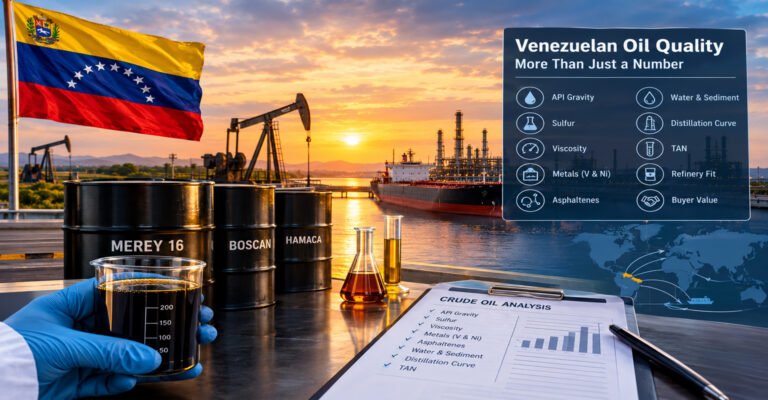
Venezuelan crude oil is known for its wide range of qualities. Some Venezuelan grades are relatively light, while others are heavy or extra heavy, with high sulfur, metals, viscosity, and asphaltene content.
That is why Venezuelan Crude Oil Specifications are important for refiners, traders, engineers, laboratories, and anyone studying crude oil quality.
A crude oil quality report can look difficult at first. It may contain numbers for API gravity, sulfur, viscosity, water and sediment, metals, vapor pressure, pour point, acidity, distillation, and other properties.
The good news is that these numbers tell a story.
They help answer simple questions:
- How heavy is the crude?
- How much sulfur does it contain?
- How difficult is it to move?
- How much water and sediment are present?
- Does it contain high levels of nickel or vanadium?
- What refinery equipment may be needed?
- What products can the crude potentially produce?
- How does one Venezuelan crude grade differ from another?
This guide explains how to read those numbers step by step.
It also explains why a single number should not be used to judge an entire crude stream.
Quick answer: Venezuelan crude is not one single quality grade. Venezuela produces and has historically produced crude oils ranging from lighter grades to very heavy and extra-heavy oils. Important quality indicators include API gravity, sulfur, viscosity, metals, water and sediment, acidity, asphaltenes, and distillation characteristics.
Venezuelan Crude Oil Specifications at a Glance
Before looking at individual properties, it helps to understand the main numbers found in a crude oil assay.
| Property | What it tells you | Why it matters |
|---|---|---|
| API gravity | Crude density/lightness | Helps classify crude |
| Sulfur | Sulfur level | Indicates sourness and affects processing |
| Viscosity | Resistance to flow | Important for pumping and handling |
| Water and sediment | Non-oil material | Important for transport and processing |
| Vanadium | Metal concentration | Can affect catalysts and refinery equipment |
| Nickel | Metal concentration | Important for refining and catalyst management |
| Asphaltenes | Heavy hydrocarbon fraction | Affects processing and residue yield |
| Pour point | Lowest practical flow temperature | Important for storage and transportation |
| RVP | Volatility | Important for handling and blending |
| Total acid number | Acidity | Helps assess corrosion risk |
| Distillation | Boiling-range distribution | Helps estimate refinery product yields |
| Nitrogen | Nitrogen compounds | Can affect hydrotreating and catalysts |
These measurements should be considered together.
For example, a crude with low API gravity and high viscosity may require more heating or dilution for transportation. If it also has high sulfur and metals, the refinery may need substantial conversion and treating capacity.
What Are Venezuelan Crude Oil Specifications?
Venezuelan Crude Oil Specifications are the physical and chemical properties used to describe a Venezuelan crude stream.
They are normally presented through a crude assay, laboratory report, sales specification, or contractual quality document.
A specification may include:
- API gravity
- Specific gravity
- Sulfur
- Viscosity
- Water
- Sediment
- Salt
- Reid vapor pressure
- Pour point
- Flash point
- Nickel
- Vanadium
- Iron
- Sodium
- Ash
- Nitrogen
- Asphaltenes
- Carbon residue
- Total acid number
- Distillation data
- SARA composition
The exact list depends on the crude, laboratory, refinery, contract, and purpose of the analysis.
It is important to understand the difference between a typical assay and a contract specification.
A typical assay describes expected characteristics.
A contractual specification can define limits that a delivered cargo must meet.
An old assay should also not automatically be treated as the quality of every current cargo. Blending, field conditions, production methods, upgrading, storage, and handling can change the measured properties.
Why Venezuelan Crude Oil Quality Data Matters
Crude oil quality affects almost every stage of the oil business.
It can influence:
- Transportation
- Storage
- Blending
- Refinery selection
- Refinery operating conditions
- Hydrogen demand
- Catalyst use
- Product yields
- Sulfur removal
- Residue production
- Commercial value
The U.S. Energy Information Administration identifies API gravity and sulfur content as two of the most widely used measures of crude oil quality. Refineries generally choose crude slates that match their equipment and product needs.
This is especially important for Venezuelan crude because many Venezuelan streams are heavy and sour.
The EIA has described Venezuelan crude as predominantly sour and medium to heavy, which helps explain why refinery configuration is important when processing it.
Are All Venezuelan Crude Oils Heavy?
No.
This is one of the most important points to understand.
Venezuela has produced crude oils with a broad range of API gravities.
A study of crude oils from several Venezuelan basins reported API gravity values from about 6.4° to 32.8° API in its sample set. The study classified the samples into extra-heavy, heavy, medium, and light groups.
Therefore, saying simply that “Venezuelan crude is heavy” is useful as a general description of much of the country’s production, but it does not describe every Venezuelan crude stream.
Venezuelan Crude Oil Specifications: API Gravity
API gravity is usually the first number people look at in a crude oil assay.
It describes how heavy or light petroleum is compared with water.
The API gravity scale works in the opposite direction from density:
- Higher API = lighter crude
- Lower API = heavier crude
A crude with 35° API is lighter than a crude with 15° API.
A crude near or below 10° API can be extremely heavy.
How Is API Gravity Calculated?
API gravity is related to specific gravity.
The standard relationship is:
API gravity = (141.5 / specific gravity at 60°F) − 131.5
For example, if a crude has a specific gravity of about 0.96, its API gravity is around 16°.
This is consistent with reported Merey 16 data. A current industry product database lists Merey 16 at about 16.3° API and 0.96 specific gravity, while S&P Global describes typical Merey 16 quality as about 16° API.
Why API Gravity Matters
API gravity gives an immediate indication of crude density.
Lower API crude often means:
- More heavy molecules
- More residue
- Higher viscosity
- More difficult pumping
- Greater need for conversion
- Different refinery economics
But API gravity alone does not tell the whole story.
Two crude oils can have similar API gravity but behave differently because their sulfur, metals, asphaltenes, acidity, and distillation profiles are different.
That is why a complete crude assay is more useful than API gravity alone.
Venezuelan Crude Oil Specifications: Sulfur Content
Sulfur is another major number in a crude oil assay.
Crude oils with relatively low sulfur are generally called sweet crude.
Crude oils with higher sulfur are generally called sour crude.
The sulfur number is normally reported as:
wt% sulfur
or
weight percent sulfur.
For example:
- 0.5 wt% sulfur means 0.5% of the crude’s mass is sulfur.
- 2.5 wt% means 2.5% by weight.
- 5 wt% is a very high sulfur level.
Many Venezuelan crude grades contain substantial sulfur.
Historical contractual data for Merey 16 lists approximately 2.8 wt% sulfur, while more recent industry information describes typical Merey 16 sulfur at around 3.4%. These differences show why the exact assay and cargo specification should always be checked before using a number.
Why Sulfur Matters in Refining
Sulfur affects refinery processing because sulfur compounds must often be removed from petroleum products.
High-sulfur crude can increase:
- Hydrotreating requirements
- Hydrogen consumption
- Sulfur recovery requirements
- Catalyst demands
- Corrosion concerns
- Refinery operating costs
The exact impact depends on the refinery configuration and the sulfur compounds present.
Sulfur is therefore both a quality characteristic and an important commercial factor.
Venezuelan Crude Oil Specifications: Viscosity
Viscosity measures how strongly a liquid resists flowing.
Think about water and honey.
Water flows easily.
Honey flows much more slowly.
Heavy crude can behave more like a very thick liquid than a light petroleum stream.
Venezuelan heavy crude oils can have very high viscosity.
For example, an older contractual analysis of Merey 16 reported a viscosity of 461.8 cSt at 100°F. A separate historical Boscán specification reported an extremely high viscosity of 13,700 cSt at 100°F.
These figures demonstrate why viscosity must be read with its temperature.
Why Temperature Matters
Oil becomes less viscous when it is heated.
That means a viscosity value without a temperature is incomplete.
Always look for:
- Temperature
- Measurement method
- Units
- Kinematic or dynamic viscosity
Common units include:
- cSt for kinematic viscosity
- cP for dynamic viscosity
A report might say:
Viscosity: 500 cSt at 100°F
That is very different from simply saying:
Viscosity: 500
Why High Viscosity Matters
High-viscosity crude may require:
- Heating
- Dilution
- Specialized pumping
- Different pipeline conditions
- Blending with lighter hydrocarbons
It can also affect refinery feed handling.
For this reason, viscosity is a key part of Venezuelan Crude Oil Specifications.
Venezuelan Crude Oil Specifications: Water and Sediment
Water and sediment are often reported together as BS&W, meaning basic sediment and water.
This measurement tells you how much material in the sample is not crude oil.
It may include:
- Free water
- Sediment
- Fine solids
- Other suspended material
Water and sediment are important because buyers generally want to know how much actual crude oil they are receiving.
Why Water Matters
Water can contribute to:
- Corrosion
- Salt-related refinery problems
- Transportation issues
- Extra handling
- Measurement problems
Water can also carry dissolved salts.
For that reason, crude oil preparation often includes dehydration and desalting.
Why Sediment Matters
Sediment can include:
- Sand
- Clay
- Rust
- Scale
- Other solids
Solids can cause:
- Fouling
- Plugging
- Equipment wear
- Tank-bottom accumulation
A crude assay therefore does more than describe the oil itself. It also helps describe the condition of the material being delivered.
Venezuelan Crude Oil Specifications: Salt Content
Salt is another important refinery-feed property.
Crude oil may contain water containing dissolved salts such as chlorides.
If salt is not properly removed before refining, chloride-related problems can occur.
Crude oil desalting is therefore a standard refinery operation.
A quality report may list salt as:
- PTB
- lb/1,000 bbl
- mg/L
- another laboratory-specific unit
Always check the units before comparing two reports.
Why Salt Is Important
High salt levels can contribute to:
- Corrosion
- Fouling
- Deposits
- Hydrochloric acid formation in refinery systems
The exact risk depends on the salt type, water content, refinery process, and operating conditions.
Venezuelan Crude Oil Specifications: Vanadium and Nickel
Vanadium and nickel are important trace metals in crude oil.
They are especially relevant when studying heavy crude.
Research on Venezuelan petroleum has found significant variation in vanadium, nickel, and sulfur among crude oils from different Venezuelan basins.
These metals can be reported in:
- ppm
- mg/kg
For many practical purposes, ppm and mg/kg are numerically equivalent for dilute mass concentrations.
Why Vanadium Matters
Vanadium can cause problems in refinery processing.
It can contribute to:
- Catalyst contamination
- High-temperature corrosion
- Ash formation
- Operational challenges
ASTM’s D8252 method specifically covers quantitative measurement of vanadium and nickel in crude and residual oil using X-ray fluorescence. ASTM notes that knowing vanadium and nickel concentrations is important for processing and contractual purposes.
Why Nickel Matters
Nickel is also important because it can affect catalysts used in refinery conversion processes.
High levels can increase catalyst management concerns.
This is one reason a refinery buyer should not look only at API gravity and sulfur.
A crude with acceptable API gravity and sulfur could still present processing challenges if its metal content is high.
Venezuelan Crude Oil Specifications: Asphaltenes
Asphaltenes are among the heaviest and most complex components found in crude oil.
They are associated with:
- Heavy crude
- High viscosity
- Residue production
- Fouling concerns
- Coke formation during certain conversion processes
Asphaltenes are often measured as a percentage by weight.
High asphaltene crude generally requires careful handling and refinery planning.
Some Venezuelan extra-heavy crude oils can contain substantial asphaltene fractions. Historical assay data for an 8° API Venezuelan crude, for example, reported 10.98 wt% asphaltenes.
This is an example of why crude quality cannot be summarized by API gravity alone.
Venezuelan Crude Oil Specifications: SARA Analysis
SARA stands for:
- Saturates
- Aromatics
- Resins
- Asphaltenes
SARA analysis divides crude oil into four broad chemical groups.
It can help explain why two crudes with similar API gravity may behave differently.
Saturates
Saturates include many relatively stable hydrocarbon structures.
They are important because they contribute to lighter and middle petroleum fractions.
Aromatics
Aromatics contain ring structures.
They can be important in understanding crude composition and refinery behavior.
Resins
Resins are heavier polar compounds.
They can influence crude stability and interact with asphaltenes.
Asphaltenes
Asphaltenes are the heaviest fraction in the SARA framework.
They are strongly associated with residue and heavy-oil behavior.
Research on Venezuelan crude oils has used API gravity and SARA composition to distinguish different oil types across Venezuelan basins.
Venezuelan Crude Oil Specifications: Pour Point
Pour point is a low-temperature flow property.
It indicates the lowest temperature at which an oil is expected to remain capable of flowing under the specified test conditions.
A higher pour point can create transportation and storage challenges in cold conditions.
Historical contractual data reported a pour point of -12°C for Merey 16, while a Boscán specification reported 59°C.
The dramatic difference demonstrates how different Venezuelan crude streams can be.
Why Pour Point Matters
A high pour point may require:
- Heating
- Insulated storage
- Heated pipelines
- Careful tank management
- Temperature control during transportation
This is especially important for very heavy crude.
Venezuelan Crude Oil Specifications: Reid Vapor Pressure
Reid vapor pressure, or RVP, is a measure related to the volatility of petroleum liquids.
It is important for:
- Storage
- Transportation
- Vapor emissions
- Blending
- Handling
Heavy crude generally has lower volatility than very light crude, but the actual RVP depends on the crude composition and handling conditions.
Historical contractual specifications reported an RVP of 1.55 psi for Merey 16 and 0.25 psi for Boscán.
Again, these are historical examples, not universal current specifications.
Venezuelan Crude Oil Specifications: Total Acid Number
Total Acid Number, or TAN, measures the amount of acidic material in crude.
It is commonly reported in:
mg KOH/g
A higher TAN can indicate greater potential for certain types of corrosion under refinery conditions.
But TAN should not be interpreted by itself.
Refinery corrosion depends on:
- Temperature
- Acid type
- Water
- Sulfur compounds
- Materials of construction
- Process conditions
- Flow conditions
Historical Venezuelan crude assay data show that TAN can vary significantly between crude streams.
Venezuelan Crude Oil Specifications: Nitrogen
Nitrogen compounds are another important part of crude oil quality.
Nitrogen can create challenges during refining because some nitrogen-containing compounds can interfere with catalysts and increase the severity of hydrotreating requirements.
Heavy Venezuelan crude can contain significant nitrogen.
For example, historical assay data for several Venezuelan crude samples reported nitrogen values ranging from hundreds to several thousand ppm.
This does not mean every Venezuelan crude contains those levels.
It means the assay should always be checked for the specific crude stream.
Venezuelan Crude Oil Specifications: Distillation Data
Distillation is one of the most useful sections of a crude assay.
It tells the refinery how the crude’s components are distributed across boiling ranges.
A report may provide:
- Initial boiling point
- 5% recovered
- 10% recovered
- 20% recovered
- 30% recovered
- 50% recovered
- 70% recovered
- 90% recovered
- Final boiling point
The data can be used to estimate how much material may fall into different boiling ranges.
Why Distillation Matters
Refiners need to understand how much of the crude may become:
- Light naphtha
- Heavy naphtha
- Kerosene
- Jet-range material
- Diesel-range material
- Gas oil
- Vacuum gas oil
- Residue
A heavy crude often produces a larger share of high-boiling material.
That does not necessarily make it undesirable.
A refinery with strong conversion equipment may be designed specifically to process such feeds.
Venezuelan Crude Oil Specifications: Carbon Residue
Carbon residue indicates the tendency of an oil to leave carbon-rich material after severe heating under a defined test.
Common methods include:
- Conradson carbon residue
- Micro carbon residue
High carbon residue can be associated with:
- Heavy crude
- Asphaltenes
- Residue formation
- Coke production
This measurement is particularly important for refineries with coking or other residue-conversion units.
Historical assay information for Venezuelan heavy crude shows that carbon residue can become substantial as API gravity decreases.
Understanding Venezuelan Crude Oil Grades
One of the biggest mistakes when discussing Venezuelan Crude Oil Specifications is treating Venezuela as if it produces one standard crude.
It does not.
Different fields and streams can have very different characteristics.
Some commonly discussed Venezuelan grades include:
- Merey 16
- Boscán
- Bachaquero
- Mesa 30
- Santa Bárbara
- Hamaca
- Other regional and blended streams
Their characteristics can vary significantly.
Merey 16
Merey 16 is one of the best-known Venezuelan crude grades.
S&P Global describes it as having typical characteristics of approximately:
- 16° API gravity
- 3.4% sulfur
Historical contractual data for Merey 16 reported:
- 16.0° API
- 2.80 wt% sulfur
- 461.8 cSt viscosity at 100°F
- Less than or equal to 1% water and sediment
- 1.55 psi RVP
- -12°C pour point
The difference between these published sulfur values illustrates an important lesson:
Always identify the assay date and source.
Boscán
Boscán is a very heavy Venezuelan crude.
Historical contractual specifications reported:
- 10.6° API
- 5.28 wt% sulfur
- 13,700 cSt viscosity at 100°F
- 0.91% water and sediment
- 0.25 psi RVP
- 59°C pour point
These numbers show why Boscán requires special attention to transportation, heating, handling, and refinery processing.
Mesa 30
Mesa 30 is a substantially lighter Venezuelan crude than Boscán or Merey 16.
Historical contractual data reported approximately:
- 30.0° API
- 1.01 wt% sulfur
- 11.21 cSt viscosity at 100°F
- 1.1 psi RVP
- -21°C pour point
This comparison shows how broad the Venezuelan crude quality range can be.
Venezuelan Crude Oil Specifications Comparison
The following table uses reported historical or industry values to illustrate the differences. It should not be treated as a current contractual specification for every cargo.
| Crude | Approx. API | Approx. sulfur | General description |
|---|---|---|---|
| Merey 16 | ~16° | ~2.8–3.4% | Heavy, sour |
| Boscán | ~10.6° | ~5.28% | Very heavy, high sulfur |
| Mesa 30 | ~30° | ~1.01% | Medium, relatively lower sulfur |
Sources report different values depending on assay date and specification.
This is why a good crude-quality article should avoid presenting one number as permanent.
How to Read a Venezuelan Crude Oil Assay
Now let’s walk through a crude assay in a practical order.
Step 1: Identify the Crude Grade
First, find the name of the crude.
It could be:
- Merey 16
- Boscán
- Mesa 30
- Another Venezuelan stream
- A refinery blend
Do not compare numbers until you know what crude they represent.
Step 2: Check the Assay Date
The date is extremely important.
Look for:
- Sample date
- Test date
- Publication date
- Revision date
An old assay can still be useful for background information, but it should not automatically be treated as the quality of a current cargo.
Step 3: Check the Sample Source
Find out where the sample came from.
It could be:
- Wellhead
- Field
- Gathering system
- Storage tank
- Export terminal
- Blended cargo
A blended export crude may have different characteristics from crude taken directly from a single field.
Step 4: Look at API Gravity
API gravity gives you the first broad picture.
Ask:
Is this crude light, medium, heavy, or extra heavy?
Do not stop there.
Step 5: Look at Sulfur
Next, check sulfur.
Ask:
- Is it low sulfur?
- Is it medium sulfur?
- Is it high sulfur?
- How does it compare with the refinery’s crude limits?
Sulfur can have a major effect on processing.
Step 6: Check Viscosity
Look carefully at:
- Value
- Temperature
- Units
- Test method
This tells you much more about handling requirements.
Step 7: Check Water and Sediment
Look for:
- BS&W
- Water
- Sediment
- Salt
These numbers help determine whether the crude is suitable for transport and refinery feed preparation.
Step 8: Check Metals
Look at:
- Vanadium
- Nickel
- Iron
- Sodium
- Other reported metals
High metal content may be important for refinery catalyst management.
Step 9: Check Asphaltenes and Carbon Residue
These numbers can help explain the heavy nature of the crude.
They are particularly important for refinery conversion planning.
Step 10: Study the Distillation Curve
Finally, examine the boiling-range distribution.
This helps the refinery understand the crude’s potential product slate.
A Simple Venezuelan Crude Oil Quality Example
Imagine a fictional crude report says:
- API gravity: 15°
- Sulfur: 3.2 wt%
- Viscosity: 600 cSt at 100°F
- Vanadium: 350 ppm
- Nickel: 80 ppm
- Water and sediment: 0.5%
- TAN: 1.2 mg KOH/g
- Asphaltenes: 8 wt%
How should you read it?
API gravity
At 15° API, this is a heavy crude.
Sulfur
At 3.2 wt%, it is clearly sour.
Viscosity
600 cSt at 100°F indicates a thick crude that needs careful handling.
Vanadium
350 ppm is significant enough to deserve refinery attention.
Nickel
The nickel number adds another important metals-related processing consideration.
Water and sediment
0.5% indicates that non-oil material is present and should be considered in custody and refinery preparation.
TAN
The TAN suggests that acidity should be considered along with the rest of the corrosion picture.
Asphaltenes
8 wt% indicates a substantial heavy fraction.
The overall picture is therefore a heavy, sour crude with high viscosity and meaningful metals and asphaltene content.
Notice that this conclusion comes from looking at several properties together.
Why API Gravity Alone Is Not Enough
Suppose two Venezuelan crude samples both have 16° API.
It would be tempting to call them identical.
They are not necessarily identical.
One could have:
- 2.5% sulfur
while another could have:
- 3.5% sulfur.
One could have:
- 200 ppm vanadium
while another could have:
- 400 ppm.
One could have:
- Low viscosity
while another could have:
- Very high viscosity.
They could also have different:
- Distillation curves
- Asphaltenes
- Nitrogen
- TAN
- Carbon residue
- Salt
- Water
Therefore, API gravity is a starting point, not a complete quality description.
Why Sulfur Alone Is Not Enough
The same principle applies to sulfur.
A crude with 2% sulfur is not automatically the same as another crude with 2% sulfur.
The sulfur compounds may differ.
The crude may also differ in:
- API gravity
- Metals
- Viscosity
- Asphaltenes
- Nitrogen
- Distillation
- Acidity
The refinery must consider the whole crude assay.
Venezuelan Crude Oil Specifications and Refinery Configuration
A refinery’s ability to process crude depends heavily on its equipment.
A simple refinery may have:
- Atmospheric distillation
- Basic hydrotreating
A more complex refinery may include:
- Vacuum distillation
- Fluid catalytic cracking
- Hydrocracking
- Delayed coking
- Sulfur recovery
- Extensive hydrotreating
Heavy, sour crude generally requires more sophisticated processing than light, sweet crude.
This does not mean heavy crude cannot be processed.
It means the refinery must be designed and operated for the crude.
Why Coking Capacity Matters
Coking units are particularly important for very heavy crude.
A coker can convert heavy residue into:
- Petroleum coke
- Lighter hydrocarbons
- Other refinery feedstocks
This can increase the value that a refinery extracts from heavy crude.
That is one reason heavy Venezuelan grades can be relevant to complex refineries.
Venezuelan Crude Oil Specifications and Blending
Blending is common in the oil industry.
A producer or trader may combine streams to achieve a target quality.
For example, a very heavy crude may be blended with a lighter hydrocarbon stream.
Blending can change:
- API gravity
- Sulfur
- Viscosity
- Pour point
- Metals concentration
- Distillation profile
This means the quality of a cargo can differ from the typical quality of an individual field stream.
Why Blending Matters for Merey 16
Historical information has described Merey 16 as a blend involving heavy Venezuelan crude and lighter streams.
Therefore, it is important to distinguish:
field crude
from
export blend.
The two terms do not necessarily describe the same material.
Venezuelan Crude Oil Specifications and Dilution
Very heavy crude may require a diluent to improve flow.
A diluent is a lighter hydrocarbon used to reduce viscosity.
The objective can be to make the crude easier to:
- Pump
- Transport
- Store
- Blend
The exact diluent and blending ratio depend on the production and transportation system.
This is particularly relevant for extra-heavy crude from the Orinoco region.
Venezuelan Crude Oil Specifications and Transportation
Crude quality affects transportation.
High-viscosity oil may require special operating conditions.
Factors can include:
- Pipeline temperature
- Pumping pressure
- Diluent availability
- Storage temperature
- Pipeline design
- Tank heating
Pour point also becomes important.
If the crude becomes too thick at low temperature, moving it can become difficult.
Venezuelan Crude Oil Specifications and Storage
Storage tanks must also account for crude quality.
Heavy crude can create challenges involving:
- Sediment
- Water
- Sludge
- High viscosity
- Tank heating
- Cleaning
Storage temperature can affect viscosity.
Water may settle at the tank bottom.
Sediment can accumulate over time.
For this reason, storage management is an important part of crude handling.
Venezuelan Crude Oil Specifications and Refinery Economics
Quality influences refinery economics because different crude properties change processing requirements and product yields.
A refinery may consider:
- Crude purchase price
- Transportation cost
- Diluent cost
- Processing cost
- Hydrogen requirements
- Catalyst costs
- Sulfur recovery
- Coke production
- Product yields
- Product prices
A heavy crude may sell at a discount to lighter crude because it can require additional processing.
The EIA notes that heavier and more sour crude grades are typically harder to refine than lighter, sweeter grades and can trade at discounts, although the actual value depends on market and refinery conditions.
Venezuelan Crude Oil Specifications and Product Yield
The crude assay helps refiners estimate what products may be produced.
Potential products include:
- LPG
- Naphtha
- Gasoline components
- Kerosene
- Jet fuel components
- Diesel
- Gas oil
- Vacuum gas oil
- Fuel oil
- Petroleum coke
Heavy crude generally has more material in higher boiling ranges.
That can increase the importance of conversion units.
But actual yields depend on:
- Refinery configuration
- Operating conditions
- Crude blend
- Catalyst
- Product specifications
An assay therefore provides valuable information, but it does not guarantee an exact refinery yield.
Venezuelan Crude Oil Specifications and ASTM Test Methods
A crude oil number is only useful if you know how it was measured.
Laboratories use standardized methods for many crude properties.
Examples include ASTM methods for:
- Sulfur
- Density
- Viscosity
- Distillation
- Metals
- Water
- Sediment
- Vapor pressure
For example, ASTM D8252 covers the measurement of vanadium and nickel in crude and residual oil using X-ray fluorescence. ASTM notes that these measurements are relevant to refinery processing and contractual limits.
When comparing two assays, check:
- Test method
- Sample preparation
- Temperature
- Units
- Reporting basis
Otherwise, you may compare numbers that were not measured in exactly the same way.
Common Units in Venezuelan Crude Oil Reports
Crude oil reports can use many units.
Here are some common examples.
API
Used for:
API gravity
Example:
16.0° API
wt%
Used for:
Weight percentage
Example:
3.0 wt% sulfur
ppm
Used for trace elements.
Example:
300 ppm vanadium
cSt
Used for kinematic viscosity.
Example:
500 cSt at 100°F
mg KOH/g
Commonly used for:
Total Acid Number
Example:
1.2 mg KOH/g
PTB
Often used for salt.
Example:
10 PTB
Always confirm the exact definition in the report.
How to Compare Two Venezuelan Crude Assays
When comparing two crude samples, use the same order each time.
Compare API gravity
Which crude is denser?
Compare sulfur
Which contains more sulfur?
Compare viscosity
Which is more difficult to move?
Compare metals
Which contains more vanadium and nickel?
Compare water and sediment
Which has more non-hydrocarbon material?
Compare asphaltenes
Which contains more heavy material?
Compare distillation
Which has more material in the higher boiling ranges?
Compare TAN
Which may require more attention to acidity?
This creates a more complete comparison than simply looking at API gravity.
Venezuelan Crude Oil Specifications: A Practical Checklist
When you receive a Venezuelan crude oil report, check these items first:
- Crude grade
- Field or origin
- Sample date
- Assay date
- API gravity
- Specific gravity
- Sulfur
- Viscosity
- Water
- Sediment
- Salt
- Vanadium
- Nickel
- Iron
- Sodium
- Nitrogen
- Asphaltenes
- Carbon residue
- TAN
- Pour point
- RVP
- Distillation
- SARA data
- Test methods
- Units
This checklist can prevent many basic mistakes.
Common Mistakes When Reading Venezuelan Crude Oil Specifications
Mistake 1: Assuming all Venezuelan crude is the same
Venezuela has a broad range of crude qualities.
Research covering multiple Venezuelan basins found API values ranging from extra-heavy to light crude within its sample set.
Mistake 2: Looking only at API gravity
API gravity is important, but it is only one property.
Always check sulfur, viscosity, metals, and the rest of the assay.
Mistake 3: Ignoring temperature
Viscosity without temperature is not a complete measurement.
Always check the test temperature.
Mistake 4: Treating a typical assay as a guarantee
A typical assay is not necessarily a contractual specification.
Cargo quality can vary.
Mistake 5: Using old numbers as current numbers
Historical specifications are useful for comparison, but they should be clearly labeled as historical.
Mistake 6: Ignoring units
Do not compare:
- wt%
- ppm
- mg/kg
- cSt
- cP
without understanding what each unit represents.
Mistake 7: Comparing different test methods
Two laboratories may use different analytical methods.
Check the method before drawing conclusions.
Mistake 8: Ignoring blending
An export blend can have different properties from individual field crude.
People Also Ask About Venezuelan Crude Oil Specifications
What are the main Venezuelan crude oil specifications?
The main specifications include API gravity, sulfur, viscosity, water and sediment, salt, metals such as vanadium and nickel, asphaltenes, carbon residue, TAN, pour point, vapor pressure, and distillation characteristics.
The exact specification depends on the crude grade and the contract or assay being used.
Is Venezuelan crude oil heavy or light?
Venezuelan crude spans a broad quality range.
Many important Venezuelan streams are heavy or extra heavy, but Venezuela also produces lighter crude oils. Research across several Venezuelan basins has documented API gravities from about 6.4° to 32.8° in the analyzed samples.
Is Venezuelan crude oil high in sulfur?
Many Venezuelan crude grades have relatively high sulfur content.
For example, historical data reported approximately 2.8 wt% sulfur for Merey 16 and 5.28 wt% for Boscán.
The exact value varies by crude stream and assay.
What is the API gravity of Merey 16?
Merey 16 is generally described as having an API gravity of about 16°.
S&P Global lists typical Merey 16 at 16° API, while other published datasets report values close to 16.3°.
What is the sulfur content of Merey 16?
Published values vary by source and assay.
Historical contractual data reported approximately 2.8 wt%, while S&P Global currently describes typical Merey 16 sulfur as about 3.4%.
Always use the applicable cargo or contract specification when precision matters.
What is Boscán crude?
Boscán is a very heavy Venezuelan crude associated with the Maracaibo Basin.
A historical contractual specification reported approximately 10.6° API and 5.28 wt% sulfur.
Why is Venezuelan crude difficult to refine?
Many Venezuelan grades are heavy and sour and can also contain significant metals, asphaltenes, and other heavy components.
These properties can increase the need for:
- Conversion capacity
- Hydrotreating
- Hydrogen
- Catalyst management
- Sulfur removal
- Residue processing
The actual difficulty depends on the crude and refinery configuration.
What metals are important in Venezuelan crude?
Vanadium and nickel are particularly important.
They can affect refinery catalysts and processing.
ASTM specifically recognizes the importance of vanadium and nickel measurements for refinery processing and contractual purposes.
What is a crude oil assay?
A crude oil assay is a detailed laboratory description of crude oil properties.
It can contain:
- Gravity
- Sulfur
- Viscosity
- Distillation
- Metals
- Water
- Sediment
- Acidity
- Carbon residue
- Other chemical properties
It helps refiners understand how the crude may behave in processing.
Why do crude oil specifications vary?
They can vary because of:
- Different fields
- Different reservoirs
- Production conditions
- Blending
- Dilution
- Upgrading
- Storage
- Sampling
- Laboratory methods
- Assay dates
Therefore, the exact source of the data matters.
People Also Search For
Readers researching Venezuelan Crude Oil Specifications commonly look for related topics such as:
- Merey 16 crude specifications
- Merey 16 API gravity
- Merey 16 sulfur content
- Boscán crude specifications
- Venezuelan heavy crude oil
- Venezuelan extra heavy crude
- Venezuela crude oil API gravity
- Venezuela crude sulfur content
- Orinoco Belt crude oil
- PDVSA crude oil
- Venezuelan crude assay
- crude oil API gravity
- crude oil sulfur content
- crude oil viscosity
- vanadium in crude oil
- nickel in crude oil
- heavy sour crude oil
- crude oil quality analysis
- crude oil assay explained
- crude oil SARA analysis
These related terms are useful because they show that people usually want to understand both the quality of Venezuelan crude and the meaning of the numbers in a crude assay.
How Venezuelan Crude Oil Specifications Help Buyers
A buyer can use a crude assay to determine whether a crude fits a refinery.
The buyer may ask:
- Can the refinery handle the API gravity?
- Can it process the sulfur level?
- Is the viscosity manageable?
- Are metals within refinery limits?
- Is the salt content acceptable?
- Is the crude compatible with existing blends?
- What conversion units will be required?
- What product yields are expected?
This is why crude quality information has both technical and commercial value.
How Venezuelan Crude Oil Specifications Help Refiners
For refiners, the assay is part of feedstock planning.
It can help with:
- Crude selection
- Blend planning
- Unit optimization
- Hydrogen planning
- Catalyst planning
- Sulfur recovery
- Coker operation
- Product forecasting
The more complete the assay, the better the refinery can understand the feed.
How Venezuelan Crude Oil Specifications Help Traders
Traders also need to understand crude quality.
Quality differences can affect:
- Refinery compatibility
- Transportation
- Blending
- Market value
- Freight
- Contract adjustments
- Destination suitability
Merey 16 has also been used as a reference grade in Venezuelan crude pricing frameworks. Historical contracts have explicitly used adjustments for differences in gravity and sulfur from a Merey 16 reference specification.
This shows how physical quality characteristics can have commercial importance.
How Venezuelan Crude Oil Specifications Help Engineers
Engineers can use quality data to understand:
- Pumping requirements
- Heating requirements
- Desalting
- Corrosion considerations
- Catalyst exposure
- Fouling risk
- Refinery unit loading
The crude assay therefore connects laboratory measurements with real equipment.
How to Build a Simple Crude Quality Summary
If you need to summarize a Venezuelan crude report for a manager or client, you do not need to copy every laboratory number.
Start with the most important characteristics.
For example:
Crude: Merey 16
API: Approximately 16°
Sulfur: Approximately 3%
Type: Heavy and sour
Viscosity: High
Metals: Important processing consideration
Refinery implication: Requires a refinery configuration capable of handling heavy, sour feed
Then provide the complete assay separately.
This gives the reader both a quick answer and technical detail.
A Better Way to Present Venezuelan Crude Oil Quality Data
A useful report should separate three types of information.
1. Measured data
Example:
API gravity: 16.2°
2. Interpretation
Example:
The crude is heavy.
3. Operational meaning
Example:
The refinery may need appropriate heavy-oil conversion capacity.
This structure makes technical information easier to understand.
Why Source Quality Matters
Not every crude oil number found online has the same reliability.
A strong source should ideally provide:
- Crude name
- Assay date
- Test method
- Units
- Sample information
- Laboratory information
- Original documentation
For technical work, primary or authoritative sources are preferable.
Examples include:
- Government energy agencies
- ASTM standards
- Official company documents
- Refinery documents
- Laboratory reports
- Peer-reviewed research
- Recognized market-data providers
For example, the EIA provides general information about API gravity and sulfur as major crude-quality measures, while ASTM provides standardized analytical methods for important properties such as metals.
What a Complete Venezuelan Crude Oil Report Should Tell You
A strong report should allow you to answer five basic questions.
1. How heavy is the crude?
Check:
- API gravity
- Specific gravity
2. How sour is it?
Check:
- Total sulfur
3. How difficult is it to handle?
Check:
- Viscosity
- Pour point
- RVP
4. What contaminants are present?
Check:
- Water
- Sediment
- Salt
- Vanadium
- Nickel
- Iron
- Sodium
5. What might happen in the refinery?
Check:
- Distillation
- Asphaltenes
- Carbon residue
- Nitrogen
- SARA
- Metals
- Sulfur
- TAN
Together, these measurements create a much clearer picture of the crude.
Key Takeaways About Venezuelan Crude Oil Specifications
The most important lessons are simple.
First, Venezuela does not produce one uniform crude.
Crude quality varies widely among fields and streams.
Second, API gravity is only the beginning.
It tells you about density but not the complete refining behavior.
Third, sulfur is a major quality indicator.
Many Venezuelan grades are sour, so sulfur management is important.
Fourth, viscosity matters for transportation.
Very heavy crude can require heating, dilution, or other handling measures.
Fifth, metals matter.
Vanadium and nickel can affect refinery catalysts and processing.
Sixth, water, sediment, and salt should not be ignored.
They can create operational and refinery problems.
Seventh, distillation tells an important part of the product story.
It helps show where the crude’s components fall across boiling ranges.
Eighth, the assay date matters.
A historical number should not automatically be presented as today’s cargo specification.
Ninth, the refinery matters.
The same crude can have very different value depending on the refinery’s equipment.
Finally, read the whole assay.
The best understanding comes from looking at API gravity, sulfur, viscosity, metals, water, sediment, asphaltenes, acidity, and distillation together.
Understanding Venezuelan Crude Oil Specifications becomes much easier when each number is connected to a practical question.
API gravity tells you how heavy or light the crude is.
Sulfur tells you how sour it is.
Viscosity tells you how easily it flows.
Water and sediment show non-oil material.
Salt points to desalting needs.
Vanadium and nickel help identify metals-related refinery concerns.
Asphaltenes and carbon residue help describe the heavy end of the crude.
TAN provides information about acidity.
Distillation shows how the crude is distributed across boiling ranges.
Most importantly, Venezuelan crude should not be treated as a single uniform product. Published data show large differences among Venezuelan grades. Merey 16, Boscán, and Mesa 30, for example, have very different reported API gravity, sulfur, viscosity, and other characteristics.
When reading a crude oil quality report, always check the grade, sample date, source, test method, units, and assay conditions before drawing conclusions.
That approach produces a more accurate and useful understanding of Venezuelan crude quality—and helps connect laboratory data with transportation, refining, and commercial decisions.