Venezuela is once again becoming an important part of the global oil conversation. After years of lower production, weak investment, aging equipment, infrastructure problems, and difficult access to international markets, the country is looking for ways to increase its oil output. Venezuela Oil Production and Prices are now being shaped by new deals, foreign investment, oilfield repairs, export plans, refinery demand, and changing market conditions.
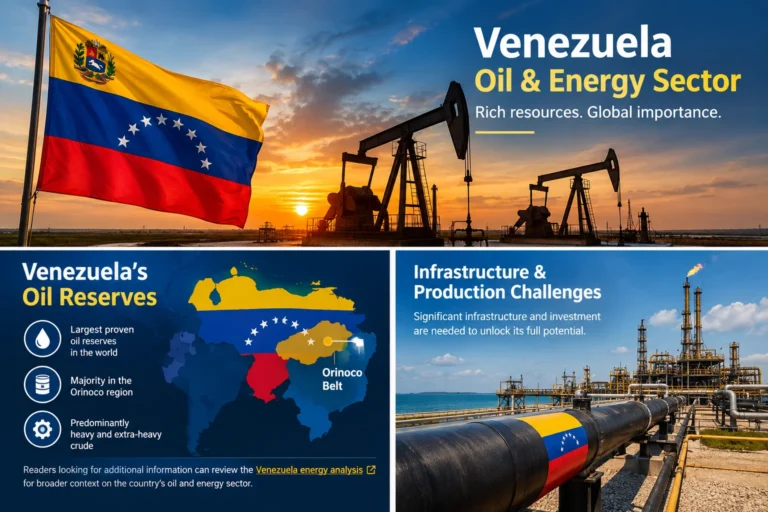
Venezuela has enormous oil resources, especially in the Orinoco Belt. However, large reserves do not automatically lead to high production. Oil must be found, extracted, processed, transported, stored, and sold. Every part of that chain needs money, equipment, workers, technology, and reliable infrastructure.
This is why the oil story in Venezuela is about much more than the number of barrels produced each day. The country also needs to improve the quality and movement of its crude, reduce operating problems, attract long-term investment, and find buyers willing to purchase its heavy oil.
New energy deals could help support that process in 2026. International companies can bring capital, technology, technical knowledge, and access to wider markets. At the same time, Venezuela’s state oil company, PDVSA, remains central to the country’s energy system.
The big question is how quickly these changes can translate into higher production and stronger exports. The answer will depend on investment, infrastructure, oil prices, international demand, and the ability to keep projects operating over several years.
Venezuela Oil Production and Prices: What Is Changing in 2026?
Venezuela’s oil industry is entering 2026 with a recovery story that has been developing over several years. Production has already moved away from the extremely low levels seen during the worst periods of the country’s oil crisis, but the industry still faces major challenges.
The next stage is more difficult because easy production gains are limited. Bringing an old well back into operation can sometimes add barrels quickly, but maintaining those barrels requires continued spending. Mature fields naturally decline, and equipment that has been repaired once may need additional maintenance.
New projects also require time.
Companies need to study fields, prepare development plans, secure equipment, repair infrastructure, drill wells, improve processing capacity, and arrange export logistics. These steps mean that a deal announced in one year does not necessarily produce its full output immediately.
Several developments are important for the 2026 outlook:
- New investment can support oilfield repairs and drilling.
- International energy companies can provide technical expertise and project financing.
- Better infrastructure can help more crude reach export terminals.
- Heavy-oil projects can benefit from improved processing and transportation systems.
- Greater market access can give producers more options when selling crude.
- Refinery demand can influence the value of Venezuelan heavy oil.
- International oil prices can affect whether new projects are financially attractive.
Together, these factors explain why Venezuela’s oil recovery needs to be viewed as a long-term process rather than a single production target.
Why Venezuela Has So Much Oil but Produces Less Than Its Potential
Venezuela is known for having some of the world’s largest oil reserves. Much of this resource is concentrated in the Orinoco Belt, where the crude is particularly heavy.
The size of the resource base creates a major opportunity. But developing heavy oil is expensive and technically demanding.
A country can have billions of barrels underground and still struggle to produce them at a high rate. Oil production depends on working wells, pumps, pipelines, treatment facilities, electricity, storage, transport, skilled workers, and investment.
When several of these systems weaken at the same time, production can fall.
Venezuela experienced a long period in which its oil industry faced many of these problems. Investment declined, infrastructure deteriorated, production equipment became harder to maintain, and the country faced major economic and international pressures.
The result was a large gap between Venezuela’s resource potential and its actual daily production.
The Difference Between Oil Reserves and Oil Production
Oil reserves describe petroleum resources that can potentially be recovered under certain technical and economic conditions. Production describes how much oil is actually being extracted and sold.
That difference is important.
A country may have enormous reserves but produce only a fraction of them each year. Increasing production requires investment and technical capacity.
For Venezuela, the challenge is therefore not finding oil. The challenge is producing it efficiently and consistently.
The country needs to make its existing fields more productive while also developing new opportunities.
Venezuela Oil Production and Prices Depend on Heavy Crude
One of the biggest issues in Venezuela’s oil industry is the nature of its crude.
Much of Venezuelan production comes from heavy and extra-heavy oil. This crude is thicker than lighter oil and can require additional processing and transportation support.
Heavy crude can still be highly valuable, but it requires refineries with suitable equipment.
This creates a different pricing structure for Venezuelan barrels.
International oil benchmarks provide a general indication of market prices, but Venezuelan crude can trade at a discount because buyers may face additional costs when handling and refining it.
The size of that discount can change over time.
Factors affecting the value of Venezuelan crude include:
- The quality and density of the oil
- Refinery requirements
- Transportation costs
- Availability of diluent
- Shipping conditions
- Export market access
- Competition from other heavy crude suppliers
- Overall international oil prices
- Buyer demand
This is why Venezuela Oil Production and Prices should always be considered together. Producing more barrels is useful, but the country also needs to receive a reasonable value for each barrel.
Venezuela Oil Production and Prices in the Orinoco Belt
The Orinoco Belt is one of the most important areas in Venezuela’s oil industry.
The region contains enormous deposits of heavy and extra-heavy crude. Its development has the potential to support higher production for many years.
However, the oil in this region presents special technical challenges.
Companies may need to use special production methods and additional materials to move the crude from the field to processing facilities. Pipelines may require upgrades, and treatment systems need to handle the properties of heavy oil.
This means investment in the Orinoco Belt is not limited to drilling.
A successful project may require improvements across the entire production chain.
What the Orinoco Belt Needs to Increase Output
Higher production in the region can depend on several improvements:
- Well maintenance: Existing wells need regular work to maintain production.
- New drilling: Additional wells can increase output when field conditions support them.
- Pipelines: Reliable transportation is necessary to move crude efficiently.
- Processing: Heavy oil needs suitable treatment before it can enter the export system.
- Diluent: Extra-heavy crude may require lighter materials to improve its flow.
- Power supply: Oil operations depend on reliable electricity and other utilities.
- Storage: More production requires enough storage before crude is shipped.
- Export terminals: Ports must be able to handle additional volumes.
The more of these pieces that work together, the easier it becomes to turn Venezuela’s underground resources into actual export barrels.
New Deals Could Increase Venezuela Oil Production
New oil agreements are important because Venezuela needs capital and technical support to rebuild production.
Energy projects require large amounts of money. Companies must spend on wells, equipment, maintenance, transportation, processing, workers, and technology before they can receive revenue from additional production.
International partnerships can help spread these costs and bring specialized skills into the industry.
A foreign company may have experience managing heavy-oil projects in other countries. It may also have access to equipment suppliers, engineers, drilling technology, and international financing.
For Venezuela, this can help shorten the time needed to repair or expand certain operations.
However, investment does not guarantee immediate production growth.
Why Oil Deals Take Time
An oil agreement is usually the beginning of a project rather than the end.
After an agreement is reached, companies may need to:
- Inspect existing facilities
- Evaluate oil reservoirs
- Prepare development plans
- Order equipment
- Repair wells
- Upgrade pipelines
- Improve processing systems
- Arrange financing
- Hire or train workers
- Improve export logistics
- Begin additional drilling
Some projects can produce results relatively quickly, especially when existing infrastructure is available. Larger developments can take much longer.
This timing matters when looking at Venezuela’s 2026 production outlook.
The Role of Foreign Investment in Venezuela Oil Production and Prices
Foreign investment can play an important role in the future of Venezuelan oil.
International companies can contribute capital, technology, equipment, and management experience. They may also have established relationships with suppliers and customers around the world.
This can make it easier to develop fields that require large investments.
Foreign participation can be especially useful in mature oil fields where production has fallen but significant resources remain underground.
Instead of building an entirely new oil system, companies can sometimes focus on repairing wells and restoring existing facilities.
What Investors Look For
Oil companies normally consider several factors before committing large amounts of capital.
These can include:
- Expected oil prices
- Production costs
- Access to equipment
- Export opportunities
- Contract terms
- Regulatory conditions
- Infrastructure quality
- Availability of skilled workers
- Political and economic stability
- Ability to recover investment
These issues matter because oil projects are long-term investments.
A company may be willing to invest heavily when it believes the project can produce reliable returns over many years. If operating conditions are uncertain, investment may be slower.
PDVSA and the Future of Venezuela Oil Production
PDVSA remains at the center of Venezuela’s oil industry.
The company has historically controlled a large part of the country’s oil production and energy infrastructure. Foreign companies may participate in projects, but PDVSA remains an important part of the operating structure.
The relationship between PDVSA and international partners can therefore affect how quickly projects move forward.
Strong cooperation can help combine local knowledge with international technology and capital.
At the same time, large oil projects need clear responsibilities. Companies must understand who will operate wells, who will fund repairs, how production will be measured, and how the resulting crude will be marketed.
Long-term planning is particularly important because oil fields can operate for decades.
Venezuela Oil Production and Prices and Export Growth
Increasing production is only useful if Venezuela can move the additional crude to buyers.
This sounds simple, but exporting heavy crude involves several stages.
Oil must travel from production areas to processing facilities. It may then need blending or dilution before being transported to storage and export terminals. Tankers must be available to carry the crude to buyers.
A problem at any stage can limit exports.
For example, higher field production could create a bottleneck if pipelines cannot move the additional crude. More crude at a processing facility could create a storage problem if export capacity is limited.
This means Venezuela needs to improve the entire export chain rather than focusing only on oil wells.
What Can Support Higher Venezuelan Oil Exports?
Several improvements can make higher exports easier:
- More reliable pipelines
- Better storage capacity
- Improved port operations
- Stronger tanker availability
- More efficient crude processing
- Reliable access to diluent
- Stable production from major fields
- More international buyers
- Improved market access
These improvements can help turn additional production into actual export revenue.
Venezuela Oil Production and Prices in the U.S. Gulf Coast Market
The U.S. Gulf Coast has historically been an important market for heavy crude because some refineries in the region have equipment designed to process heavier oil.
This creates a commercial connection between Venezuelan production and U.S. refinery demand.
When refineries need heavy crude and Venezuelan barrels are available under acceptable commercial conditions, those barrels can be attractive.
Geography can also help.
Venezuela is relatively close to the United States compared with many other oil-producing regions. Shorter shipping distances can reduce some transportation costs.
But proximity does not guarantee a specific price.
The final value depends on crude quality, refinery demand, transportation costs, trade conditions, and the price of competing crude.
Why Heavy-Oil Refineries Matter
Refineries are designed around specific types of crude.
Some facilities can process heavy oil efficiently because they have equipment such as cokers and other upgrading systems. These refineries can be natural buyers for Venezuelan crude.
When refinery demand for heavy oil is strong, Venezuelan producers may have more opportunities to sell their barrels.
When demand is weaker, discounts may need to increase to attract buyers.
This is one reason refinery activity can have a direct effect on Venezuela Oil Production and Prices.
Venezuela Oil Production and Prices and the Asian Market
Venezuelan crude can also reach international markets outside North America.
Asian countries have large refining industries and significant crude oil demand. Some refineries can process heavier grades, making Venezuelan crude commercially relevant.
However, shipping Venezuelan oil to Asia can involve longer transportation routes.
Longer shipping distances can raise freight costs and reduce the value of the crude received by the producer.
This means Venezuelan exporters must compare different markets carefully.
A buyer offering a higher headline price may not always produce the highest final return if shipping and other costs are also high.
How Exporters Choose Between Markets
Oil exporters may consider:
- The price offered by the buyer
- Shipping costs
- Refinery compatibility
- Payment terms
- Delivery time
- Market access
- Competition from other crude suppliers
- Quality discounts
This commercial calculation helps determine where Venezuelan barrels ultimately go.
Why Venezuelan Crude Can Sell at a Discount
The word “discount” is often used when discussing Venezuelan crude prices.
A discount does not necessarily mean there is no demand for the oil.
Different crude grades naturally trade at different prices. Heavy crude can be cheaper than lighter crude because it may require more processing.
Venezuelan crude can also face additional costs linked to transportation, blending, market access, and other commercial factors.
The discount therefore reflects the total economics of buying and processing the crude.
If Venezuela can improve the quality of its production, reduce transportation problems, increase access to suitable refineries, and improve export efficiency, the commercial value of its crude could become stronger.
The Importance of Diluent for Venezuela Oil Production
Diluent is an important part of Venezuela’s heavy-oil system.
Extra-heavy crude can be difficult to move because of its thickness. Mixing it with a lighter material can make it easier to transport through pipelines and prepare for processing.
Without enough suitable diluent, production and exports can become more difficult.
This creates another challenge for Venezuelan producers.
They must consider not only the crude coming out of the ground but also the materials needed to move that crude through the production system.
Why Diluent Costs Matter
Higher diluent costs can increase the total cost of producing and transporting Venezuelan oil.
If international prices are high, those costs may be easier to absorb.
If oil prices fall, however, expensive transportation and diluent requirements can reduce project margins.
This is one reason the economics of heavy oil can change quickly when global market conditions change.
Venezuela Oil Production and Prices and Infrastructure
Infrastructure is one of the most important parts of the production recovery.
Oil fields need roads, power, pipelines, pumps, storage tanks, processing plants, ports, and other facilities.
Years of limited investment can leave these systems in poor condition.
Repairing infrastructure can therefore create some of the fastest opportunities for production growth.
A field does not always need completely new development to produce more oil. Sometimes existing capacity can be restored through repairs and maintenance.
Infrastructure Areas That Matter Most
The main areas include:
- Oil wells and pumping equipment
- Gathering systems
- Crude pipelines
- Processing facilities
- Storage tanks
- Power systems
- Ports and loading equipment
- Roads and field transportation
- Refineries
- Export terminals
Investment in one area can support improvements in another.
For example, repairing wells may increase production, but that extra oil still needs a working pipeline. Improving a pipeline can increase transportation capacity, but there must be enough production to fill it.
Venezuela Oil Production and Prices and Refinery Capacity
Refineries play an important role in the value chain.
Venezuela has historically had a large refining system, but maintaining refinery operations can be challenging when equipment needs major repairs or when feedstock and spare parts are difficult to secure.
Domestic refining matters because Venezuela needs fuel for its own economy.
At the same time, refinery performance can affect crude production decisions.
If domestic refineries operate more reliably, they can provide a more stable outlet for some crude and help reduce pressure on fuel supplies.
Why Refining Problems Can Affect Production
Oil production and refining are connected.
If crude cannot be processed or exported efficiently, producers may face storage limitations.
Storage limitations can eventually affect field operations.
This is why increasing production requires planning across the entire energy system.
The country cannot simply increase the number of wells without considering what happens to the additional crude afterward.
Venezuela Oil Production and Prices and Global Supply
The global oil market is extremely large.
Venezuela is an important producer with enormous reserves, but its production is only one part of worldwide supply.
Other major producers can increase or reduce output. Global demand can rise or fall. Refineries can change their crude preferences, and inventories can move higher or lower.
These factors can all influence oil prices at the same time.
For this reason, a rise in Venezuelan production does not automatically produce a large change in the global oil price.
What Happens If Venezuela Adds More Barrels?
The market response depends on the size and speed of the increase.
If Venezuela adds a modest amount of crude while global demand is also growing, the additional supply may be absorbed relatively easily.
If Venezuela adds significant supply while other producers are also increasing output and demand is weak, the additional barrels could contribute to a more competitive market.
Several variables therefore need to be watched together:
- Venezuelan production growth
- Global oil demand
- Production from other major producers
- Refinery demand
- Global inventories
- Shipping costs
- Crude quality differences
This broader view gives a more realistic understanding of Venezuela Oil Production and Prices.
Could Higher Venezuela Oil Production Affect Global Oil Prices?
Higher Venezuelan production could add supply to international markets, but its effect would depend on the wider balance between supply and demand.
Oil prices are influenced by expectations as well as physical barrels.
If traders and companies expect Venezuela to increase production significantly, they may adjust their market plans before all of the additional oil reaches buyers.
However, Venezuela’s production recovery is likely to depend on the pace of investment and infrastructure improvements.
That means the market impact should be viewed as a process rather than a single event.
Venezuela Oil Production and Prices and OPEC
Venezuela is part of the wider OPEC oil-producing system.
This means its production can be viewed within the broader discussion about oil supply management and market balance.
OPEC countries collectively produce a major share of the world’s crude oil, so changes in output from major members can influence global supply conditions.
For Venezuela, the challenge is to increase production while operating within its broader international energy relationships.
This can create an important balance between national production goals and wider market conditions.
What Could Push Venezuela Oil Production Higher?
Several factors could support additional growth.
More Foreign Investment
More capital can help companies repair wells, replace equipment, drill new production wells, and improve processing facilities.
Better Infrastructure
Reliable pipelines, storage, power systems, and export terminals can allow existing production capacity to operate more efficiently.
Improved Market Access
More reliable access to international buyers can make it easier for producers to sell additional crude.
Higher Oil Prices
Strong global oil prices can improve the financial case for expensive heavy-oil projects.
Better Technical Performance
Improved reservoir management and modern production methods can help increase recovery from existing fields.
Stronger Refinery Demand
Refineries that need heavy crude can provide a stable market for Venezuelan barrels.
These factors can reinforce each other. Investment can improve infrastructure, infrastructure can increase exports, and stronger exports can generate more revenue for future investment.
What Could Slow Venezuela Oil Production Growth?
The recovery also faces serious obstacles.
Oil production can decline quickly when equipment is not maintained. Heavy crude projects can require large amounts of capital, and infrastructure repairs can take time.
Other possible obstacles include:
- Limited access to financing
- Aging oilfield equipment
- Pipeline problems
- Refinery outages
- Export bottlenecks
- Shortages of specialized equipment
- High production costs
- Difficult heavy-crude logistics
- Changes in international market access
- Lower global oil prices
These risks do not mean production cannot grow. They show why production forecasts can change as projects move forward.
Venezuela Oil Production and Prices: The Role of Oilfield Decline
Oil wells naturally decline over time.
Even a well that produces strongly at the beginning can produce less later. Companies therefore need to drill additional wells or use improved recovery methods to maintain total field production.
This creates a constant investment requirement.
If a producer wants to increase total output, it must first replace natural decline and then add new production on top of that.
This is an important point when looking at Venezuela’s recovery.
A production increase of a certain number of barrels does not necessarily mean the same number of new barrels came from new projects. Some of the increase may come from restoring production that had previously been lost.
How Technology Could Support Venezuela Oil Production
Technology can help Venezuela improve production from existing fields.
Modern reservoir analysis can help companies identify where additional oil may be recovered. Improved drilling techniques can also make some projects more efficient.
In heavy-oil fields, specialized production methods can help move crude from underground formations.
Technology can also improve:
- Well monitoring
- Pump performance
- Reservoir management
- Pipeline operations
- Processing efficiency
- Maintenance planning
- Safety systems
- Production forecasting
Technology alone cannot solve every problem, but it can make investment more productive.
Venezuela Oil Production and Prices and Oilfield Services
Oilfield service companies are another important part of the recovery.
Producers depend on contractors for drilling, well maintenance, equipment, engineering, transportation, and specialized technical work.
If service capacity is limited, production projects can move more slowly.
A healthy oilfield service network can make it easier to repair wells and develop new projects.
This is especially important when a country is trying to rebuild an industry after years of reduced investment.
Why Skilled Workers Matter
Oil production is a highly technical industry.
Engineers, geologists, technicians, mechanics, electricians, drillers, operators, and other specialists are needed across the production chain.
Equipment can be purchased, but experienced workers are also necessary to install, operate, maintain, and repair that equipment.
Building a strong workforce can therefore be an important part of Venezuela’s long-term oil recovery.
Training new workers and bringing experienced professionals into the industry can help companies operate projects more reliably.
Venezuela Oil Production and Prices and Government Revenue
Oil remains extremely important to Venezuela’s economy.
Higher production can increase export revenue if the additional barrels are sold at commercially useful prices.
This can create more money for the government and the wider economy.
But the amount of revenue generated depends on more than production.
A simple way to think about it is:
Oil revenue depends on the number of barrels sold, the price received for each barrel, and the costs required to produce and move those barrels.
That means increasing production is only part of the financial story.
Reducing unnecessary costs and improving the value received per barrel can also matter.
Why Production Targets Can Be Difficult to Reach
Oil production targets can be useful because they give companies and governments a clear objective.
However, targets are not guarantees.
A target may assume that new wells are completed on time, equipment arrives as planned, pipelines work properly, and market conditions remain supportive.
If any of those assumptions change, actual production can be lower than expected.
This is common in large oil projects around the world.
For Venezuela, the gap between a production target and actual output may depend heavily on investment speed and infrastructure reliability.
Venezuela Oil Production and Prices: Short-Term Versus Long-Term Growth
There are two different ways to think about Venezuela’s production recovery.
The first is short-term growth.
This can come from repairing existing wells, restoring equipment, improving operations, and bringing idle capacity back into service.
The second is long-term growth.
This requires larger investment in drilling, infrastructure, processing capacity, and field development.
Short-term improvements can happen faster, while long-term projects may take years.
Both are important if Venezuela wants to build a more stable oil industry.
What Higher Production Could Mean for Venezuelan Oil Exports
Higher production could allow Venezuela to increase exports if the country has enough transportation and market access.
More exports could create several potential effects:
- Higher oil revenue
- Greater use of existing infrastructure
- More demand for tanker services
- More activity in oil-producing regions
- Greater demand for equipment and services
- More crude available to international refiners
The size of these effects would depend on the scale of production growth and the price received for the additional barrels.
Venezuela Oil Production and Prices and the Cost of Shipping
Shipping is an important part of the oil business.
Crude oil is moved over long distances by tanker, and freight rates can change based on fuel costs, vessel availability, trade routes, and market conditions.
For Venezuela, shipping costs matter because the country must compare the economics of selling crude to different destinations.
Nearby markets can sometimes provide transportation advantages.
Longer-distance markets may offer different pricing opportunities but also higher freight costs.
This makes logistics an important part of crude pricing.
Why Oil Prices Still Matter to Venezuela’s Recovery
Even if Venezuela improves production, global oil prices will continue to matter.
Heavy-oil projects can be expensive, so producers need sufficient revenue to justify continued investment.
When oil prices are strong, companies may have more money available for drilling and maintenance.
When prices fall sharply, companies may delay projects or focus on the lowest-cost production first.
This means the future of Venezuelan oil will depend partly on conditions outside the country.
Venezuela Oil Production and Prices in a Lower-Price Environment
A lower oil-price environment would create different challenges.
Projects with high production costs could become less attractive. Companies may focus on existing fields where infrastructure is already available.
Investment decisions could become more selective.
In such a situation, improving efficiency would become especially important.
Companies would need to control costs while maintaining production.
Venezuela Oil Production and Prices in a Strong-Price Environment
Higher international oil prices can improve the economics of Venezuelan production.
More expensive projects may become financially attractive, and companies may have greater motivation to invest in field development.
Higher prices can also increase the value of export barrels.
However, higher prices do not remove Venezuela’s infrastructure and operational challenges.
A producer still needs functioning wells, pipelines, processing plants, storage, and export facilities.
What Investors Will Watch in 2026
Several indicators can help show whether Venezuela’s oil recovery is gaining strength.
Production Growth
Actual monthly production can show whether new projects are adding barrels consistently.
Export Volumes
Exports reveal whether additional production is reaching international buyers.
Investment Activity
New agreements and capital spending can indicate whether companies are preparing for longer-term growth.
Infrastructure Repairs
Visible improvements in pipelines, processing plants, ports, and storage can support future production.
Heavy-Crude Discounts
Changes in the discount applied to Venezuelan crude can show how market conditions are affecting its commercial value.
Refinery Demand
Strong demand from refineries capable of processing heavy crude can support Venezuelan exports.
Venezuela Oil Production and Prices: Three Possible Paths
The future does not have to follow one exact path.
Gradual Recovery
Under a gradual recovery, production increases steadily as companies repair existing fields and add new wells.
This would create a slow but potentially more stable improvement.
Faster Expansion
A faster expansion could occur if investment increases strongly, infrastructure improves quickly, and international market access remains supportive.
This could bring additional barrels to the market more quickly.
Uneven Growth
Production could also rise in some areas while remaining weak in others.
For example, certain projects may receive strong investment while older infrastructure continues to limit other fields.
This would create a mixed recovery rather than a smooth national increase.
These scenarios show why production forecasts should be treated as estimates rather than fixed outcomes.
Venezuela Oil Production and Prices and Global Oil Demand
Global oil demand will be another major factor.
If economies grow and transportation demand remains strong, additional crude supply can find buyers more easily.
If global economic growth weakens, demand may grow more slowly.
This can affect the price received for Venezuelan exports.
Demand from aviation, road transportation, industry, shipping, and petrochemicals all contribute to the wider oil market.
Venezuela’s production recovery therefore takes place within a much larger global energy system.
The Impact of Refinery Demand on Venezuelan Crude
Refinery demand is especially important because Venezuelan oil is heavy.
Refiners with equipment designed to process heavy crude may value Venezuelan barrels differently from refiners that mainly use lighter grades.
If heavy-crude demand rises, Venezuela may have more opportunities to sell its production.
If refiners shift toward lighter crude, Venezuelan producers may need to offer more attractive pricing.
This relationship between crude quality and refinery design is one of the most important parts of the Venezuelan oil market.
Venezuela Oil Production and Prices and Energy Investment
Investment in Venezuela’s oil industry can have effects beyond oil production itself.
New projects may create demand for:
- Engineering services
- Construction
- Equipment
- Transportation
- Maintenance
- Skilled labor
- Port services
- Industrial materials
This can create wider economic activity in oil-producing areas.
However, the size of these effects depends on the scale and duration of investment.
Short projects create temporary activity, while long-term field development can support a larger and more stable service industry.
Can Venezuela Return to Its Former Production Levels?
This is one of the biggest questions surrounding the country’s oil industry.
Venezuela has produced much more oil in the past, so the historical record shows that the country has significant production capacity.
But returning to previous levels would require much more than simply restarting old wells.
The industry would need sustained investment, infrastructure modernization, reliable operations, skilled workers, technology, and stable access to markets.
The time required would depend on how quickly these conditions improve.
A recovery can therefore be measured in stages rather than through one simple comparison with the past.
What Higher Venezuela Oil Production Could Mean for Consumers
Changes in Venezuelan oil production do not automatically translate into cheaper gasoline.
Retail fuel prices are affected by many factors, including crude prices, refinery costs, transportation, taxes, local market conditions, and currency movements.
Additional Venezuelan crude could add supply to the international market, but the effect on consumers would depend on the size of the increase and other market conditions.
The relationship is therefore indirect.
Venezuela Oil Production and Prices: What Could Go Wrong?
A number of risks could slow the recovery.
One major risk is underinvestment.
Oil fields need continuous spending. If investment stops after a production increase, output can eventually decline again.
Infrastructure is another risk.
Pipelines, storage facilities, processing plants, and export terminals need regular maintenance.
Market access also matters.
If producers face difficulty selling their crude, additional production may not generate the expected financial return.
Major Risks to Watch
- Production equipment failures
- Pipeline restrictions
- Refinery problems
- Export bottlenecks
- High shipping costs
- Heavy-crude discounts
- Limited investment
- Lower international oil prices
- Shortages of specialized equipment
- Delays in new projects
- Changes in market access
These risks can affect both production and profitability.
Venezuela Oil Production and Prices: What Could Support a Stronger Recovery?
The same factors that create risks can also create opportunities.
A stronger recovery could be supported by:
- Long-term investment
- Reliable foreign partnerships
- Better oilfield maintenance
- Improved drilling activity
- Modern production technology
- Better pipeline systems
- Improved export terminals
- More efficient heavy-crude processing
- Stable access to international buyers
- Strong refinery demand
The key is coordination.
Investment in only one part of the system is less useful than investment across the entire production chain.
How New Deals Could Change the Venezuelan Oil Industry
New agreements can change the industry’s structure by bringing additional capital and expertise into projects that previously lacked sufficient investment.
They can also create a clearer path for long-term development.
The most important question is what happens after the agreement is signed.
A successful project needs continued spending, good management, working infrastructure, and access to buyers.
If those conditions remain in place, new deals can become the foundation for additional production.
Venezuela Oil Production and Prices: What to Watch Through 2026
The oil market will continue to change throughout the year.
Readers and investors watching Venezuela’s energy sector can focus on several practical indicators.
Look for evidence of:
- New drilling activity
- Repaired wells returning to production
- Higher crude exports
- Improved refinery operations
- New infrastructure investment
- Changes in heavy-crude discounts
- More international partnerships
- Higher or lower tanker activity
- Changes in global oil demand
- Shifts in international crude prices
These indicators can provide a clearer picture than a single production headline.
Frequently Asked Questions About Venezuela Oil Production and Prices
Is Venezuela increasing oil production in 2026?
Venezuela is seeking to increase production through investment, field development, infrastructure improvements, and cooperation with international energy companies. The actual pace of growth will depend on how quickly projects are completed and how reliably the country’s oil system operates.
Why does Venezuela have so much oil?
Venezuela has very large petroleum resources, especially in the Orinoco Belt. Much of the resource consists of heavy and extra-heavy crude, which requires specialized production and processing systems.
Why is Venezuelan crude often sold at a discount?
Venezuelan crude is often heavier than many international benchmark grades. Heavy crude can require additional refining work and transportation support, which can reduce the price buyers are willing to pay compared with lighter crude.
What is the Orinoco Belt?
The Orinoco Belt is a large oil-producing region in Venezuela that contains extensive deposits of heavy and extra-heavy crude. It is central to the country’s long-term production potential.
Who is involved in Venezuela’s oil industry?
PDVSA remains a major part of the country’s oil industry, while international energy companies can participate in specific projects and partnerships.
Why does Venezuela need foreign investment?
Foreign investment can provide capital, technology, equipment, engineering expertise, and project-management skills that can help rebuild production and infrastructure.
Can Venezuela increase oil exports?
Higher exports are possible if production rises and the country has enough pipelines, storage, processing capacity, port capacity, tankers, and international market access.
Why is heavy oil more difficult to produce?
Heavy oil is thicker and can be more difficult to move. It may require special production methods, additional processing, and blending with lighter materials before transportation.
Could higher Venezuelan production affect global oil prices?
Additional Venezuelan barrels would add supply to the global market. The effect on prices would depend on the size of the increase, global demand, production from other countries, refinery activity, and other market conditions.
Can Venezuela return to much higher production levels?
Venezuela has significant resource potential, but reaching much higher production would require sustained investment, infrastructure improvements, reliable operations, skilled workers, technology, and stable access to international markets.
Venezuela Oil Production and Prices: The Bigger Picture
The Venezuelan oil story in 2026 is not simply about producing more barrels.
It is about rebuilding an entire energy system.
The country has enormous oil resources, but turning those resources into reliable production requires investment at every stage.
Wells must work. Pipelines must move crude. Processing facilities must operate. Storage must be available. Ports must load tankers. Refineries must have demand for the crude. International buyers must be willing and able to purchase it.
This is why new oil deals are receiving attention.
They can provide a starting point for investment and production growth, but their long-term effect will depend on what happens after the agreements are signed.
Venezuela Oil Production and Prices: The Role of Long-Term Investment
The biggest opportunity for Venezuela may be its ability to combine existing resources with new investment.
The country does not need to discover a completely new oil resource. It already has a very large one.
The challenge is making that resource commercially productive.
Long-term investment can help improve:
- Oilfield recovery
- Production equipment
- Pipeline networks
- Processing capacity
- Export infrastructure
- Refinery operations
- Technical skills
- Market access
A stable investment cycle can also help companies plan further ahead.
Instead of focusing only on short-term production increases, companies can invest in projects designed to produce for many years.
Venezuela Oil Production and Prices and the Future of the Energy Sector
Oil is likely to remain central to Venezuela’s energy sector for the foreseeable future.
At the same time, the global energy market is changing.
Oil demand, refinery technology, electric vehicles, renewable energy, energy efficiency, and international climate policies are all part of the wider energy picture.
For Venezuela, this creates both an opportunity and a timing challenge.
The country has large oil resources, but developing them requires significant capital. Companies must consider how future oil demand could change over the life of a project.
This makes efficient and commercially disciplined investment increasingly important.
What the 2026 Oil Story Means for Venezuela
If new deals lead to higher investment and better operations, Venezuela could gradually increase its production and exports.
That could create more oil revenue and increase the country’s role in international crude markets.
But the recovery will not happen automatically.
The country must continue improving infrastructure, attracting investment, maintaining wells, developing heavy-oil technology, and keeping export channels open.
The strongest gains are likely to come when several parts of the industry improve together.
Final Thoughts on Venezuela Oil Production and Prices
Venezuela Oil Production and Prices are entering an important period in 2026 as new deals, investment plans, infrastructure work, and international market conditions come together.
Venezuela has one of the world’s largest oil resource bases, but its future production will depend on how effectively it can turn those resources into reliable commercial output.
The main opportunities are clear. More investment can repair wells and infrastructure. International partnerships can bring technology and technical expertise. Better pipelines and export facilities can help move more crude to buyers. Strong refinery demand can support heavy-oil sales.
At the same time, the challenges should not be ignored.
Venezuelan crude is often heavy and technically demanding. Production requires reliable equipment, suitable processing systems, diluent, transportation, storage, and export capacity. Oil prices can change quickly, and international demand can move in either direction.
The most important development to watch is therefore not a single production number. It is whether Venezuela can build a more reliable system that consistently produces, transports, processes, and exports crude.
If that system improves over time, Venezuela’s large oil resources could support higher production and stronger participation in global oil markets.
For 2026, the story is ultimately about execution. New agreements may create opportunities, but investment, infrastructure, technology, market access, and sustained operations will determine how much of that potential becomes real production.