Venezuelan Oil Quality is becoming a bigger part of the crude-buying conversation as refiners look more closely at the real value of heavy barrels. Venezuela is known for large volumes of heavy and extra-heavy crude, especially from the Orinoco Belt, but calling all Venezuelan crude “heavy” does not tell a buyer enough. API gravity, sulfur, viscosity, metals, water, sediment, asphaltenes, acidity, distillation range and other properties can change the cost of moving, blending and refining each cargo.
That matters because the market does not value crude oil by volume alone. A 500,000-barrel cargo can look attractive at the loading terminal and become much less attractive after freight, dilution, refinery processing and product-yield costs are included.
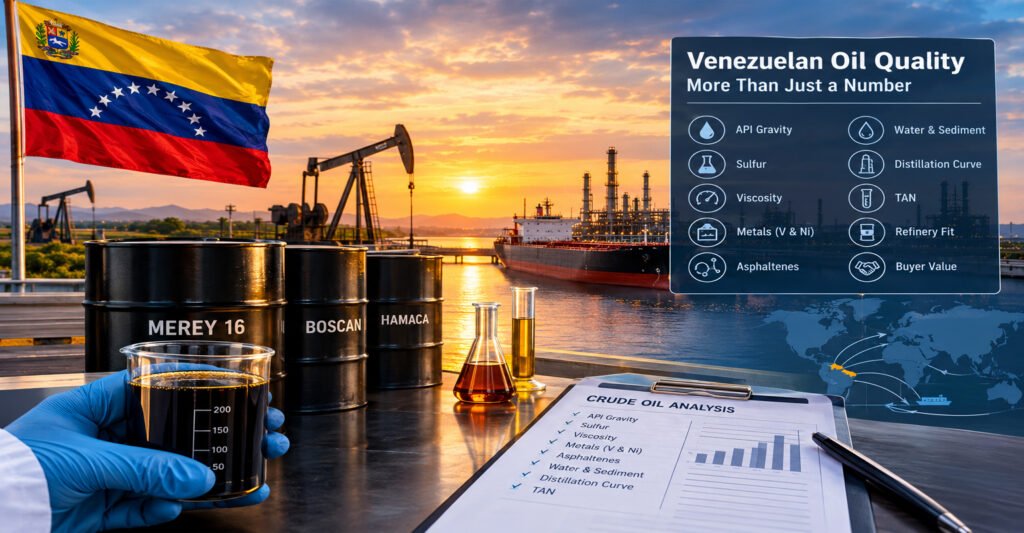
The change is already visible in the market. S&P Global began publishing additional daily assessments for Merey 16, Boscan and Hamaca in October 2026. Merey 16 is assessed on a free-on-board basis from Venezuela, while Boscan and Hamaca are assessed delivered at port along the U.S. Gulf Coast. The assessments also show differentials against Latin American Brent and WTI references.
That is important for buyers because it gives the market more ways to compare Venezuelan barrels by grade, location and delivery point.
The main lesson is simple:
Venezuelan Oil Quality is not one number.
It is a group of crude properties that can either add value or create costs depending on the refinery, shipping route, blending plan and market.
What Is Venezuelan Oil Quality?
Venezuelan Oil Quality refers to the physical and chemical properties of crude produced in Venezuela.
These properties help determine how easily a refinery can process the oil and how much value it can create from the barrel.
The most important measurements include:
-
- API gravity
- Sulfur content
- Viscosity
- Density
- Metals
- Asphaltenes
- Water and sediment
- Salt
- Total acid number
- Pour point
- Distillation curve
- Carbon residue
- Nitrogen
- Wax
- Hydrogen content
A buyer normally looks at these properties through a crude assay or a more specific cargo specification.
A crude assay is a detailed laboratory report that describes the behavior and composition of a crude stream.
For a refinery, that information can be more useful than a simple statement that a crude is “heavy” or “sour.”
This is why Venezuelan Oil Quality needs to be viewed at the crude-stream level.
Venezuela does not produce one uniform crude.
The country has produced light, medium, heavy and extra-heavy streams. EIA data has previously listed many Venezuelan crude streams with very different API gravities and sulfur levels.
The difference can be large enough to change which refinery wants the barrel.
Why Venezuelan Oil Quality Is Not the Same Across the Country
One of the biggest mistakes in discussing Venezuelan Oil Quality is treating the country as if it produces one standard grade.
It does not.
The Orinoco Belt is dominated by extra-heavy crude, but other Venezuelan producing areas have historically supplied heavier, medium and lighter streams.
The Maracaibo Basin in western Venezuela has produced crude grades with different characteristics from many Orinoco streams.
Eastern Venezuela also contains a wider range of crude qualities.
That means two Venezuelan cargoes can have very different commercial values even if both are sold under the broad label of Venezuelan crude.
For buyers, the important question is not simply:
“What is Venezuelan oil quality?”
It is:
“What are the exact properties of this crude stream and what can my refinery do with it?”
That question moves the discussion from a country label to a refinery decision.
Venezuela has a wide crude-quality range
Historical EIA crude-stream data illustrates the range.
Some Venezuelan streams have had API gravity well above 30 degrees, while others have been close to or below 15 degrees. Sulfur levels also vary widely between streams.
This range matters because API gravity and sulfur are two of the first indicators buyers use to classify crude.
A lighter crude generally contains a greater share of lower-boiling hydrocarbons.
A heavier crude contains more high-boiling material.
A higher-sulfur crude usually needs more refinery treatment to meet product specifications.
The result is a simple commercial rule:
The same benchmark price does not create the same refinery value for every crude.
What Makes Venezuelan Crude Heavy?
A major part of Venezuelan Oil Quality is the large amount of heavy and extra-heavy petroleum found in the country.
The U.S. Energy Information Administration says most of Venezuela’s proven oil reserves are extra-heavy crude from the Orinoco Belt.
Heavy crude contains a larger share of high-molecular-weight hydrocarbon components.
These components can include resins and asphaltenes.
As a result, the oil can be dense and highly viscous.
Some Venezuelan heavy crude can be difficult to move without heating, blending or dilution.
That does not mean heavy crude has no value.
It means the buyer needs the right system to process it.
Why is Venezuelan oil so thick?
The answer depends on the crude stream.
Some Venezuelan crude is thick because it contains a large amount of heavy hydrocarbon material. Geological processes, including biodegradation in some reservoirs, can also remove lighter hydrocarbon components and leave a heavier oil.
The Orinoco Belt contains huge accumulations of extra-heavy crude.
This is one reason Venezuela has historically relied on blending and upgrading methods to make some crude streams easier to transport and process.
For buyers, thickness becomes a cost when it affects:
- Pipeline movement
- Pumping
- Heating
- Storage
- Loading
- Tanker operations
- Blending
- Refinery feed handling
That is why viscosity matters alongside API gravity.
API Gravity Is One of the First Quality Signals
API gravity is one of the most widely used measurements in crude trading.
It indicates how dense a petroleum liquid is compared with water.
The API scale works in an unusual way:
A higher API number means a lighter crude.
A lower API number means a heavier crude.
This is important when discussing Venezuelan Oil Quality because many major Venezuelan export streams sit in the heavy or very heavy part of the crude spectrum.
S&P Global’s October 2026 assessments list typical values of about 16 API for Merey 16, 10.6 API for Boscan and 21.2 API for Hamaca.
These numbers immediately show why buyers cannot treat the three grades as identical.
Why does API gravity matter to a refinery?
API gravity can affect the amount and type of products a refinery can make from crude.
A lighter crude often provides a larger share of lighter fractions after distillation.
A heavy crude contains more material that remains in the bottom of the refinery process.
That bottom material may need additional processing.
Complex refineries use equipment such as:
- Fluid catalytic crackers
- Hydrocrackers
- Delayed cokers
- Residue upgrading units
- Desulfurization units
- Hydrogen systems
A refinery with strong conversion capacity can often make better use of heavy crude than a simple refinery.
That difference is central to Venezuelan Oil Quality and buyer value.
Sulfur Changes the Value of Venezuelan Heavy Crude
Sulfur is another major part of Venezuelan Oil Quality.
Crude with relatively high sulfur is often described as sour crude.
Sour crude can require more processing to remove sulfur from fuels and other products.
The cost can include additional hydrogen, energy, catalyst use and equipment requirements.
S&P Global’s October 2026 crude assessments list typical sulfur content of about 3.4% for Merey 16, 5.4% for Boscan and 2.2% for Hamaca.
Those differences are commercially important.
A refinery may be willing to buy a high-sulfur crude if the price discount is large enough.
But the refinery needs to calculate the cost of turning that crude into saleable products.
Is Venezuelan crude high in sulfur?
Many important Venezuelan export grades are high-sulfur crude, but the country does not produce only high-sulfur oil.
Mesa 30, for example, has historically been much lighter and lower in sulfur than heavy Venezuelan grades such as Merey and Boscan. Historical contractual data lists Mesa at about 30 API and around 1.01% sulfur, compared with about 16 API and 2.8% sulfur for Merey 16.
The exact quality of a cargo can vary with the blend and specification.
That is why buyers use current assay information rather than relying only on an old published number.
Merey 16 Is a Key Reference for Venezuelan Oil Quality
Merey 16 has become one of the best-known Venezuelan crude grades.
It is a heavy, sour blend associated with Venezuelan production, including heavy crude from the Orinoco region.
Historical contractual data has listed Merey 16 at about 16 API, with sulfur around 2.8%, viscosity around 461.8 cSt at 100°F, and water and sediment at no more than 1% in the cited specification.
S&P Global’s newer market assessment uses a typical Merey 16 specification of 16 API and 3.4% sulfur.
The difference is worth noticing.
It does not automatically mean one source is wrong.
Crude specifications can differ by assay date, commercial specification, blend, sampling method and market methodology.
That is why a serious buyer should always ask:
- Which assay?
- What date?
- Which blend?
- Which loading point?
- Which contractual specification?
- Which quality tolerance?
- Which delivery basis?
This is one of the most important lessons in Venezuelan Oil Quality.
Why Merey 16 matters to buyers
Merey 16 is important because it sits at the center of Venezuela’s export discussion.
It is heavy.
It is sour.
It requires suitable refinery equipment.
It can also become attractive when priced at a large enough discount to compensate for those challenges.
A refinery that has the right configuration may see a heavy Venezuelan barrel very differently from a refinery that mainly processes light sweet crude.
Boscan Shows Why Crude Quality Can Change Commercial Value
Boscan is another important Venezuelan crude grade.
It is heavier and generally higher in sulfur than Merey 16.
S&P Global’s October 2026 assessment lists typical Boscan quality at 10.6 API and 5.4% sulfur.
That is a very heavy and sour crude profile.
Historical EIA information also identified Boscan as a heavy sour crude produced in western Venezuela, with an API gravity of about 10.7 and sulfur around 5.2%.
The small differences between those figures again show why buyers should use current market specifications.
For a refinery, Boscan can require strong conversion and sulfur-removal capability.
But the same properties can create an opportunity when the crude is priced attractively.
This is where Venezuelan Oil Quality becomes a pricing issue rather than only a laboratory issue.
Hamaca Adds Another Layer to the Venezuelan Crude Picture
Hamaca is another Venezuelan crude stream now receiving a dedicated market assessment.
S&P Global lists typical Hamaca quality at about 21.2 API and 2.2% sulfur.
That places it in a different quality position from very heavy Boscan.
The difference matters because buyers may compare Hamaca with other heavy crude grades from Latin America, Canada or elsewhere.
The refinery does not only ask whether Hamaca is heavy.
It asks:
How does Hamaca perform against competing crude?
How much conversion capacity is required?
How much sulfur removal is needed?
How much diluent is required?
What are the expected product yields?
What is the delivered cost?
Those questions determine the barrel’s real value.
Venezuelan Oil Quality and the Importance of Viscosity
Viscosity measures how strongly a liquid resists flowing.
For heavy Venezuelan crude, viscosity can be a major commercial issue.
A high-viscosity crude may need:
- Heating
- Dilution
- Specialized pumps
- Different pipeline operating conditions
- Careful storage management
- Blending with lighter hydrocarbons
Historical Merey 16 specifications have reported very high viscosity compared with lighter crude grades.
That does not make the crude unusable.
It means the supply chain needs to be designed around its physical behavior.
This is one reason Venezuelan Oil Quality extends beyond refinery chemistry.
Quality affects logistics.
Why viscosity matters before the refinery
Imagine two crude cargoes with similar benchmark prices.
One flows easily through the supply system.
The other needs dilution and additional handling.
The second barrel may cost more to deliver even before it reaches the refinery gate.
This is why buyers calculate a delivered crude value rather than simply comparing headline prices.
For heavy Venezuelan crude, the calculation can include:
- Loading costs
- Freight
- Insurance
- Diluent
- Storage
- Port fees
- Heating
- Quality adjustments
- Refinery processing costs
- Product yield
- Carbon costs
- Financing
- Inventory losses
The result is a more complete view of Venezuelan Oil Quality.
Diluent Is Part of the Quality Equation
Extra-heavy crude can be difficult to transport without changing its physical properties.
Venezuela has used diluents such as naphtha to help move and process extra-heavy crude.
Reuters reported in March 2026 that Venezuela resumed exports of diluted crude oil after a 15-month pause. The diluted crude was produced by blending extra-heavy Orinoco crude with imported heavy naphtha, with cargoes moving to markets including the U.S. Gulf Coast.
This shows why Venezuelan Oil Quality cannot be separated from blending.
The crude in a tank may not have the same commercial behavior as the crude directly from the reservoir.
Why does Venezuela blend heavy crude?
The basic reason is flow and marketability.
Extra-heavy crude can be too viscous for easy transportation under some conditions.
Adding a lighter hydrocarbon can reduce viscosity and make the mixture easier to move.
But diluent has a cost.
That cost becomes part of the economics of the final barrel.
If naphtha prices rise, the economics of diluted crude can become less attractive.
If diluent becomes cheaper or more available, heavy crude economics can improve.
Therefore, Venezuelan Oil Quality interacts with the wider refined-product and blending markets.
The Refinery Is Where Crude Quality Becomes Money
Crude quality is not valuable or poor in isolation.
Its value depends on the refinery.
A complex refinery can often process heavy sour crude more efficiently than a simple refinery.
This is why some U.S. Gulf Coast refineries have historically been important buyers of Venezuelan heavy crude.
The U.S. Energy Information Administration says Venezuelan heavy crude has been well suited to U.S. Gulf Coast refineries.
S&P Global has also reported that Gulf Coast refiners with coking capacity can increase their use of heavy Venezuelan crude.
This creates a clear commercial relationship:
Venezuelan Oil Quality determines what the refinery needs to do.
The refinery configuration determines how expensive that work is.
The market price determines whether the final economics are attractive.
What Makes a Refinery Suitable for Venezuelan Heavy Crude?
A refinery does not need one special machine to process Venezuelan crude.
It needs the right combination of units.
Important equipment can include:
- Cokers
- Hydrocrackers
- FCC units
- Hydrotreaters
- Desulfurization systems
- Hydrogen production
- Residue processing units
Cokers are especially important because they can convert very heavy residue into lighter products and petroleum coke.
Hydrocrackers can convert heavier molecules into higher-value products using hydrogen.
Hydrotreaters remove sulfur and other unwanted compounds.
The more complex the refinery, the greater its ability to process difficult crude slates.
That does not mean complexity automatically makes Venezuelan crude profitable.
The refinery still has to compare the crude against competing feedstocks.
Venezuelan Oil Quality Can Create a Discount
Heavy sour crude often trades at a discount to lighter or sweeter benchmark crudes.
The discount compensates the buyer for additional processing and logistics costs.
But the discount is not fixed.
It changes with:
- Refinery demand
- Freight
- Availability
- Crude inventories
- Product margins
- Competing heavy grades
- Seasonal refinery maintenance
- Sanctions and trade rules
- Diluent costs
- Shipping capacity
In 2026, Venezuelan crude discounts have moved as market conditions changed.
Reuters reported in September that traders were seeking deeper discounts because shipping costs had risen sharply.
That is an important distinction.
A wider discount does not necessarily mean the crude itself became worse.
It can mean the total cost of delivering the crude became higher.
Is Venezuelan Crude Good Quality?
This is one of the most common questions buyers and readers ask.
The best answer is:
It depends on the crude and the refinery.
Calling crude “good” or “bad” without context can be misleading.
A light sweet crude may be easier for a simple refinery to process.
A heavy sour crude may be more valuable to a complex refinery if it is priced correctly.
For example, a refinery with substantial coking capacity may prefer a discounted heavy crude because its equipment is designed to convert difficult bottom-of-the-barrel material.
A simple refinery may prefer a lighter grade even if that crude has a higher purchase price.
So Venezuelan Oil Quality should be judged by refinery fit, not by a simple quality ranking.
The Difference Between Crude Quality and Crude Value
This distinction is critical.
Crude quality is about physical and chemical characteristics.
Crude value is about economics.
A crude can have difficult quality characteristics and still have strong value.
A crude can also have attractive quality and be overpriced.
For a buyer, the real calculation is closer to:
Crude value = product revenue minus crude cost, transport, processing and other costs.
The quality of the crude changes several parts of that equation.
Heavy crude may require more processing.
High-sulfur crude may require more sulfur removal.
High-viscosity crude may require more blending.
High-metal crude may affect catalysts and refinery operations.
High-asphaltene crude may affect residue handling.
The buyer therefore needs a full economic model.
Crude Assays Are Becoming More Important
A crude assay is one of the most useful tools for evaluating Venezuelan Oil Quality.
An assay can include detailed information about:
- API gravity
- Sulfur
- Viscosity
- Distillation
- Metals
- Nitrogen
- Asphaltenes
- Carbon residue
- Salt
- Water
- Pour point
- Acidity
It can also help a refinery estimate product yields.
That matters because two crude grades with the same API gravity can behave very differently inside a refinery.
Why API gravity alone is not enough
Imagine two crude streams that are both around 16 API.
One could contain different levels of sulfur, metals, nitrogen and asphaltenes.
The two barrels might therefore produce different refinery results.
This is why Venezuelan Oil Quality should never be reduced to API gravity.
API gravity is an important starting point.
It is not the whole story.
Sulfur, Metals and the Hidden Cost of Heavy Crude
Some heavy crude oils contain significant concentrations of metals such as vanadium and nickel.
These metals can be associated with heavy hydrocarbon fractions and asphaltenes.
Research on Venezuelan heavy crude has documented vanadium and nickel in asphaltene fractions.
For refiners, metals can matter because they may affect catalysts and refinery equipment.
Catalyst management is a major operating issue in complex refining.
If a crude causes faster catalyst deactivation, the refinery may need to spend more on catalyst replacement or regeneration.
This becomes part of the crude’s economic penalty.
Therefore, Venezuelan Oil Quality can affect costs that do not appear in the simple crude purchase price.
What Are Asphaltenes and Why Do Buyers Care?
Asphaltenes are large, complex hydrocarbon molecules found in heavier crude oils.
They can affect:
- Viscosity
- Stability
- Blending
- Fouling
- Residue behavior
- Processing
A heavy crude with a high asphaltene content can require more careful handling.
Blending can also create compatibility problems if two crude streams do not mix well.
For this reason, buyers may test crude blends before making large purchases.
This is another reason a crude assay is so valuable.
The buyer is not only asking:
“What is the crude?”
The buyer is asking:
“How will this crude behave in my system?”
Vanadium and Nickel Add Another Quality Layer
Heavy Venezuelan crude has attracted technical attention because of metals such as vanadium and nickel.
These elements can be present in heavy fractions and asphaltenes.
Historical Venezuelan crude assay material shows substantial variation in metal content across different streams.
The exact value for a current cargo should always come from the relevant assay rather than from a general country estimate.
This is important for Venezuelan Oil Quality because metal content can affect refinery catalyst life and residue processing.
A buyer who ignores metals may underestimate the real processing cost.
Total Acid Number Can Affect Refinery Decisions
Total acid number, or TAN, measures the amount of acidic compounds in crude.
A higher TAN can increase corrosion concerns in certain refinery systems.
Not every Venezuelan crude has the same TAN.
That is why buyers look at detailed crude assays.
A refinery may accept a crude with higher acidity if it has the equipment, operating experience and economic margin to manage it.
Another refinery may demand a larger discount.
This again shows why Venezuelan Oil Quality is relative to the buyer.
Water and Sediment Also Matter
Water and sediment may seem less important than API gravity or sulfur.
But they still matter.
Excess water can increase transportation and handling costs.
Salt associated with produced water can create refinery corrosion and fouling risks.
Sediment can create operational problems.
Crude contracts therefore normally include limits for water and sediment.
A buyer needs to know the specification before taking delivery.
This is especially important for heavy crude because handling and separation can be more complicated.
Why Refinery Complexity Changes the Price Buyers Are Willing to Pay
The same Venezuelan cargo can have different values for different refiners.
Consider two buyers.
Buyer A: Simple refinery
Buyer A has limited residue conversion.
Heavy Venezuelan crude creates a large amount of low-value residue.
The refinery may need a large discount.
Buyer B: Complex refinery
Buyer B has a large coker, hydrocracker and sulfur-removal system.
The refinery can turn more of the heavy material into useful products.
Buyer B may accept a higher crude price.
This is why Venezuelan Oil Quality cannot be separated from refinery design.
The buyer is effectively purchasing a feedstock for a specific machine system.
U.S. Gulf Coast Refiners Have a Natural Advantage
The U.S. Gulf Coast has a large concentration of complex refineries.
Many were designed or modified to process heavy crude.
S&P Global reported in January 2026 that Gulf Coast refiners could increase their use of heavy Venezuelan crude and that coking refineries were particularly suited to those barrels.
This helps explain why Venezuelan heavy crude can be especially attractive in the Gulf Coast market.
The refinery system already understands the feedstock.
The infrastructure has experience with heavy barrels.
And some refineries have equipment designed to handle high-sulfur residue.
For Venezuelan Oil Quality, this means location matters almost as much as chemistry.
India Shows a Different Side of Venezuelan Oil Quality
Indian refiners also have sophisticated processing systems, but delivered economics are critical.
Indian buyers have looked closely at Venezuelan heavy crude because some refineries can process it.
However, the long voyage from Venezuela can increase freight costs.
In early 2026, Indian refiners were reported to seek discounts for Venezuelan crude because of its heavy, viscous and acidic properties.
Later in 2026, higher freight costs further changed the economics.
Reports showed that delivered costs for Venezuelan Merey in India rose sharply during periods of higher shipping costs.
The lesson is important:
A refinery may be technically able to process Venezuelan crude and still decide not to buy it if the delivered price is too high.
China and the Question of Refinery Fit
China has historically been an important destination for Venezuelan heavy crude.
Some Chinese independent refineries have experience with heavy feedstocks.
But not every Asian refinery is equally prepared.
S&P Global reported in January 2026 that several East Asian refiners were less familiar with Venezuelan grades such as Merey and Boscan and generally preferred lighter sweet crude.
That does not mean those refiners cannot process Venezuelan crude.
It means the commercial and technical barriers can be higher.
For a buyer unfamiliar with the crude, laboratory testing, trial cargoes and refinery modeling become more important.
Why a Crude Differential Matters
Crude oil is often priced against a benchmark.
For Venezuelan heavy crude, buyers may discuss the price as a differential to Brent or another reference.
A negative differential means the crude sells below the benchmark.
The size of the discount reflects several factors.
These can include:
- Quality
- Location
- Freight
- Market demand
- Refinery economics
- Supply availability
- Commercial risk
- Contract terms
The new S&P Global assessments for Merey 16, Boscan and Hamaca include outright prices and differentials to Latin American Brent and WTI-related references.
That makes the market easier to compare.
It also makes Venezuelan Oil Quality more visible in commercial pricing.
The Delivered Barrel Matters More Than the Loading Price
A buyer does not really care about the crude price at the Venezuelan terminal alone.
The buyer cares about the cost when the crude reaches the refinery.
A simple example shows why.
Suppose a Venezuelan cargo is offered at a large discount to Brent.
The buyer may think the deal is attractive.
But then add:
- Ocean freight
- Insurance
- Port delays
- Demurrage
- Diluent
- Financing
- Quality penalties
- Refinery processing costs
The discount may shrink quickly.
This is why Venezuelan Oil Quality and logistics must be evaluated together.
Freight Can Change the Value of Heavy Venezuelan Crude
Shipping costs became a major issue for Venezuelan crude in 2026.
Reuters reported that Venezuela’s September 2026 exports fell as traders sought higher discounts to offset elevated freight costs. Exports were reported at about 1.08 million barrels per day, down nearly 9% from August.
This shows how quickly transportation can change the economics of a crude stream.
Heavy crude already needs a suitable refinery.
If freight also rises sharply, the number of profitable buyers becomes smaller.
That can force the seller to widen the discount.
The crude itself has not changed chemically.
Its delivered value has changed.
Why New Venezuelan Crude Price Assessments Matter
The launch of new S&P Global assessments for Venezuelan crude is more than a data-market development.
It gives buyers more precise reference points.
Merey 16 now has a FOB Venezuela assessment.
Boscan and Hamaca have delivered U.S. Gulf Coast assessments.
This creates a better framework for comparing different crude streams and delivery locations.
For buyers, better price transparency can help with:
- Contract negotiations
- Refinery planning
- Hedging
- Cargo comparison
- Supplier selection
- Quality adjustments
- Benchmarking
This is a significant development for Venezuelan Oil Quality because quality and price can now be discussed more directly for specific streams.
What Buyers Should Look for in a Venezuelan Crude Assay
A buyer evaluating Venezuelan crude should look beyond API gravity.
A useful checklist includes:
- API gravity
- Sulfur
- Viscosity
- Metals
- Asphaltenes
- Nitrogen
- Carbon residue
- TAN
- Salt
- Water
- Sediment
- Pour point
- Distillation curve
- Residue yield
- Hydrogen content
- Wax content
- Stability
The buyer should also ask whether the data represents:
- A current cargo
- A historical sample
- A blended stream
- A field stream
- A contractual specification
- A typical value
- A guaranteed specification
This distinction is critical.
A “typical” crude value should not automatically be treated as a contractual guarantee.
Why Buyers Should Not Rely on Old Crude Specifications
Crude quality can change as production patterns change.
The blend can change.
The fields contributing to a stream can change.
Production conditions can change.
Diluent ratios can change.
Storage can affect the cargo.
Water and sediment can vary.
That means an old assay can be useful for background information but should not replace current cargo data.
This is particularly important when discussing Venezuelan Oil Quality because published values for some Venezuelan grades differ between sources and time periods.
Merey 16 is a good example.
Historical contractual information gives one sulfur figure, while newer market assessment material uses another typical value.
The correct response is not to choose one number blindly.
The correct response is to identify the assay and date.
How Blending Can Change Venezuelan Oil Quality
Blending is common in crude markets.
A heavy crude may be blended with a lighter stream.
An extra-heavy crude may be blended with diluent.
Different fields may contribute to a commercial blend.
The final cargo therefore represents a specific mixture.
That mixture can have different:
- API gravity
- Sulfur
- Viscosity
- Metals
- Distillation profile
- Residue yield
This is why buyers need cargo-specific information.
The name on the bill of lading is not enough to understand the full refinery behavior.
Venezuelan Oil Quality and the Orinoco Belt
The Orinoco Belt is central to Venezuela’s oil story.
EIA says most of Venezuela’s proven reserves are extra-heavy crude associated with the Orinoco Belt.
The huge size of these resources creates a long-term opportunity.
But the quality characteristics create technical challenges.
Extra-heavy crude requires:
- Advanced production methods
- Diluent or upgrading solutions
- Heavy-oil transportation systems
- Complex refining capacity
- Specialized equipment
- Reservoir management
This means Venezuela’s future production growth is closely connected to its ability to manage heavy crude.
The issue is not simply producing more barrels.
It is producing barrels that can reach buyers at competitive delivered economics.
Why Production Growth Does Not Automatically Mean Higher Oil Value
A country can increase production without increasing the value of every barrel.
If new production is heavy and difficult to transport, the market may require a larger discount.
If refinery capacity for heavy crude is limited, the buyer pool may shrink.
If freight increases, delivered prices can fall relative to benchmarks.
If diluent becomes expensive, netbacks can weaken.
Therefore, Venezuelan Oil Quality is one of the factors that determines whether additional production creates strong commercial returns.
This is especially important as companies invest in mature Venezuelan fields and heavy-oil projects.
Mature Fields Can Also Change Crude Quality
Field redevelopment does not always produce exactly the same crude quality over time.
As a field matures, operators may change:
- Well locations
- Water injection
- Artificial lift
- Workover programs
- Production zones
- Blending practices
- Gathering systems
Water cut can also change.
The resulting field stream may require different treatment.
This makes ongoing sampling important.
For buyers, a crude stream is not necessarily a frozen product.
Its characteristics can evolve with field operations.
Heavy Crude and Recovery Factor
Recovery factor measures the percentage of oil in place that can ultimately be produced.
Venezuela has enormous resources, but producing a larger share of those resources requires technical investment.
The challenge is especially large for extra-heavy oil.
Production methods must work with the physical properties of the crude.
This creates a connection between reservoir engineering and Venezuelan Oil Quality.
A producer that improves recovery but creates a more difficult blend may not capture the full value of the additional barrels.
A producer that improves both recovery and handling can create a stronger commercial result.
What Refiners Can Gain From Discounted Heavy Crude
Heavy crude can offer an advantage when it is priced below competing feedstocks.
A complex refinery may buy discounted heavy crude and use its conversion units to create valuable fuels.
The refinery’s decision is based on margin.
The crude can be attractive when:
Value of refined products > crude cost + processing cost + logistics cost
That is why heavy crude discounts exist.
The discount is not necessarily a sign that the crude has no value.
It can be the mechanism that makes the economics work.
Venezuelan Oil Quality and Product Yields
Product yield is another important factor.
A refinery wants to know how much gasoline, diesel, jet fuel, fuel oil, LPG and other products it can obtain from a crude.
Heavy crude generally produces a larger share of heavy fractions.
Those fractions need further conversion.
A refinery with strong conversion capacity can turn them into higher-value products.
A refinery without that equipment may be forced to sell more low-value residue or fuel oil.
Therefore, Venezuelan Oil Quality affects the refinery’s product slate.
What Does “Heavy Sour” Really Mean?
The phrase “heavy sour” combines two different measurements.
Heavy refers mainly to density or API gravity.
Sour refers mainly to sulfur content.
A crude can be:
- Light sweet
- Light sour
- Medium sweet
- Medium sour
- Heavy sweet
- Heavy sour
Venezuelan export grades often fall toward the heavy sour end of this scale.
Merey 16 and Boscan are good examples.
But Venezuela also produces lighter and lower-sulfur streams.
That is why country-level labels can be misleading.
Venezuelan Oil Quality and Refinery Upgrading
Upgrading is the process of improving the properties of heavy crude or heavy refinery streams.
It can involve:
- Removing carbon
- Adding hydrogen
- Breaking large hydrocarbon molecules
- Reducing sulfur
- Reducing metals
- Producing lighter products
Upgrading can improve the marketability of heavy oil.
But upgrading facilities require major capital.
This creates an important investment question for Venezuela.
Should heavy crude be upgraded before export?
Should it be diluted?
Should it be exported to complex refineries?
The answer depends on infrastructure, market conditions and expected margins.
Why Some Buyers Prefer Heavy Crude When Prices Are Right
It may sound strange that refiners would actively seek difficult crude.
But a refinery is designed to make money from processing feedstock.
If a heavy crude sells at a sufficient discount, a complex refinery can capture value by processing it.
This is especially true when competing heavy crude supplies are tight.
The buyer is not buying “quality” in the consumer-product sense.
The buyer is buying an economic feedstock.
This is the key idea behind the changing market for Venezuelan Oil Quality.
The Buyer’s Real Question: How Much Discount Is Enough?
A refinery may ask:
“How much discount do I need to make this crude profitable?”
That number changes constantly.
If refining margins rise, the refinery may accept a smaller discount.
If freight rises, the required discount may become larger.
If another heavy crude becomes cheaper, Venezuelan crude may need to follow.
If a refinery has an outage in its coker, it may reduce heavy crude purchases.
If the coker returns, demand can rise.
This makes heavy crude pricing dynamic.
Why Direct Refinery Buying Is Becoming More Important
The Venezuelan crude market has also seen changes in who buys the barrels.
Reuters reported in July 2026 that refiners and oil companies were increasing direct purchases from PDVSA, reducing the earlier dominance of major trading houses.
Direct relationships can help refiners manage crude quality more closely.
A refinery buying directly may have better control over:
- Grade
- Volume
- Delivery timing
- Quality specifications
- Contract terms
- Cargo testing
For a heavy crude buyer, that can be valuable.
The closer the relationship between producer and refinery, the easier it can be to match crude quality with refinery needs.
What a Quality Bank Means for Venezuelan Crude Buyers
Some crude sales use quality adjustments.
A base specification is established.
If the delivered crude is better or worse than the agreed specification, the price may be adjusted.
This can apply to:
- API gravity
- Sulfur
- Water
- Sediment
- Metals
- Other properties
The concept helps buyers and sellers share quality risk.
For Venezuelan crude, detailed quality adjustments can become more important as different grades receive clearer market pricing.
Venezuelan Oil Quality and the Importance of Sampling
Sampling sounds simple, but it is critical.
A buyer needs a sample that represents the cargo.
Heavy crude can have different characteristics at different points in the supply chain.
Storage conditions can affect mixing.
Blending can create differences.
Water and sediment may settle.
Therefore, sampling procedures matter.
Independent inspection can help buyers confirm that the cargo meets contract specifications.
This supports better commercial decisions.
How Technology Can Improve Crude Quality Monitoring
Digital tools can help producers and buyers track crude quality.
Modern systems can combine:
- Laboratory results
- Inline sensors
- Tank measurements
- Production data
- Pipeline data
- Blend calculations
- Refinery models
The goal is faster and more reliable information.
For Venezuela, better quality monitoring could help reduce uncertainty around heavy crude streams.
It could also support more precise pricing.
This is another reason Venezuelan Oil Quality may become more important as export volumes grow.
The Role of Refinery Modeling
Refineries use models to estimate how a crude will behave.
A model can estimate:
- Product yields
- Hydrogen needs
- Sulfur removal
- Coker operation
- Catalyst demand
- Energy consumption
- Margin
A crude assay becomes an input into this model.
The refinery can then compare Venezuelan crude against other options.
For example:
Venezuelan Merey versus Canadian heavy crude.
Venezuelan Boscan versus Mexican Maya.
Venezuelan Hamaca versus another Latin American heavy grade.
The winner is not always the crude with the lowest purchase price.
The winner is the crude with the best expected refinery margin.
Venezuelan Crude Versus Canadian Heavy Crude
For U.S. refiners, Venezuela competes with other heavy crude suppliers.
Canadian heavy crude is one of the most important alternatives.
The buyer can compare:
- API gravity
- Sulfur
- Transportation
- Pipeline access
- Freight
- Refinery compatibility
- Supply reliability
- Price differential
If Venezuelan crude arrives at the refinery at a higher total cost than Canadian crude, the refinery may choose Canada.
This creates competitive pressure on Venezuelan sellers.
The chemistry of the barrel matters.
But location and logistics can matter just as much.
Venezuelan Crude Versus Mexican Maya
Mexican Maya is another heavy sour crude that has historically been important to U.S. Gulf Coast refiners.
Venezuelan grades can compete with Maya when refinery configurations overlap.
The buyer compares the full economic value.
This can include:
- Purchase price
- Quality
- Freight
- Supply reliability
- Refinery yield
- Contract flexibility
If Venezuela wants to increase market share, its crude must compete not only on production volume but on delivered economics.
That is why Venezuelan Oil Quality is central to future export growth.
Why Refinery Location Changes Venezuelan Oil Value
The farther a refinery is from Venezuela, the more transport becomes part of the economics.
A Gulf Coast refinery may have a shorter and more established trade route.
An Indian refinery may face a longer voyage.
An Asian refinery may face another logistics structure.
This does not automatically make one market better.
A refinery with exceptionally strong heavy-oil processing capability may still buy from far away.
But freight must be covered by the crude discount or refinery margin.
The result is a simple rule:
The best buyer is often the refinery that can turn the crude’s difficult properties into value most efficiently.
Venezuelan Oil Quality and Freight Are Now Closely Linked
The 2026 market has shown how quickly freight can change Venezuelan crude economics.
Reuters reported that higher freight costs contributed to weaker Venezuelan exports in September and increased pressure for larger discounts.
That creates a chain:
Heavy crude → limited refinery pool → longer routes → freight exposure → required discount → lower seller netback.
Breaking that chain can improve value.
Venezuela can potentially improve economics through:
- Better port operations
- More reliable tankers
- Shorter waiting times
- Better blending
- More direct refinery contracts
- Greater access to nearby complex refineries
Why Buyers Care About Reliability Alongside Quality
A crude can have an excellent assay and still be difficult to buy if cargoes are unpredictable.
Refineries need stable feedstock planning.
They schedule crude deliveries weeks and months ahead.
Unexpected delays can force them to purchase replacement barrels.
That can be expensive.
Therefore, a buyer evaluates:
- Quality
- Volume
- Timing
- Reliability
- Contract performance
- Logistics
This means Venezuelan Oil Quality is only one part of the total buying decision, but it is a very important one.
Venezuela’s Oil Infrastructure Can Affect Quality and Value
Oil quality does not exist only underground.
The infrastructure handling the crude can affect its marketability.
Important systems include:
- Gathering lines
- Pipelines
- Storage tanks
- Separation facilities
- Blending systems
- Loading terminals
- Diluent systems
- Upgraders
- Refineries
Poor infrastructure can increase water, sediment, delays or blending problems.
Better infrastructure can improve consistency.
For buyers, consistency has value.
A refinery can optimize operations more easily when the crude stream behaves predictably.
Why Consistency Can Be More Valuable Than a Small Quality Improvement
A refinery may prefer a crude with slightly less attractive headline quality if the stream is stable.
Why?
Because refinery planning depends on predictable feedstock.
If every cargo has different sulfur, API gravity and viscosity, the refinery may need to change operating conditions.
That creates uncertainty.
A stable crude stream can make refinery optimization easier.
Therefore, Venezuela could improve crude value not only by changing the chemistry but also by improving consistency.
What Happens When Heavy Crude Quality Gets Worse?
Suppose a Venezuelan blend becomes heavier.
The buyer may need:
- More conversion
- More hydrogen
- More energy
- More diluent
- More catalyst
- More residue processing
The refinery may ask for a larger discount.
Now suppose sulfur also rises.
The required discount could increase further.
If metals rise, catalyst costs may also increase.
The effect can compound.
This is why small changes in crude quality can have a larger impact on commercial value than a buyer might expect.
What Happens When Venezuelan Oil Quality Improves?
The opposite can happen.
If a crude becomes lighter:
- Distillation may become easier
- Product yields may improve
- Residue may decline
- Conversion requirements may fall
If sulfur declines:
- Desulfurization requirements may fall
- Hydrogen consumption may decrease
- Product treatment may become easier
If viscosity falls:
- Transportation may become easier
- Diluent needs may decrease
These changes can increase buyer interest.
That is the positive side of Venezuelan Oil Quality.
Could Better Blending Increase Venezuelan Crude Value?
Yes.
Blending can be used to create a crude stream that better matches refinery requirements.
A producer may combine heavier crude with lighter material to improve flow properties.
But the economics must be calculated carefully.
The lighter component has its own value.
If the producer uses expensive diluent, the cost must be recovered in the final crude price.
The best blend is therefore not simply the lightest possible mixture.
It is the blend that maximizes total value.
Why Crude Buyers Need to Think in Terms of Netback
Netback is the amount left after relevant costs are deducted from the sale price.
For a Venezuelan producer, a simplified calculation might look like:
Benchmark price − crude differential − freight − blending cost − other selling costs = producer netback
For a refinery, the calculation is different:
Product revenue − crude cost − freight − refinery operating cost = refinery margin
These two sides need to meet.
If the seller demands too high a price, the buyer loses interest.
If the buyer demands too deep a discount, the producer may not have enough incentive to supply.
Venezuelan Oil Quality sits in the middle of this negotiation.
The New Market Data Could Improve Price Discovery
The new S&P Global assessments for Venezuelan crude may help reduce uncertainty in this process.
Merey 16 now has a FOB Venezuela assessment.
Boscan and Hamaca have delivered U.S. Gulf Coast assessments.
The assessments are also connected to Brent and WTI-related differentials.
This matters because buyers can compare crude prices more directly.
It also helps traders and refiners discuss quality-adjusted value.
A better benchmark does not automatically produce a higher crude price.
But it can make the market more transparent.
People Also Ask: What Is the Best Venezuelan Crude?
There is no single answer.
The “best” crude depends on the refinery.
A refinery designed for light sweet crude may prefer a lighter Venezuelan stream.
A complex refinery with strong coking capacity may prefer discounted heavy crude.
Merey 16, Boscan and Hamaca have different physical properties.
So the better question is:
Which Venezuelan crude gives this refinery the best margin?
That is the practical meaning of Venezuelan Oil Quality.
People Also Ask: Which Venezuelan Crude Is the Heaviest?
Boscan is among the very heavy Venezuelan commercial crude grades.
S&P Global’s October 2026 specification lists Boscan at about 10.6 API and 5.4% sulfur.
Other Venezuelan heavy and extra-heavy streams can also have very low API gravity.
The answer therefore depends on whether the comparison is between named export grades or the wider group of Venezuelan crude streams.
People Also Ask: Is Merey 16 Heavy Crude?
Yes.
Merey 16 is a heavy sour Venezuelan crude.
Its name reflects its approximate API gravity.
Current S&P Global assessment methodology describes it at about 16 API and 3.4% sulfur.
Historical contractual specifications have used somewhat different sulfur values, which shows why buyers should check the current assay and specification for each transaction.
People Also Ask: Why Does Venezuela Produce So Much Heavy Oil?
The answer is largely geological.
Venezuela’s Orinoco Belt contains enormous deposits of extra-heavy crude.
The physical properties of this petroleum make extraction, transportation and refining more difficult than for lighter crude.
But these resources are commercially important because they are very large.
EIA identifies the Orinoco Belt as the main source of Venezuela’s extra-heavy reserves.
People Also Ask: Can Heavy Venezuelan Crude Be Refined Into Gasoline?
Yes.
Heavy Venezuelan crude can be processed into gasoline, diesel, jet fuel and other products.
The challenge is the refinery configuration.
A simple refinery may not be able to convert enough of the heavy material into high-value products.
A complex refinery with coking, hydrocracking and other conversion units can process more of the heavy fractions.
That is why refinery complexity is central to Venezuelan Oil Quality.
People Also Ask: Why Does Venezuelan Crude Sell at a Discount?
The discount can reflect several factors.
These include:
- Heavy API gravity
- High sulfur
- High viscosity
- Metals
- Refinery processing costs
- Diluent requirements
- Freight
- Market access
- Supply risk
- Buyer competition
The size of the discount changes with market conditions.
It should not be treated as a permanent penalty.
People Also Ask: Does Heavy Crude Mean Low Quality?
Not necessarily.
Heavy crude is not automatically “bad” crude.
It is a different type of feedstock.
A refinery designed for heavy crude may consider it highly useful.
The commercial value depends on what the refinery can do with it and how much the buyer pays.
This is one of the most important points for readers trying to understand Venezuelan Oil Quality.
People Also Ask: What Is the API Gravity of Venezuelan Crude?
There is no single API gravity for all Venezuelan crude.
The country produces a wide range of grades.
S&P Global currently lists typical values around 16 API for Merey 16, 10.6 API for Boscan and 21.2 API for Hamaca.
Historical EIA crude-stream data also shows Venezuelan streams ranging from light grades to very heavy grades.
Therefore, the answer must always specify the crude grade.
People Also Ask: What Is the Sulfur Content of Venezuelan Crude?
Sulfur varies widely.
Current S&P Global assessment information lists approximately:
- Merey 16: 3.4%
- Boscan: 5.4%
- Hamaca: 2.2%
These are typical market specifications, not universal values for every Venezuelan barrel.
This range is another reason why Venezuelan Oil Quality should be discussed grade by grade.
What Buyers Should Ask Before Purchasing Venezuelan Heavy Crude
A refinery considering Venezuelan crude should ask a clear set of questions.
Quality questions
- What is the current API gravity?
- What is the sulfur content?
- What is the viscosity?
- What are the nickel and vanadium levels?
- What is the asphaltene content?
- What is the TAN?
- What is the water and sediment level?
- What is the salt content?
- What is the distillation curve?
Logistics questions
- Where is the cargo loading?
- How much freight is expected?
- Is diluent included?
- What tanker size is available?
- What are expected port delays?
- What is the delivery window?
Refinery questions
- Can the refinery process the crude?
- How much residue will be produced?
- Is enough coking capacity available?
- How much hydrogen is required?
- How will sulfur affect operations?
- How will metals affect catalysts?
Commercial questions
- What is the benchmark?
- What is the differential?
- Is the price FOB or delivered?
- Are quality adjustments included?
- Who carries demurrage risk?
- What happens if the cargo fails specification?
These questions turn Venezuelan Oil Quality into a practical procurement framework.
How Refiners Can Compare Venezuelan Crude With Other Heavy Grades
A fair comparison should use a common framework.
For example:
| Factor | Venezuelan Heavy Crude | Competing Heavy Crude |
|---|---|---|
| API gravity | Compare actual assay | Compare actual assay |
| Sulfur | Compare current cargo | Compare current cargo |
| Viscosity | Check transport needs | Check transport needs |
| Metals | Check catalyst impact | Check catalyst impact |
| Freight | Calculate delivered cost | Calculate delivered cost |
| Diluent | Add actual cost | Add actual cost |
| Refinery fit | Model yields | Model yields |
| Price differential | Use relevant benchmark | Use relevant benchmark |
| Product value | Model expected output | Model expected output |
The goal is not to identify the “best” crude.
The goal is to identify the crude that gives the best margin.
Why the Future of Venezuelan Oil Depends on Quality Management
Venezuela has enormous oil resources.
But resource size alone does not determine export value.
The country needs barrels that can be:
- Produced efficiently
- Moved safely
- Blended consistently
- Loaded reliably
- Sold competitively
- Refined profitably
This is where Venezuelan Oil Quality becomes part of the country’s broader production strategy.
More production without better quality control and logistics could create bottlenecks.
More production with better quality management could create stronger export economics.
The Role of International Oil Companies
International companies working in Venezuela can bring technical experience in heavy-oil development, reservoir management, crude handling and refinery integration.
Recent activity by international energy companies has increased attention on Venezuela’s heavy crude resources.
Eni’s 2026 Junín 5 agreement, for example, involves a very large heavy-oil resource base and long-term development plans.
Chevron, Repsol and other companies have also been involved in Venezuelan production and redevelopment.
The quality challenge remains the same:
How can more heavy crude be produced and delivered at a cost that buyers can accept?
Heavy Oil Technology Can Improve Commercial Value
Technology can improve the economics of heavy crude.
Potential tools include:
- Horizontal drilling
- Artificial lift
- Reservoir monitoring
- Steam or thermal methods where suitable
- Water injection
- Improved well completions
- Diluent optimization
- Upgrading
- Digital blending
- Pipeline monitoring
The goal is not always to make heavy crude into light crude.
The goal is to produce, move and process it more efficiently.
That can reduce the discount required by buyers.
Why Digital Crude Blending Could Become More Important
Modern blending systems can help operators target a desired crude specification.
Instead of mixing barrels based only on volume, operators can model:
- API gravity
- Sulfur
- Viscosity
- Metals
- Diluent
- Product demand
This can produce more consistent cargoes.
Consistency can make a crude more attractive to refiners.
That means better blending can potentially increase the value of Venezuelan Oil Quality without changing the underlying reservoir.
Quality Management Can Support Better Contracts
Better quality information can also improve contract design.
A producer can offer a clear specification.
A buyer can model the crude more accurately.
Quality adjustments can be included.
Sampling procedures can be agreed in advance.
The result is less uncertainty.
This can support longer-term relationships between Venezuelan producers and international refiners.
For heavy crude, that stability can be valuable.
Why Venezuela Needs More Than Production Growth
The global market does not simply need more Venezuelan barrels.
It needs barrels that fit into refinery systems.
If Venezuela increases production faster than export and refinery capacity can absorb heavy crude, discounts may widen.
If infrastructure improves at the same time, the market can absorb more barrels.
If refinery demand grows, heavy crude can become more valuable.
The balance between these factors will determine the commercial outcome.
Venezuelan Oil Quality is therefore part of the supply-growth equation.
What Could Increase the Value of Venezuelan Heavy Crude?
Several developments could improve buyer economics.
Better refinery access
More complex refineries buying Venezuelan crude would expand demand.
Better shipping economics
Lower freight would increase the delivered value of Venezuelan barrels.
Better blending
More consistent crude could reduce refinery uncertainty.
Better quality data
Accurate assays could improve price discovery.
More direct contracts
Direct relationships could reduce transaction costs and improve supply planning.
More heavy-oil upgrading
Upgrading could improve the quality of some streams before export.
Stronger infrastructure
Better pipelines, storage and terminals could reduce delays.
Together, these factors could strengthen the market value of Venezuelan Oil Quality.
What Could Reduce the Value of Venezuelan Heavy Crude?
The opposite risks also matter.
The value of heavy Venezuelan crude could weaken if:
- Freight remains high
- Heavy crude supply grows faster than refinery demand
- Diluent costs rise
- Refinery margins fall
- Competing heavy crude becomes cheaper
- Quality becomes less consistent
- Port delays increase
- Processing costs rise
- Buyers demand larger discounts
This shows why crude quality cannot be viewed separately from market conditions.
Venezuela’s Heavy Crude Has a Buyer — But Not Every Buyer
One of the most useful ways to understand the Venezuelan market is to stop thinking about “the global oil market” as one buyer.
There are many buyers.
Some want light sweet crude.
Some want medium crude.
Some want heavy sour crude.
Some have cokers.
Some do not.
Some are close to Venezuela.
Some face long shipping routes.
Some have existing Venezuelan crude experience.
Some would need to test the crude first.
This makes Venezuelan Oil Quality a market-segmentation issue.
The right crude goes to the right refinery.
Why Market Familiarity Matters
Refineries that have processed Venezuelan crude before may have a technical advantage.
They already understand:
- Crude behavior
- Blend requirements
- Refinery response
- Catalyst impacts
- Product yields
- Storage requirements
A new buyer may need more testing.
S&P Global reported in early 2026 that some East Asian refiners were unfamiliar with Venezuelan grades such as Merey and Boscan.
That familiarity gap can affect demand.
The more transparent and consistent Venezuelan crude becomes, the easier it may be for new buyers to evaluate.
How Better Data Can Expand the Buyer Pool
Better crude data can lower uncertainty.
A refinery considering a new crude wants to know what will happen inside its units.
Detailed assays help answer that question.
Independent market assessments can also help buyers understand the price.
The combination of:
assay + benchmark + differential + freight + refinery model
creates a much clearer purchasing decision.
This is exactly why Venezuelan Oil Quality is becoming more commercially important.
Venezuelan Oil Quality and the Future of Price Discovery
The introduction of new Venezuelan crude assessments is an important step.
Merey 16, Boscan and Hamaca now have more visible market references.
The assessments use specific delivery points and benchmark relationships.
As trading grows, more market participants can compare grades.
That can help buyers understand whether a discount is caused by:
- Quality
- Freight
- Location
- Supply
- Market demand
Separating these factors is essential.
Why “Quality Discount” and “Freight Discount” Are Different
This is an important distinction.
A quality discount compensates a buyer for the cost or difficulty associated with the crude itself.
A freight discount compensates for expensive transportation.
The two can happen at the same time.
For example, a Venezuelan crude may already sell below Brent because it is heavy and sour.
If tanker costs rise, the seller may need to lower the price again.
The second discount does not mean the crude became more sour or heavier.
It means the delivered economics became worse.
This distinction helps explain recent Venezuelan crude pricing.
The Strategic Importance of Heavy-Oil Refineries
Heavy-oil refineries can become more valuable when heavy crude supply increases.
Venezuela is one source.
Canada is another.
Mexico, Brazil and other producers also supply heavy or medium-heavy crude.
Complex refineries can benefit from feedstock diversity.
They can choose between grades based on price and refinery margins.
For Venezuela, the challenge is to make its heavy crude competitive against these alternatives.
That competition will keep Venezuelan Oil Quality at the center of crude procurement.
Why Buyers May Pay More for Better-Than-Expected Quality
Suppose a cargo arrives lighter than expected.
The refinery may produce more valuable products.
If sulfur is also lower than expected, processing costs may fall.
If viscosity is lower, handling may become easier.
These improvements can create additional value.
Depending on the contract, the seller may benefit through a quality adjustment.
This is why accurate assays protect both sides.
Why Sellers Need to Protect Quality Consistency
For producers, consistent quality can become a competitive advantage.
A buyer may accept a slightly higher price for a crude that behaves consistently.
That can reduce the refinery’s operational uncertainty.
It can also support longer-term supply agreements.
Therefore, Venezuela’s crude strategy should not focus only on increasing barrels.
It should also focus on producing reliable commercial grades.
Venezuelan Oil Quality Is Becoming a Commercial Strategy
The changing market shows that crude quality is no longer just a technical subject for laboratory teams.
It affects:
- Marketing
- Pricing
- Contracts
- Refinery planning
- Shipping
- Investment
- Production strategy
That is why the term Venezuelan Oil Quality is becoming more useful as an industry concept.
It describes the connection between what comes out of the reservoir and what a buyer is willing to pay.
What Investors Should Watch in Venezuelan Crude Quality
Investors following Venezuela’s oil sector should monitor several indicators.
Crude grade
Watch the mix of light, medium, heavy and extra-heavy production.
API gravity
A shift toward heavier barrels can increase handling and refining costs.
Sulfur
Higher sulfur can increase refinery treatment requirements.
Viscosity
Higher viscosity can increase transportation and blending costs.
Diluent use
Rising diluent demand can increase the cost of moving extra-heavy crude.
Freight
Higher shipping costs can reduce producer netbacks.
Refinery demand
More complex refineries buying Venezuelan crude can support prices.
Quality assessments
New market benchmarks can improve transparency.
These indicators can provide a better picture of the sector than production volume alone.
What Refiners Should Watch in 2026 and Beyond
Refiners considering Venezuelan crude should watch:
- Merey pricing
- Boscan pricing
- Hamaca pricing
- Brent differentials
- WTI differentials
- Freight rates
- Diluent prices
- U.S. Gulf Coast refinery utilization
- Indian refinery demand
- Asian refinery demand
- Canadian heavy crude prices
- Mexican crude supply
- Venezuelan production growth
The interaction between these markets will determine how attractive Venezuelan barrels become.
A Simple Framework for Understanding Venezuelan Oil Quality
Readers can think about the issue in five steps.
Step 1: What is the crude?
Identify the exact grade.
Step 2: What are its properties?
Check API, sulfur, viscosity, metals and other assay data.
Step 3: Where is it going?
Calculate freight and delivery costs.
Step 4: Who will refine it?
Match the crude to refinery capability.
Step 5: What is the final margin?
Compare product value with the full cost of the crude.
This framework is much more useful than simply asking whether Venezuelan oil is “good.”
The Bigger Picture for Venezuela’s Oil Market
Venezuela’s oil opportunity is enormous, but it is also technically demanding.
The country’s largest resource base is heavily weighted toward extra-heavy crude.
That creates a special commercial challenge.
The country must produce the oil.
It must move the oil.
It must find buyers.
And those buyers must be able to process it profitably.
The quality of the crude is part of every step.
That is why Venezuelan Oil Quality is becoming a more important market signal.
Buyers Are Pricing the Whole Barrel, Not Just the Oil
Venezuelan Oil Quality is changing how buyers look at the country’s heavy crude because the market is becoming more precise about what each barrel costs and what each barrel can produce.
API gravity tells buyers how heavy the crude is.
Sulfur tells them more about the treatment burden.
Viscosity tells them about transport and handling.
Metals can affect refinery catalysts.
Asphaltenes can affect processing and stability.
Water and sediment affect handling.
Distillation characteristics affect product yields.
Freight changes delivered cost.
Diluent changes transportation economics.
Refinery complexity determines how much value can be extracted.
That means the value of Venezuelan crude cannot be measured by its headline price alone.
The same heavy barrel can be unattractive to one refinery and highly valuable to another.
That is the central idea behind the changing market.
Venezuela does not need every refinery in the world to want its crude.
It needs the right refineries to see enough value in the barrel to cover its quality, logistics and processing costs.
The new market assessments for Merey 16, Boscan and Hamaca are an important step because they give buyers clearer reference points for comparing specific Venezuelan grades.
At the same time, recent freight pressures show that crude quality is only part of the equation. A heavy barrel can be technically attractive and still lose its advantage if transportation costs rise too far.
For Venezuela, the next stage of oil growth will therefore be about more than producing additional barrels.
It will be about producing barrels with predictable quality, moving them efficiently, matching them with the right refineries and pricing them against the alternatives.
For buyers, the lesson is just as clear.
Do not ask only how much Venezuelan crude costs.
Ask what the crude can do inside the refinery.
Ask what it costs to deliver.
Ask how much processing it needs.
Ask how consistent the quality is.
And most importantly, ask what the barrel is worth after every cost is included.
That is where Venezuelan Oil Quality becomes more than a technical description.
It becomes a measure of commercial value.
Sources and Research Basis
This article uses publicly available industry and government information, including:
- U.S. Energy Information Administration country and crude-stream data
- S&P Global Energy crude-quality and market-assessment information
- Reuters reporting on Venezuelan crude trade, freight and exports
- Historical crude assay and contractual specification records
- Published petroleum research on heavy crude, asphaltenes, vanadium and nickel
- Refining-industry information on heavy crude processing and refinery complexity
Crude specifications can change by assay date, blend, cargo and contract. Values in this article described as “typical” or “historical” should not be treated as a guaranteed specification for every Venezuelan cargo.