
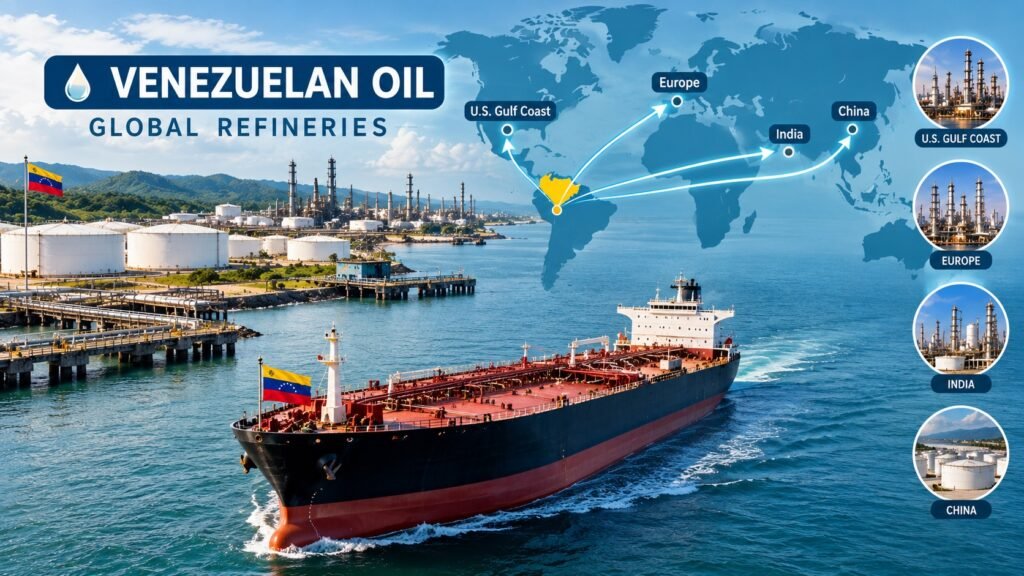
Why Venezuelan Oil Trade Routes Are Changing
The journey from an oil field in Venezuela to a refinery on another continent is much more than a tanker trip. It starts with production, then moves through gathering systems, pipelines, storage tanks, blending facilities, export terminals, shipping lanes, and finally a refinery. Every stage can affect where Venezuelan Oil goes and how much a buyer is willing to pay for it.
For many years, Venezuela’s international oil trade was strongly connected to a smaller group of buyers. The United States had a natural advantage because of its geographic location and its large concentration of refineries capable of processing heavy crude. China later became a major destination, while India and Europe also remained important parts of the wider trade network.
That pattern has been changing.
The shift is important because Venezuelan Oil is not a standard light crude that every refinery can process in the same way. Much of Venezuela’s production comes from heavy and extra-heavy resources, especially in the Orinoco Belt. These barrels can require special refinery equipment, blending, diluent, and careful transportation planning.
A refinery therefore looks at more than the price of the crude.
It also looks at:
-
- Crude quality
- Sulfur content
- Refinery equipment
- Freight costs
- Tanker availability
- Port conditions
- Supply reliability
- Blending requirements
- Insurance costs
- Regulatory conditions
- Expected product margins
This is why the trade routes carrying Venezuelan Oil can change even when the crude itself comes from the same fields.
What the New Venezuelan Oil Trade Map Looks Like
The current trade picture is more varied than the old China-centred model.
The United States has become a major destination again, while India has emerged as an important long-distance buyer. European markets also remain part of the network, although their role can change depending on refinery economics and available supply.
A June 2026 tanker-market analysis based on Signal Ocean data reported that Venezuelan crude exports in the first half of 2026 reached 28.25 million metric tons across 273 cargoes, more than double the 13.25 million metric tons recorded in the first half of 2025. The United States took about 12.19 million metric tons, or roughly 43% of the total, while India received about 5.07 million metric tons.
Those figures show why Venezuelan Oil is becoming an important subject for both refiners and tanker markets.
The trade is no longer simply about finding one large customer.
It is increasingly about creating several workable routes.
Those routes include:
- Venezuela to the U.S. Gulf Coast
- Venezuela to other U.S. destinations
- Venezuela to India
- Venezuela to Europe
- Venezuela to Caribbean storage locations
- Potential future routes to other markets
Each route has different costs and risks.
How Venezuelan Oil Moves Before It Reaches the Coast
Before a tanker can carry Venezuelan Oil overseas, crude must travel through Venezuela’s internal oil system.
The journey begins at producing fields.
Crude is gathered from wells and moved toward processing facilities. Depending on the type of crude, it may be blended, upgraded, treated, or combined with other hydrocarbons before it is ready for export.
The basic process looks like this:
- Wells produce crude.
- Gathering systems collect the oil.
- Pipelines move crude toward processing areas.
- Heavy crude may be blended or upgraded.
- Storage tanks hold export volumes.
- Pipelines move crude toward terminals.
- Tankers load the prepared cargo.
- Ships carry the crude to another country.
- Refineries process the crude into useful products.
Every step matters.
If a pipeline operates below capacity, less Venezuelan Oil can reach storage.
If storage becomes full, production may face additional pressure.
If a terminal cannot load ships quickly, tankers may wait.
If tankers wait, transportation becomes more expensive.
If transportation becomes more expensive, buyers may demand a larger discount.
This shows why the international route begins long before the vessel leaves Venezuela.
The Orinoco Belt and Venezuelan Oil Quality
The Orinoco Belt is central to the country’s oil future.
It contains very large quantities of extra-heavy crude, which has different characteristics from lighter grades produced in many other oil regions.
Extra-heavy crude is dense.
It can also contain high levels of sulfur and other components that require more complex refining.
This does not make the crude unusable.
Instead, it means the crude is best matched with refineries that have the equipment needed to process it.
That technical relationship is one of the main reasons certain destinations are more attractive for Venezuelan Oil.
A refinery with advanced heavy-oil processing equipment may see value in a Venezuelan cargo that a simpler refinery would avoid.
The refinery may have:
- Coking units
- Vacuum distillation
- Hydroprocessing systems
- Sulfur removal equipment
- Heavy-residue processing capacity
These systems allow a complex refinery to extract useful products from difficult crude.
Why Heavy Crude Shapes Venezuelan Oil Routes
Heavy crude affects the entire supply chain.
It affects how the oil is transported.
It affects which pipelines can handle it.
It affects the need for blending.
It affects the refinery that eventually receives it.
It also affects the final delivered cost.
This is why Venezuelan Oil trade routes are strongly connected to refinery technology.
A tanker cannot simply choose the nearest port.
The cargo needs a suitable destination.
A refinery must be able to process the crude efficiently enough to justify the transportation cost.
This creates a relationship between the oil field and the refinery that can stretch across thousands of miles.
Why Diluent Matters for Venezuelan Oil Exports
Extra-heavy crude can require diluent to improve its movement through pipelines and other transportation systems.
Naphtha is one material that can be used for this purpose.
The idea is straightforward.
Heavy crude can be difficult to move.
A lighter hydrocarbon can be mixed with it.
The resulting blend can be easier to transport.
That means an oil-exporting country can also import materials needed to make its crude exportable.
This is an important part of the Venezuelan Oil trade system.
The international trade can therefore move in two directions.
Crude moves outward.
Blending materials can move inward.
The two flows support each other.
Export Terminals and Venezuelan Oil
Export terminals are the bridge between Venezuela’s land-based oil system and global shipping.
A terminal needs enough storage.
It needs loading equipment.
It needs pipeline connections.
It needs safe marine access.
It needs workers and operational systems.
If any of these areas become unreliable, Venezuelan Oil exports can slow even when production remains available.
This is why export capacity is just as important as production capacity.
A country can have oil underground and still struggle to deliver it to international buyers.
The trade route only works when every link is functioning.
The Importance of Puerto José
Puerto José has historically been one of Venezuela’s most important crude export locations.
Its position on the northeastern coast gives it access to Caribbean and Atlantic shipping routes.
From this area, tankers can head toward the United States, Europe, India, and other destinations.
The terminal is therefore more than a loading point.
It is part of the connection between Venezuelan production and global refining.
For Venezuelan Oil, the condition and capacity of major export terminals can influence the timing and cost of international deliveries.
A tanker waiting for a berth creates a cost.
A full storage tank creates another problem.
A delayed cargo can affect a refinery’s planning thousands of miles away.
The Short Route to the United States
The United States has an important geographic advantage when buying Venezuelan Oil.
Venezuela is relatively close to the U.S. Gulf Coast.
The cargo does not need to travel around Africa or across the full Atlantic before reaching many American refineries.
That can reduce voyage time.
It can also reduce fuel use and tanker costs.
But geography alone does not explain the trade.
The U.S. Gulf Coast also has extensive refining capacity designed to process a broad range of crude grades.
Some facilities are particularly well suited to heavy crude.
This creates a strong technical match between Venezuelan barrels and certain American refineries.
Why U.S. Gulf Coast Refineries Matter
The Gulf Coast is one of the world’s most important refining regions.
It has:
- Large refineries
- Deepwater ports
- Crude storage
- Pipeline networks
- Petrochemical facilities
- Product export terminals
- Experienced crude traders
This infrastructure gives the region an advantage when handling heavy imported crude.
For Venezuelan Oil, the Gulf Coast offers something important.
It combines proximity with refinery capability.
That means a cargo can travel a relatively short distance and still reach a refinery that knows how to process heavy feedstock.
How the U.S. Route Changes Tanker Demand
A tanker carrying Venezuelan Oil to the United States can complete its voyage much faster than one traveling to China.
That affects vessel utilization.
Imagine two cargoes of the same size.
One travels a relatively short Caribbean route.
The other travels thousands of additional nautical miles toward Asia.
The second tanker remains occupied for longer.
That means more ships may be required to move the same monthly volume.
This is why destination changes can affect the tanker market even when total Venezuelan exports remain similar.
Why Shorter Routes Can Be Attractive
Shorter routes can reduce:
- Fuel costs
- Vessel time
- Insurance exposure
- Freight costs
- Delivery uncertainty
They can also make scheduling easier.
A refinery may be able to receive another cargo sooner.
A trader may be able to reuse the vessel more quickly.
A producer may be able to move more barrels with the same shipping capacity.
This can improve the commercial value of Venezuelan Oil.
But shorter does not always mean better.
The refinery still needs to process the crude.
The Role of India in Venezuelan Oil Trade
India has become an important part of the changing Venezuelan Oil trade map.
India has a large refining industry with several sophisticated facilities.
Its refiners can process a wide variety of crude grades.
That gives Venezuelan sellers another major market outside the Western Hemisphere.
India is much farther away from Venezuela than the U.S. Gulf Coast.
That makes freight more important.
But if the refinery can extract enough value from the heavy crude, the long-distance shipment can still make commercial sense.
Why Indian Refineries Can Process Heavy Crude
Indian refining capacity includes large and complex facilities.
These refineries can process different types of crude and produce a wide range of fuels and other petroleum products.
This matters because Venezuelan Oil can be more demanding to process than lighter grades.
A complex Indian refinery may be able to use heavy crude while producing valuable products such as:
- Diesel
- Gasoline
- Jet fuel
- Fuel oil
- Other refinery products
The economics depend on the refinery’s configuration and current product margins.
The Longer India Route
The route from Venezuela to India is much longer than the route to the United States.
That means freight becomes a larger part of the final cost.
The delivered price can be thought of as:
Crude price + freight + insurance + handling + other logistics costs
A low crude price may become less attractive if freight rises sharply.
A higher-priced cargo may still work if the refinery receives strong margins.
This is why the India market for Venezuelan Oil can respond quickly to shipping conditions.
Freight Rates and Venezuelan Oil
Freight rates are one of the most important hidden costs in crude trading.
The crude price gets most of the attention.
But a refinery ultimately pays for a delivered barrel.
That includes transportation.
When tanker supply is tight, freight can rise.
When many vessels are available, freight can fall.
The difference can change which destination offers the best economics.
For Venezuelan Oil, this is particularly important because the country can serve both nearby Atlantic markets and much more distant Asian buyers.
Europe and the Venezuelan Oil Market
Europe provides another possible destination for Venezuelan Oil.
European refineries can process different crude grades, including heavier feedstocks in some facilities.
But Europe is also highly competitive.
European buyers can source crude from:
- North Africa
- West Africa
- The Middle East
- North Sea producers
- The United States
- Latin American suppliers
That means Venezuelan crude must compete on delivered economics.
The buyer considers the crude’s price, freight, quality, and expected refinery value.
Why Europe Still Matters
Europe does not need to be the largest destination to be useful.
A diversified market gives Venezuela more options.
If U.S. demand changes, European buyers can provide another outlet.
If Indian freight becomes expensive, Atlantic destinations may become more attractive.
If another supplier experiences a disruption, European refiners may look for alternative crude.
This flexibility can support the wider Venezuelan Oil trade.
What Happened to the China Route
China played a major role in Venezuela’s oil trade for many years.
Chinese demand provided an important outlet for Venezuelan heavy crude.
The long-distance trade also created a major tanker route between South America and Asia.
But the current market has changed.
The first half of 2026 data cited by Breakwave Advisors showed the United States becoming the largest destination for Venezuelan crude, with India in second place, while the earlier China-centered pattern was much smaller in the data set.
This change matters for shipping.
A China-heavy trade requires many long-haul voyages.
A U.S.-heavy trade relies much more on shorter regional voyages.
India sits between those models as a significant long-distance market.
How a China Shift Changes Shipping
If fewer Venezuelan Oil cargoes travel to China, tankers spend less time on those long routes.
That can change tanker availability.
The same vessel may complete more shorter voyages.
This can affect:
- Vessel demand
- Freight rates
- Voyage duration
- Tanker utilization
- Regional shipping patterns
If China becomes a larger buyer again, the opposite effect could occur.
More long-distance voyages would tie up vessels for longer periods.
Could China Become Important Again
Oil markets change constantly.
A buyer can return when prices, refinery demand, commercial agreements, or other conditions change.
There is no rule that says a destination must remain small forever.
China has a huge refining system and remains a major global crude buyer.
That means it remains relevant when thinking about the long-term future of Venezuelan Oil.
However, a future increase in China-bound cargoes would require suitable commercial conditions and workable transportation economics.
The Caribbean as a Trade Gateway
Venezuela’s location gives it a natural connection to the Caribbean.
The Caribbean is not simply a waterway between Venezuela and the United States.
It is also a regional logistics space.
Cargoes can be:
- Stored
- Transferred
- Blended
- Redirected
- Held before final sale
This gives traders additional flexibility.
A cargo of Venezuelan Oil does not always need to move directly from the loading terminal to the final refinery.
It can be part of a more complex chain.
Why Caribbean Storage Matters
Storage can help traders manage timing.
Suppose a refinery is not ready to receive a cargo immediately.
The crude may be stored temporarily.
Suppose a tanker is delayed.
Storage can provide a buffer.
Suppose a trader finds a better destination.
The cargo may be redirected.
This flexibility can make the Caribbean an important part of the wider Venezuelan Oil trade network.
The Role of Trading Companies
Trading companies can connect producers with international refiners.
They can arrange:
- Cargo purchases
- Tanker charters
- Storage
- Financing
- Blending
- Resales
- Final deliveries
This means the company physically loading the crude is not necessarily the same company that ultimately processes it.
The commercial path can be more complicated than the physical path.
For Venezuelan Oil, trading companies can therefore help connect Venezuelan supply with multiple international destinations.
Why Traders Matter to Route Flexibility
A producer that sells directly to one refinery has fewer options.
A trader with several buyers may be able to redirect a cargo when market conditions change.
For example:
- A U.S. buyer may reduce purchases.
- An Indian refinery may increase demand.
- A European buyer may offer a better price.
- Freight may become cheaper on one route.
- Another tanker may become available.
The trader can compare those options.
This makes commercial flexibility an important part of the future Venezuelan Oil network.
Refinery Configuration Controls Destination Choices
A refinery is not a generic machine.
Each facility has a specific design.
Some are better suited to light crude.
Others can process heavier material.
Some have large coking units.
Others rely more heavily on different conversion processes.
That means a refinery’s equipment can influence the value of Venezuelan Oil.
A heavy crude cargo can be valuable to one refinery and less attractive to another.
What Refiners Look For in Venezuelan Oil
Refiners generally consider several technical characteristics.
These include:
- API gravity
- Sulfur
- Metals
- Residue
- Acidity
- Distillation properties
- Contaminants
- Stability
The refinery then compares those qualities with its own equipment.
A refinery with heavy-oil processing capability may be comfortable with a crude grade that another refinery would avoid.
This is why crude quality and refinery technology are closely connected.
The Importance of Refinery Margins
Refineries buy crude because they expect to turn it into products with higher value.
Those products include gasoline, diesel, jet fuel, fuel oil, and other materials.
When product margins are strong, refiners may have more room to pay for suitable crude.
When margins weaken, they become more careful about crude costs.
This can change the attractiveness of Venezuelan Oil without any change in the crude itself.
Diesel Demand and Heavy Crude
Diesel demand can influence refinery crude choices.
Complex refineries can process heavy crude through several stages to produce valuable middle distillates.
If diesel margins are strong, a refinery may value certain heavy crude grades more highly.
If gasoline margins dominate, the refinery may adjust its crude mix.
This shows why global fuel markets influence Venezuelan export routes.
The oil field and the final consumer are connected.
Why Finished Products Matter
A refinery does not buy a barrel just to store it.
It buys the barrel because it expects to create useful products.
Those products may then enter:
- Transport markets
- Aviation markets
- Industrial markets
- Petrochemical markets
- Power markets
A change in consumer demand can therefore change crude demand.
For Venezuelan Oil, that means the ultimate destination can be influenced by people who never see the original barrel.
The Difference Between Production and Exports
Production and exports are not the same thing.
This distinction is essential when reading Venezuelan oil data.
A country can produce crude without exporting the same volume.
Some barrels may remain in storage.
Some may be processed domestically.
Some may be used in blending.
Some may be delayed by logistics.
Some may be committed to other arrangements.
This is why Venezuelan Oil export numbers can rise or fall even when production changes more slowly.
How Storage Can Change Monthly Export Numbers
Imagine production remains steady for several months.
If ships cannot load quickly, crude may accumulate.
Then terminal conditions improve.
Several tankers load close together.
Exports jump.
The higher export number does not necessarily mean production suddenly increased.
It can simply mean stored crude moved into the international market.
This is why analysts look at several months of data rather than one isolated figure.
Port Delays Can Change the Trade Route
A port delay can have wider consequences.
If a tanker waits several days, its arrival at the refinery is delayed.
The refinery may need replacement crude.
The trader may have to adjust another cargo.
The vessel may miss its next charter.
Storage can become tighter.
These effects can spread through the entire system.
For Venezuelan Oil, port performance can therefore influence international trade economics.
Why Tanker Size Matters
Different tankers carry different amounts of crude.
Large vessels can reduce transportation costs per barrel when ports and water depths allow them to operate efficiently.
Smaller vessels can provide more flexibility.
The choice depends on:
- Port depth
- Loading facilities
- Cargo size
- Destination
- Freight
- Availability
A long-distance India route may use a different shipping strategy from a shorter regional route.
This adds another layer to the movement of Venezuelan Oil.
Tanker Availability and Trade Routes
A trade route only works when vessels are available.
If tanker supply becomes tight, freight rates can rise.
Some routes may become less attractive.
If more vessels become available, longer voyages can become easier to justify.
This is particularly important for Venezuela because the country can sell to both nearby and distant buyers.
The destination choice affects how long each tanker is tied up.
Why Longer Voyages Use More Shipping Capacity
Consider a simple example.
A tanker can complete several short regional voyages during the time required for one very long Asia voyage.
If Venezuela shifts more barrels toward India or China, more tanker capacity may be needed.
If it shifts toward the United States, the same export volume can require fewer vessel-days.
That does not automatically determine freight rates.
Many other factors matter.
But it explains why the destination mix of Venezuelan Oil is closely watched by shipping markets.
Insurance and Commercial Risk
Oil transportation also depends on insurance.
Insurance costs can change because of:
- Political risk
- Maritime security
- Regulatory rules
- Vessel ownership
- Cargo documentation
- Sanctions
- Regional conflict
A route that looks cheap on a map may become more expensive after these costs are added.
That is why traders calculate the full delivered economics of Venezuelan Oil.
Regulation Can Redirect Venezuelan Oil
Oil flows are influenced by more than supply and demand.
Rules can determine which companies can participate.
They can affect:
- Buyers
- Sellers
- Tanker operators
- Insurers
- Banks
- Traders
- Ports
When regulations change, companies may change the structure of a transaction.
The physical barrel may remain the same.
The commercial route can still change.
Why the Export Network Needs Flexibility
A flexible network can respond to changes in demand.
If the United States wants more heavy crude, cargoes can move north.
If Indian refiners offer stronger economics, some cargoes can move east.
If Europe becomes more competitive, Atlantic shipments can increase.
This flexibility can make Venezuelan Oil more resilient in a changing global market.
The Importance of Multiple Buyers
Dependence on one buyer can create concentration risk.
If that buyer reduces purchases, the producer needs another outlet.
A wider customer base provides more options.
For Venezuela, those options include:
- United States
- India
- Europe
- Other Atlantic buyers
- Future Asian customers
This does not guarantee better prices.
It simply creates a broader commercial network.
Why the United States Has a Structural Advantage
The U.S. advantage comes from two main factors.
The first is distance.
The second is refinery capability.
Together, they create a strong market for suitable heavy crude.
For Venezuelan Oil, this combination can reduce the transportation burden while providing access to sophisticated processing facilities.
That is difficult for distant competitors to replicate.
Why India Provides a Different Advantage
India’s advantage is not proximity.
It is refining scale and flexibility.
Large Indian refineries can process different grades and respond to changing crude economics.
That gives Venezuela another important customer base.
The route is longer, but the refinery market is large.
This creates a useful balance between nearby U.S. demand and longer-distance Indian demand.
Europe’s Role in a Diversified System
Europe can serve as another outlet.
European refineries compete for crude in a broad market.
They can source barrels from many regions.
For Venezuelan Oil to compete, the total delivered cost must work.
But even moderate European purchases can help diversify the export network.
The Importance of Crude Discounts
Heavy crude may trade at a discount to lighter crude.
The discount helps compensate buyers for additional processing costs.
But the discount must also cover transportation.
A buyer in India may require different economics from a buyer in Texas because freight costs are different.
This means the same cargo can have different commercial value depending on its destination.
Why the Cheapest Route Is Not Always Best
A short route may have lower freight.
But another destination may offer a better crude price.
A longer voyage may still produce higher net revenue if the buyer pays enough.
The basic calculation is:
Netback = sales value minus transportation and other costs
This is one of the most important concepts in understanding Venezuelan Oil trade routes.
The producer or trader cares about the value remaining after all costs.
What Netbacks Mean for Venezuelan Oil
Suppose a U.S. refinery offers a lower price but is very close.
An Indian refinery offers a higher price but requires a much longer voyage.
The seller compares the final netback.
The higher headline price does not automatically create the better result.
Freight can remove part of the difference.
This is why route economics need to be evaluated as a whole.
The Role of Blending in Destination Choice
Blending can affect where a cargo can go.
A refinery may accept a certain grade only within specific quality limits.
If the crude is too heavy, more diluent may be required.
If sulfur is too high, the refinery may need more processing capacity.
Therefore, blending can make a cargo suitable for a wider range of buyers.
That can expand the market for Venezuelan Oil.
Why Imported Naphtha Is Part of the Story
The need for diluent means Venezuela’s crude export system can depend on imported hydrocarbons.
That may seem unusual at first.
But it makes sense when the country has large amounts of extra-heavy crude.
The country has oil underground.
It still needs another hydrocarbon to prepare that oil for efficient movement.
This is an example of how modern oil trade involves many connected flows.
How Oil Routes Connect With Product Routes
The tanker carrying crude is only one part of the system.
Other vessels may carry:
- Naphtha
- Fuel
- Gasoline components
- Other petroleum products
These flows can support crude production and export.
A disruption in one direction can affect the other.
This makes the Venezuelan energy system more interconnected than a simple crude-export map suggests.
The Role of Caribbean Refineries and Storage
Caribbean locations can provide useful intermediate infrastructure.
They can offer:
- Storage
- Transshipment
- Blending
- Refining
- Ship-to-ship transfer
- Regional distribution
These facilities can help traders manage timing.
For Venezuelan Oil, Caribbean infrastructure can therefore provide additional flexibility before cargoes reach their final destination.
Why Shipping Data Matter
Production data show how much oil is being produced.
Shipping data show where physical cargoes are moving.
That makes tanker tracking useful for understanding export routes.
It can show:
- Loading activity
- Vessel movements
- Destination patterns
- Cargo timing
- Route changes
However, shipping data must be read carefully.
Different data providers can use different methods.
One may measure crude only.
Another may include products.
Another may estimate cargoes from vessel movements.
The numbers should not be mixed without checking the definitions.
What Current Shipping Patterns Tell Us
The recent shift toward the United States and India shows that Venezuelan Oil is being connected to a wider group of international refiners.
The United States provides a short route and heavy-crude refining capacity.
India provides a large long-distance market.
Europe provides another Atlantic option.
China’s historical role remains important for understanding how much the trade map has changed.
The main lesson is that the destination network is not fixed.
Recent tanker-market data from Breakwave Advisors shows the scale of this change, with Venezuelan crude exports more than doubling in the first half of 2026 compared with the same period in 2025, while the United States became the largest destination and India ranked second.
The New Atlantic Focus
The current trade system has a stronger Atlantic character.
The United States is close.
Europe is reachable across the Atlantic.
India requires a longer eastbound voyage.
This creates a network with different levels of transportation cost.
For Venezuelan Oil, the Atlantic position is an important structural advantage.
Venezuela does not have to rely on one ocean route.
It can potentially serve multiple markets.
What a Return of Chinese Demand Would Change
If Chinese demand increases again, the shipping map could change significantly.
More cargoes would travel much farther.
More tanker capacity would be tied up.
Long-haul freight could become more important.
Venezuela could also become more exposed to Asian market conditions.
That would make the destination mix more balanced between Atlantic and Pacific-facing markets.
The Competition From Other Heavy Crude Suppliers
Venezuela is not the only producer of heavy crude.
Refineries can also consider barrels from:
- Canada
- Mexico
- Brazil
- Colombia
- The Middle East
- Other producers
Each supply source has different transportation costs and crude characteristics.
A refinery compares all available options.
This keeps pressure on sellers of Venezuelan Oil to provide competitive delivered economics.
Canadian Heavy Crude as a Competitor
Canadian heavy crude is important in several North American refining markets.
Its transportation system is different from Venezuela’s.
Canada has extensive pipeline infrastructure connecting production with refineries and export terminals.
Venezuela relies heavily on maritime transportation for international exports.
That difference matters.
Pipeline supply can offer certain advantages in reliability and cost.
Seaborne supply can offer more destination flexibility.
Brazilian Crude as Another Alternative
Brazil is another major South American oil producer.
Its output includes several crude types that can compete for international refinery demand.
Brazil also has access to major Atlantic shipping routes.
For Venezuela, this means competition can come from nearby regional suppliers as well as distant producers.
The refinery ultimately compares the delivered value of each barrel.
Why Refinery Demand Is the Final Test
The producer may have oil.
The trader may have a vessel.
The port may be ready.
But the refinery still needs to want the cargo.
That is the final commercial test.
The refinery asks whether the crude can produce valuable products at an acceptable cost.
For Venezuelan Oil, refinery demand is therefore the final destination of the entire supply chain.
The Connection Between Crude and Consumer Demand
Consumers influence crude routes indirectly.
When people buy more gasoline, refiners need suitable crude.
When aviation demand rises, jet fuel production becomes more important.
When diesel demand changes, refiners adjust their crude mix.
When petrochemical demand grows, certain refinery feedstocks become more valuable.
These changes can eventually affect where Venezuelan barrels go.
Why Stable Supply Matters
A refinery prefers predictable supply.
Unexpected delays create problems.
A refinery may need to buy replacement crude.
That replacement may be more expensive.
For this reason, infrastructure reliability can be as important as crude price.
A stable supply of Venezuelan Oil could become more valuable than a series of unpredictable cargoes offered at a lower price.
Mature Fields and Export Routes
Venezuela also has many mature producing assets.
Mature fields can face declining output, maintenance needs, and infrastructure challenges.
If production comes from several older fields, the crude may reach export terminals through systems that need ongoing investment.
This connects Venezuela’s mature-field performance with its international trade.
A stronger export network cannot compensate forever for declining production.
Production Growth and Trade Growth Are Different
If Venezuela produces more crude, exports may rise.
But only if the additional barrels can move through the system.
Production growth needs:
- Gathering capacity
- Pipeline capacity
- Processing
- Storage
- Blending
- Terminal capacity
- Tanker availability
- Buyers
Without those elements, additional production can create bottlenecks.
This is why the future of Venezuelan Oil depends on the entire system.
Why Infrastructure Investment Matters
Infrastructure investment can improve the competitiveness of Venezuelan exports.
Better pipelines can reduce delays.
Better storage can improve scheduling.
Better blending equipment can prepare more crude.
Better terminals can load ships faster.
Better maintenance can improve reliability.
These improvements can lower the cost of getting Venezuelan Oil to international refiners.
The Importance of Terminal Loading Speed
A tanker waiting at a terminal creates an economic cost.
The vessel is not completing another voyage.
The crew and vessel remain committed.
The refinery waits.
Storage schedules become more difficult.
If loading becomes faster, the same fleet can potentially move more barrels over time.
That is why terminal efficiency matters to the global Venezuelan Oil trade.
Why Shipping Routes Can Change Without New Pipelines
A country does not need to build a new pipeline to change its international market.
It may simply change the destination of existing cargoes.
For example:
- More barrels can move to the United States.
- Fewer barrels can move to China.
- India can absorb more cargoes.
- Europe can become a balancing market.
The same export terminal can serve all of these routes.
That is why commercial changes can happen faster than infrastructure changes.
The Role of Market Prices
Oil prices influence route economics.
But different crude grades can trade at different values.
A heavy crude may have a different price from a light crude.
Freight also changes.
Refinery margins change.
Therefore, the destination decision requires a complete market calculation.
For Venezuelan Oil, the most attractive destination can change from month to month.
Why Traders Watch Freight and Crude Spreads
Traders compare crude prices with freight.
They also compare different crude grades.
They may look at:
- Heavy versus light crude
- Atlantic versus Asian freight
- Refinery margins
- Regional product prices
- Tanker availability
These comparisons help determine where a cargo should go.
What Happens When Freight Rises
Higher freight can make distant destinations less attractive.
A seller may redirect a cargo toward a closer buyer.
A buyer may ask for a larger discount.
A trader may delay a shipment.
A different tanker may be chartered.
This flexibility is one reason the trade map of Venezuelan Oil can change quickly.
What Happens When Freight Falls
Lower freight can make longer voyages more competitive.
India may become more attractive.
Europe may become more attractive.
Asian buyers may have more room to purchase.
The producer may receive better netbacks even without changing the crude price.
Thus, tanker markets can influence crude markets.
Why Global Shipping Disruptions Matter
The world’s major shipping routes are connected.
When one major route becomes difficult to use, other routes can become more valuable.
Longer voyages may be required.
More vessels may be needed.
Freight can rise.
These effects can influence buyers of Venezuelan Oil because Venezuela offers an Atlantic alternative to some disrupted supply routes.
Venezuela’s Atlantic Location
Venezuela’s location gives it a useful position in the Atlantic Basin.
It is close to North America.
It has access to the Caribbean.
It can reach Europe.
It can also send cargoes eastward toward India.
This geographic flexibility is one of the country’s long-term advantages.
Why Geography Cannot Solve Every Problem
A good location does not guarantee strong exports.
The crude still needs to be produced.
Infrastructure still needs to work.
Ports need capacity.
Tanks need space.
Tanker owners need to accept the voyage.
Refineries need to want the crude.
Commercial and regulatory conditions must also support the trade.
Geography helps, but the entire system must function.
The Role of PDVSA
PDVSA remains central to Venezuela’s oil system.
Its activities connect production, infrastructure, and export operations.
The company’s role means that changes in Venezuelan oil policy and operations can influence the international supply chain.
For buyers of Venezuelan Oil, PDVSA’s ability to maintain production and export reliability remains important.
Why Commercial Partners Matter
International companies can provide technology, capital, logistics, trading expertise, and refinery relationships.
Partnerships can therefore influence how quickly Venezuela’s oil trade network develops.
Different companies may focus on:
- Production
- Upgrading
- Trading
- Shipping
- Refining
- Infrastructure
Together, these activities can create a stronger export system.
The Future of Venezuelan Oil Shipping
The future shipping pattern is unlikely to be exactly the same as the past.
The United States has gained importance.
India has become a major destination.
Europe remains part of the network.
China could change again over time.
The Caribbean will remain important because of Venezuela’s geography.
This creates a more flexible but also more complex market for Venezuelan Oil.
What Buyers Will Watch
Buyers are likely to watch several factors.
Production reliability
Can Venezuela consistently produce exportable crude?
Crude quality
Will the exported grades remain consistent?
Terminal performance
Can vessels load on time?
Diluent supply
Can heavy crude be prepared for transport?
Freight
Are tanker rates competitive?
Refinery margins
Can buyers make money processing the crude?
Regulation
Can commercial arrangements continue smoothly?
These factors will influence future purchases.
What Tanker Owners Will Watch
Shipowners will focus on:
- Cargo volume
- Route distance
- Port delays
- Vessel availability
- Freight rates
- Insurance
- Loading efficiency
A rise in Venezuelan Oil exports can support tanker demand.
But the destination matters just as much as the volume.
A million barrels going to the United States creates a different shipping requirement from a million barrels going to China.
What Traders Will Watch
Traders look at the entire commercial picture.
They compare:
- Crude prices
- Freight
- Refinery margins
- Buyer demand
- Storage
- Cargo timing
- Regulatory rules
Their decisions can redirect cargoes.
That makes traders an important part of the route system for Venezuelan Oil.
What Refiners Will Watch
Refiners focus on delivered value.
They ask:
- Is the crude compatible?
- Is the price competitive?
- Is the supply reliable?
- Can the refinery process it?
- Are product margins strong?
- Is another crude cheaper?
These questions determine whether a Venezuelan cargo becomes a regular supply or a one-time purchase.
People Also Ask About Venezuelan Oil Trade Routes
Where does Venezuelan Oil go?
Current trade patterns include the United States, India, and Europe, with the United States becoming a major destination in 2026 shipping data. The destination mix can change as refinery demand, freight, and commercial conditions change.
Who buys Venezuelan Oil?
Buyers can include refiners, international trading companies, and other commercial participants. The final refinery may not always be the same company that purchases or transports the cargo.
Why is Venezuelan Oil heavy?
A large share of Venezuela’s resource base is extra-heavy crude from the Orinoco Belt. Its density and composition require more specialized transportation and refining systems.
Where does Venezuelan Oil leave the country?
Venezuelan crude moves through several export points, with major terminals serving as links between inland production and international tanker routes.
Why does Venezuela use naphtha?
Naphtha can serve as a diluent for extra-heavy crude. It helps improve the handling and movement of heavy oil before export.
Why is India buying Venezuelan Oil?
Indian refiners operate large and complex facilities that can process a wide range of crude grades. When the delivered economics work, Venezuelan heavy crude can fit those refinery systems.
Why is the United States an important buyer?
The United States is geographically close to Venezuela and has a large refining system with facilities capable of processing heavy crude.
Why did China become important to Venezuelan Oil trade?
China became a major destination during earlier periods when Venezuelan crude trade was closely connected with Asian demand and long-term commercial arrangements.
Could China become a larger buyer again?
It is possible for trade patterns to change if commercial conditions, refinery demand, prices, and transportation economics support additional purchases.
Can Venezuela increase its oil exports?
Higher exports require more than higher production. Venezuela also needs reliable pipelines, storage, blending capacity, export terminals, tankers, and international buyers.
People Also Search For Around Venezuelan Oil
People researching the subject often search for related topics such as:
- Venezuela oil exports
- Venezuela crude production
- Venezuela oil production
- Venezuela heavy oil
- Venezuela oil recovery
- Venezuela mature oil fields
- Orinoco Belt oil
- PDVSA
- Venezuelan crude buyers
- Venezuela oil shipping
- Venezuela oil ports
- Venezuela oil exports to India
- Venezuela oil exports to the United States
- Venezuela oil exports to Europe
- Global refinery demand
These subjects are closely connected.
Production explains how many barrels may be available.
Crude quality explains which refineries can use them.
Shipping explains how those barrels reach buyers.
Refinery demand explains where they are most valuable.
Venezuelan Oil and the U.S. Gulf Coast
The U.S. Gulf Coast remains one of the most logical destinations for Venezuelan Oil because of its combination of geography and refining technology.
A cargo can travel a relatively short distance from Venezuela.
The receiving refinery can have equipment designed for heavy crude.
The region also has large storage and transportation networks.
These advantages create a strong commercial relationship.
Venezuelan Oil and Indian Refineries
India offers a different model.
The route is longer.
The shipping cost is higher.
But the refining sector is large and sophisticated.
This gives Indian buyers an important role in the future Venezuelan Oil market.
If refinery margins support purchases, long-distance shipments can remain competitive.
Venezuelan Oil and European Refineries
Europe offers another market with advanced refining capacity.
Its position across the Atlantic makes it more accessible than many Asian destinations.
But European refiners have several alternative suppliers.
Therefore, Venezuelan Oil must compete on delivered price and refinery value.
Venezuelan Oil and Asian Markets
Asia remains important even when China is less active.
India has demonstrated that a major Asian refinery market can absorb Venezuelan heavy crude.
Other Asian destinations could become relevant if commercial conditions change.
Long-distance shipping will remain the main challenge.
Venezuelan Oil and Tanker Economics
The tanker market can influence crude markets.
When vessels are expensive, long-distance crude becomes harder to sell.
When vessels are cheaper, distant buyers can become more competitive.
This is particularly relevant to Venezuelan Oil because the country can sell into markets with very different voyage lengths.
Venezuelan Oil and Global Refinery Competition
Venezuela is competing for refinery demand against producers around the world.
Refiners can compare Venezuelan crude with heavy and medium grades from other suppliers.
The winning commercial option is determined by delivered economics, refinery fit, and supply reliability.
This creates ongoing competition.
Venezuelan Oil and the Future of Trade Diversification
A wider buyer base could give Venezuela more flexibility.
Instead of depending on one major destination, exporters can compare several markets.
This could make the trade system more adaptable.
However, diversification also creates a more complicated logistics network.
More destinations mean more route decisions.
What Could Make Venezuelan Oil More Competitive
Several improvements could strengthen the trade.
Reliable production
Stable output gives buyers more confidence.
Better infrastructure
Modern equipment can reduce operational delays.
More storage
Storage can improve export scheduling.
Stronger blending capacity
Better blending can prepare more heavy crude for export.
Efficient ports
Faster loading reduces vessel waiting time.
More market access
More buyers provide additional destinations.
Reliable shipping
More available tankers improve route flexibility.
These factors work together.
What Could Limit Venezuelan Oil Exports
Several issues could constrain future growth.
Aging equipment
Older systems may require maintenance.
Heavy crude complexity
Extra-heavy crude needs specialized handling.
Terminal bottlenecks
Loading delays can reduce export efficiency.
Diluent needs
Heavy crude may require imported blending materials.
Tanker costs
Long routes can be expensive.
Refinery competition
Other producers offer alternative crude grades.
Regulatory changes
Commercial rules can change available buyers and routes.
Why Export Growth Needs More Than Production
Suppose Venezuela adds another 200,000 barrels per day of production.
That does not mean exports automatically rise by 200,000 barrels per day.
The additional crude needs somewhere to go.
Pipelines need capacity.
Storage needs capacity.
Terminals need loading capacity.
Tanker availability must be sufficient.
Buyers need to be ready.
This is why the future of Venezuelan Oil is a full-system question.
The Importance of Reliable Infrastructure
Reliable infrastructure can turn production into exports.
Unreliable infrastructure can prevent that conversion.
This is one of the most important lessons from the Venezuelan trade network.
The oil resource is only the beginning.
The commercial journey is what creates export value.
Why the Trade Route Starts at the Oil Field
It may be tempting to think of an export route as a line from a port to a refinery.
The real route starts much earlier.
It starts at the well.
The crude’s quality is established there.
The production rate is established there.
The pipeline system begins there.
The final export volume is influenced by every stage between the well and the tanker.
That is why Venezuelan Oil should be viewed as a supply chain rather than simply a commodity.
The Full Journey of Venezuelan Oil
The complete journey can be summarized as:
- Oil field
- Gathering system
- Pipeline
- Processing facility
- Blending or upgrading
- Storage
- Export terminal
- Tanker
- International shipping route
- Receiving port
- Refinery
- Finished products
- Consumers
Every stage adds cost or value.
Every stage can create a delay.
Every stage can influence the final destination.
Why the Next Few Years Matter
The international oil market is changing quickly.
Refineries are adjusting their crude mixes.
Shipping routes are changing.
Tanker costs can move sharply.
New production can enter the market.
Existing fields can decline.
Venezuela therefore faces a market where timing matters.
If it can improve production and logistics at the same time, more barrels could reach international buyers.
If production grows faster than logistics, bottlenecks could become more important.
The Future Could Be More Flexible
The strongest export network would not depend on one buyer.
It would be able to serve multiple markets.
That could mean:
- Short-haul U.S. cargoes
- Long-haul Indian cargoes
- Atlantic European cargoes
- Future Asian cargoes
- Regional Caribbean movements
This would give sellers more options when market conditions change.
For Venezuelan Oil, flexibility could become as important as volume.
Why Route Diversity Matters
Route diversity reduces dependence on one market.
It can also improve the ability to respond to changing refinery demand.
If one refinery closes for maintenance, another destination may absorb the cargo.
If freight rises on one route, another route may become more attractive.
If a buyer reduces purchases, another buyer can step in.
This does not remove market risk.
It spreads it across more destinations.
The Role of Global Refinery Demand
The ultimate destination for Venezuelan Oil is determined by refinery demand.
Refiners need crude.
But they need the right crude.
They compare grades based on expected product output and processing cost.
This means the future of Venezuelan exports will remain closely linked to global refinery economics.
Why Product Demand Will Keep Shaping Crude Routes
Gasoline demand can influence crude selection.
Diesel demand can influence crude selection.
Jet fuel demand can influence crude selection.
Petrochemical demand can influence crude selection.
As these markets change, refineries can adjust their feedstock choices.
The result can be a change in where Venezuelan Oil is sold.
What a Strong Venezuelan Oil Export System Would Need
A strong system would need several parts working together.
Production
Fields must provide consistent crude.
Processing
Heavy crude must be prepared properly.
Pipelines
Crude must reach the coast reliably.
Storage
Terminals need enough tank capacity.
Blending
Heavy crude needs suitable handling.
Shipping
Tankers must be available.
Trading
Commercial buyers must be connected.
Refining
International refineries must have demand.
This is the complete chain.
The Biggest Lesson From Changing Trade Routes
The biggest lesson is simple.
Oil does not move only because it exists.
It moves because someone wants it, a refinery can process it, a trader can arrange it, a tanker can carry it, and the final delivered cost makes sense.
That is especially true for Venezuelan Oil.
The country has very large resources.
But resources become exports only when the complete system works.
Final Outlook for Venezuelan Oil Trade Routes
The trade routes carrying Venezuelan Oil are becoming more important because they show how the country’s crude is reconnecting with different global refining markets.
The United States provides a nearby destination with a strong technical fit for heavy crude.
India provides a major long-distance market with sophisticated refining capacity.
Europe offers another Atlantic outlet.
China remains important to the historical story and could become relevant again if commercial conditions change.
The Caribbean provides a strategic regional space for storage, blending, and cargo movement.
Together, these routes create a wider network than the market had during periods of stronger dependence on a single destination.
What Readers Should Watch Next
The next stage of the trade can be understood through a few practical questions.
Can production remain reliable?
Higher output is useful only if it can be sustained.
Can heavy crude move efficiently?
The Orinoco resource base requires specialized infrastructure.
Can export terminals handle more cargoes?
Higher exports require sufficient loading capacity.
Can Venezuela maintain diluent supplies?
Heavy crude needs suitable preparation before shipment.
Will U.S. demand remain strong?
The Gulf Coast provides a natural nearby market.
Will India remain an important buyer?
Indian refineries provide an important long-distance outlet.
Will Europe increase its role?
European demand can help diversify the destination network.
Will China return?
A stronger Chinese market would reshape long-haul tanker demand.
The Bigger Picture
The future of Venezuelan Oil is not simply a question of how many barrels Venezuela can produce.
It is a question of where those barrels can go.
It is a question of which refineries can process them.
It is a question of how much transportation costs.
It is a question of whether export terminals can handle growing volumes.
It is a question of whether traders can connect sellers with buyers.
It is a question of whether global refinery demand remains strong enough to support heavy crude.
This is why trade routes deserve as much attention as production numbers.
AEO Answer About Venezuelan Oil Trade Routes
The main trade routes for Venezuelan Oil are increasingly connected to the United States, India, and Europe. The United States benefits from geographic proximity and heavy-crude refining capacity, while India offers a large long-distance market with sophisticated refineries. Europe provides another Atlantic destination, and China’s role has changed from its earlier position in Venezuela’s oil trade.
The most important factor is not simply distance.
The best destination is usually the market where the crude can be delivered at a competitive cost and processed profitably.
That requires the right combination of:
- Crude quality
- Refinery capability
- Freight
- Storage
- Port access
- Tanker availability
- Commercial terms
- Market demand
Why the Trade Map Will Keep Changing
Global oil trade is not fixed.
Refineries change.
Tanker markets change.
Prices change.
Regulations change.
Production changes.
Consumer demand changes.
As each part moves, the trade map can move with it.
For Venezuelan Oil, this means today’s major route may not be tomorrow’s major route.
The country is positioned to serve both nearby Atlantic markets and distant Asian markets.
The commercial challenge is making each route work economically.
The Long-Term Role of U.S. Refineries
U.S. Gulf Coast refineries could remain an important part of the Venezuelan export story because of their proximity and ability to process heavy crude.
If supply is reliable and commercial conditions remain favorable, short-haul shipments can remain attractive.
The route also has an advantage when tanker markets become expensive because shorter voyages require less vessel time.
The Long-Term Role of India
India can provide a second major pillar.
Its refineries can process complex crude grades.
Its large domestic fuel market creates significant demand.
The main challenge is transportation distance.
If freight remains manageable and refinery economics remain favorable, India can remain an important destination for Venezuelan Oil.
The Long-Term Role of Europe
Europe can serve as a balancing market.
It may not always take the largest volume.
But its position within the Atlantic Basin gives Venezuela another destination option.
This can help exporters respond to changes in U.S. or Indian demand.
The Long-Term Role of China
China remains relevant because of its enormous refining system.
If commercial conditions change, Venezuelan barrels could again move toward Chinese buyers.
Such a shift would have major implications for tanker demand because of the longer voyage.
For that reason, China remains an important market to watch even when current flows are smaller.
Why Venezuela Needs More Than One Route
One route creates dependence.
Several routes create options.
A diversified network can respond to changing demand.
That does not guarantee higher revenue.
But it can reduce the risk of being unable to place crude when one market weakens.
For Venezuelan Oil, the ability to switch between destinations could become a major part of future competitiveness.
The Connection Between Oil Production and Shipping
Production and shipping are often discussed separately.
They should not be.
If production rises, more ships may be needed.
If shipping becomes expensive, some production may become harder to sell.
If ports slow down, tankers wait.
If tankers wait, exports slow.
If exports slow, storage fills.
This is a connected system.
Why Venezuela’s Oil Future Is Also a Shipping Story
Venezuela has enormous crude resources.
But those resources must travel.
The trade routes determine who receives the barrels.
The tankers determine how quickly they move.
The refineries determine whether buyers want them.
The freight market determines part of the final cost.
That makes shipping a central part of the future Venezuelan Oil market.
Final Thoughts on Venezuelan Oil Trade Routes
The changing trade routes carrying Venezuelan Oil show how closely production, shipping, refining, and global demand are connected.
The United States has a strong geographic and refining advantage.
India offers a large and technically capable long-distance market.
Europe provides another Atlantic outlet.
China remains an important part of the longer-term picture.
The Caribbean connects Venezuela with regional storage and international shipping.
Behind every cargo is a much larger system.
Oil must be produced.
It must be gathered.
It must be transported.
Heavy crude may need blending.
Storage must be available.
A terminal must load the tanker.
The vessel must reach the destination.
The refinery must be ready.
And the delivered economics must work.
That is the real story behind the changing routes of Venezuelan Oil.
The next phase of Venezuela’s export future will therefore depend on more than production growth. It will depend on whether the country can build a reliable chain connecting its heavy-oil resources with refineries that want those barrels.
The trade map is already broader than it was during the period of stronger dependence on China.
The United States has become a major destination.
India has become an important long-distance buyer.
Europe remains part of the Atlantic network.
Future changes in Asian demand could create new routes again.
For Venezuelan Oil, the opportunity is not simply to produce more.
It is to create more reliable paths from the oil field to the refinery.
That is what will determine how successfully Venezuelan crude can compete in the global market.


