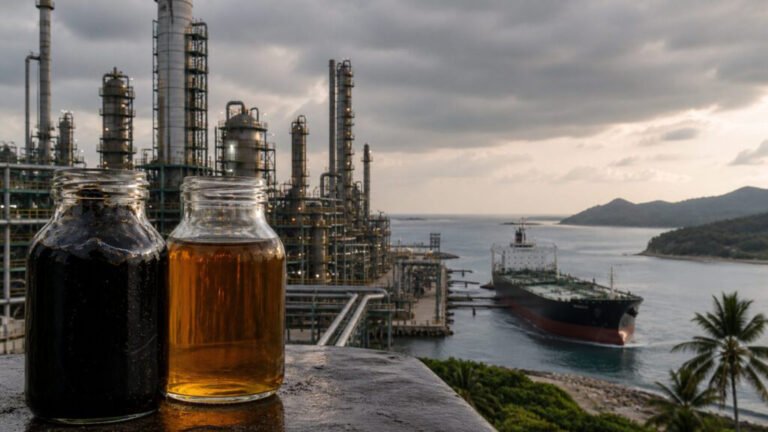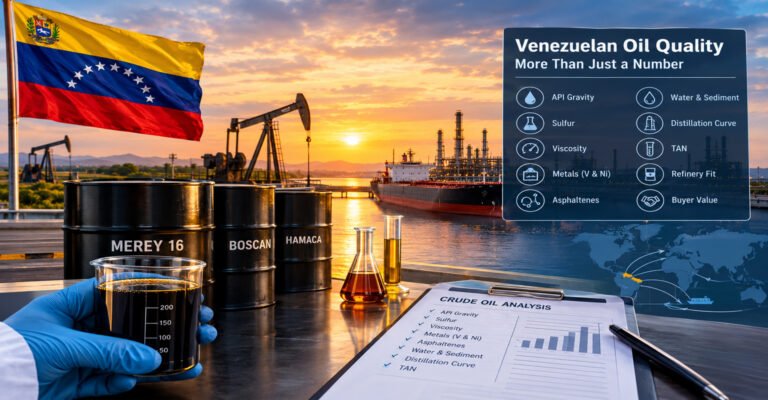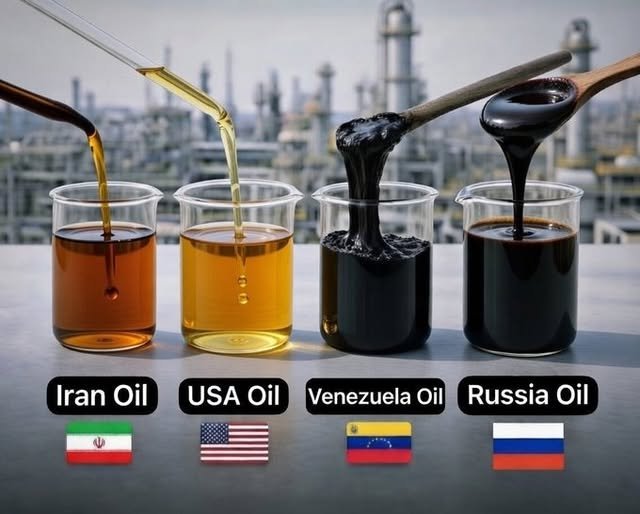
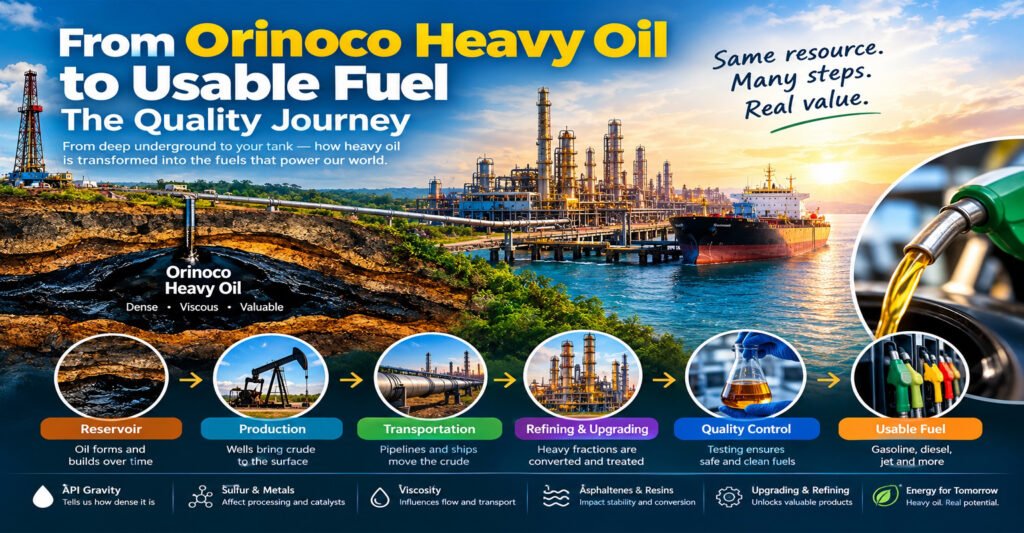
Orinoco Heavy Oil is one of the world’s most important examples of how the quality of crude oil can shape the entire energy chain. It begins deep underground as a very heavy petroleum resource, but the material that comes out of a reservoir is not ready to become gasoline, diesel, jet fuel, or other finished products. Before it can reach consumers, it may need to be produced with specialized equipment, mixed with lighter hydrocarbons, moved through pipelines, upgraded or processed, separated in a refinery, treated to remove unwanted compounds, and converted into products that meet quality requirements.
The size of the Orinoco resource makes this journey especially important. The U.S. Geological Survey estimated that the Orinoco Oil Belt contains more than 1 trillion barrels of heavy oil in place. Its assessment estimated a mean of about 513 billion barrels of technically recoverable heavy oil, with a range of 380 to 652 billion barrels. These figures describe a geological and technical resource assessment, not the amount of oil that can simply be produced and sold immediately. Production depends on wells, reservoirs, infrastructure, technology, investment, processing capacity, transportation, and market conditions.
The quality of Orinoco Heavy Oil is at the center of this challenge. Heavy crude has different physical and chemical properties from light crude. Its low API gravity means greater density. Its high viscosity can make it difficult to move. Its sulfur and metal content can create additional refinery requirements. Heavy fractions such as resins and asphaltenes can influence stability, flow, conversion, and product yields. These characteristics do not make the resource unusable. They mean that the resource needs a different path from reservoir to refinery.
Understanding that path helps explain why a barrel of crude oil should never be viewed as just a barrel. The number of barrels tells us how much petroleum exists or is produced. The crude quality tells us what kind of work must be done to turn those barrels into useful products.
This article follows Orinoco Heavy Oil through that journey. It explains what makes the crude heavy, how scientists measure its quality, why viscosity and sulfur matter, how dilution works, why upgrading is important, what happens at the refinery, how crude quality affects fuel production, and why the final value of the oil depends on much more than its headline price.
What Is Orinoco Heavy Oil?
Orinoco Heavy Oil refers to the heavy and extra-heavy petroleum resources found in Venezuela’s Orinoco Oil Belt. The belt stretches across a large part of the East Venezuela Basin and is one of the world’s major heavy-oil accumulations.
Heavy oil is generally denser and more viscous than conventional light crude. Extra-heavy oil is at the extreme end of that spectrum. The USGS has described the Orinoco accumulation as an extraordinary heavy-oil resource, while older USGS work noted that the Orinoco heavy-oil belt represents the world’s largest extra-heavy oil accumulation on an in-place basis.
The important point is that “heavy” does not mean “bad.” It means the oil has properties that require different production and processing methods.
A refinery that is designed for light crude may not be able to process large amounts of extra-heavy oil efficiently. A refinery with delayed cokers, hydrotreaters, sulfur recovery, and other conversion equipment may be much better suited to it.
That is why crude quality is connected to refinery design.
The same barrel can have very different value depending on where it goes and what equipment is available there.
Why Orinoco Heavy Oil Is So Important
The importance of Orinoco Heavy Oil begins with its enormous resource base. Venezuela’s wider petroleum system includes both lighter and heavier crude streams, but the Orinoco Belt accounts for a major share of the country’s huge proved oil reserves.
The U.S. Energy Information Administration has reported that Venezuela had about 303 billion barrels of proved crude oil reserves in 2023, with most of those reserves consisting of extra-heavy crude from the Orinoco Belt. EIA also emphasizes that the country’s reserve size does not translate directly into production because many other factors affect the ability to bring oil to market.
This distinction is important for readers who see very large reserve numbers and assume that every barrel is equally easy to produce.
A light crude reservoir can sometimes deliver oil that flows relatively easily through production equipment and pipelines. Extra-heavy oil can require more support.
The Orinoco resource therefore represents both:
- A huge petroleum endowment
- A technically demanding crude stream
Those two facts need to be understood together.
The Quality Journey Starts Underground
The quality journey for Orinoco Heavy Oil begins before the oil reaches a wellhead.
Petroleum forms through geological processes that can take millions of years. Organic material is buried, heated, transformed, and stored within geological formations. The final crude is influenced by the original source material, temperature, pressure, migration, reservoir conditions, water contact, and later alteration.
This means crude oil carries a record of its geological history.
In the Orinoco Belt, studies of crude samples have found strong evidence of biodegradation. A Venezuelan geochemical study of Orinoco crude reported heavy and extra-heavy samples with substantial heavy fractions, sulfur levels of about 1.2% to 5% in the studied samples, and evidence that biodegradation played an important role in altering the petroleum.
Biodegradation occurs when microorganisms alter or consume certain hydrocarbon compounds. The process does not simply “destroy” the oil. Instead, it changes the balance of compounds that remain.
Some lighter hydrocarbons can be preferentially affected, leaving a petroleum mixture richer in heavier components.
The result can be:
- Lower API gravity
- Higher viscosity
- More heavy fractions
- More complex processing behavior
This geological history helps explain why Orinoco Heavy Oil has properties that differ from many light crude oils.
What Makes Orinoco Heavy Oil Heavy?
The word “heavy” mainly describes density, but density is connected to the crude’s molecular composition.
Heavy crude contains a larger share of high-molecular-weight compounds. These compounds contribute to the oil’s density and viscosity.
API gravity provides a convenient way to express density. The API number becomes lower as petroleum becomes denser.
The USGS explains that API gravity is calculated from specific gravity and is widely used because density is an indicator of how crude may behave during distillation and refining.
For Orinoco Heavy Oil, low API gravity is one of the clearest signs that the crude contains a substantial heavy fraction.
But API gravity alone cannot tell the entire story.
Two crude oils with similar API gravity can behave differently in a refinery because their sulfur, metals, SARA composition, nitrogen, viscosity, distillation profile, and other properties may differ.
That is why a refinery needs a complete crude assay.
Orinoco Heavy Oil and API Gravity
API gravity is one of the first numbers an engineer may examine when evaluating Orinoco Heavy Oil.
The basic idea is simple:
Higher API gravity generally means lighter crude.
Lower API gravity generally means heavier crude.
The API scale is not a direct percentage of light or heavy molecules. It is a density-related scale.
A crude around 30° API is much lighter than a crude around 10° API. Extra-heavy oils can have very low API values.
A Venezuelan geochemical study of Orinoco samples classified oils with API values between 10° and 16° as heavy and samples below 10° as extra-heavy. The study also found that heavy fractions made up a major part of the analyzed oils.
This is useful because it connects a simple number to a physical reality.
Low API gravity generally means the refinery receives a denser feedstock with a larger proportion of heavy material.
That can influence:
- Distillation yields
- Residue production
- Conversion requirements
- Hydrogen demand
- Catalyst requirements
- Transportation behavior
- Product quality
API gravity therefore serves as an important starting point, but it is only the beginning.
Orinoco Heavy Oil and Viscosity
If API gravity tells us how dense the oil is, viscosity tells us how easily it flows.
This is one of the biggest technical issues associated with Orinoco Heavy Oil.
Imagine pouring water and thick syrup from two containers. Water flows quickly. Syrup resists movement. Heavy crude can show a similar difference, although petroleum viscosity depends strongly on temperature and composition.
The USGS has noted that high viscosity is one of the central problems associated with heavy crude because it affects production, storage, transportation, and refining. The same source notes that pipeline transportation may require viscosity reduction through heating, dilution, or partial upgrading.
This is why the quality journey does not stop when oil reaches the surface.
The crude must still be moved.
For a light crude, gravity and pumping systems may be enough for much of the journey. For very heavy crude, operators may need to change the crude’s flow properties.
Temperature can make a major difference. Heating can lower viscosity and improve movement. Dilution can also lower viscosity by mixing the heavy crude with a lighter hydrocarbon.
The choice depends on the crude, infrastructure, economics, safety requirements, and destination.
Why Temperature Matters to Orinoco Heavy Oil
Temperature is a major part of the physical behavior of Orinoco Heavy Oil.
As heavy crude becomes warmer, its viscosity generally decreases. This can make it easier to produce and transport.
As it cools, the oil can become more difficult to move.
This does not mean that every Venezuelan pipeline simply needs to be heated. Different systems use different strategies. Some rely on dilution, some on heating, some on blending, and some on a combination of methods.
Temperature also matters inside refineries. Refinery units operate within carefully controlled ranges because temperature affects vaporization, reaction rates, separation, and product quality.
For heavy crude, controlling temperature can help operators manage the feedstock from the first stages of handling through the refinery.
This is another reason crude quality is a system-wide issue.
Orinoco Heavy Oil and Sulfur
Sulfur is one of the most important chemical properties of Orinoco Heavy Oil.
Sulfur occurs naturally in crude petroleum. Its concentration varies from one crude stream to another.
Crude with higher sulfur content is often called sour crude, while lower-sulfur crude is commonly called sweet crude.
Orinoco heavy crude can contain substantial sulfur.
The Venezuelan Orinoco geochemistry study cited earlier found sulfur concentrations of about 1.2% to 5% in its analyzed samples.
Market grades can have their own specifications. For example, S&P Global reported that Merey 16, a major Venezuelan export crude, has a typical API gravity of 16 degrees and sulfur content of 3.4%.
These figures show why crude quality needs to be discussed grade by grade.
They should not be interpreted as a single sulfur value for every barrel produced in Venezuela.
Why Sulfur Matters in Refining
Sulfur matters because finished fuels have sulfur specifications.
A refinery may need to use hydrotreating and other processes to reduce sulfur in products.
Hydrotreating uses hydrogen and catalysts to remove sulfur and other unwanted components from petroleum fractions. The resulting hydrogen sulfide can then be managed in refinery sulfur-recovery systems.
For Orinoco Heavy Oil, higher sulfur can increase the importance of these processes.
The crude itself does not have to meet the same sulfur specification as gasoline or diesel. Instead, the refinery must convert the crude into products that meet their required specifications.
This creates a chain:
Crude quality affects refinery processing.
Refinery processing affects product quality.
Product quality affects whether the fuel can enter a particular market.
This is why sulfur is both a chemical property and a commercial issue.
Orinoco Heavy Oil and Metals
Heavy crude can contain metals such as vanadium and nickel.
These elements are especially important in the study of Orinoco Heavy Oil because they can occur in association with heavy petroleum fractions.
Metals can provide useful clues about petroleum history. Researchers often examine vanadium and nickel alongside sulfur, biomarkers, and other geochemical measurements.
But metals also matter inside a refinery.
Some metals can damage or deactivate catalysts used in refinery conversion and treating processes. Catalysts are valuable because they help chemical reactions occur efficiently, but their performance can be affected by contaminants in the feedstock.
A heavy crude with higher metal content may therefore require careful refinery planning.
The refinery does not simply ask, “How many barrels did we receive?”
It also asks:
- What is the API gravity?
- How much sulfur is present?
- How much vanadium is present?
- How much nickel is present?
- How much residue will remain?
- What is the viscosity?
- What is the distillation curve?
- How much conversion capacity is available?
These questions help turn a crude stream into a practical refinery plan.
Orinoco Heavy Oil and Asphaltenes
Asphaltenes are another key part of the quality story.
They are among the heaviest and most complex components in crude oil. They contain carbon and hydrogen along with smaller amounts of sulfur, nitrogen, oxygen, and metals.
High asphaltene levels can contribute to high viscosity and can affect crude stability and processing.
Studies of Venezuelan crude have shown wide differences in asphaltene content among samples.
One research study of Venezuelan crude samples reported asphaltene levels ranging from 1% to 22% among the selected oils. Such values are sample-specific, but they demonstrate how much crude composition can vary within Venezuela.
For Orinoco Heavy Oil, asphaltenes matter because they help explain why some streams are difficult to handle and why conversion processes become important.
Heavy molecules can be broken into smaller molecules through refinery conversion processes.
The goal is not simply to remove the heavy material.
The goal is to transform it into useful products.
SARA Analysis and Orinoco Heavy Oil
SARA analysis provides another way to understand Orinoco Heavy Oil.
SARA stands for:
- Saturates
- Aromatics
- Resins
- Asphaltenes
These four groups do not represent every individual chemical compound. Instead, they divide crude oil into broad chemical fractions that help researchers and engineers understand its behavior.
A Venezuelan study found that analyzed Orinoco crude samples had a strong dominance of heavy fractions, with resins plus asphaltenes accounting for more than 50% in the studied samples. Saturates were below 10%, while aromatics ranged from 20% to 48% in those samples.
These figures again apply to the studied samples rather than every barrel of Orinoco oil.
SARA is useful because it gives a deeper picture than API gravity alone.
A refinery may use SARA information to understand:
- Heavy fraction content
- Stability concerns
- Asphaltene behavior
- Conversion needs
- Potential residue formation
For Orinoco Heavy Oil, SARA analysis helps explain why the crude may require deeper conversion than a lighter feedstock.
Orinoco Heavy Oil and Distillation
Once crude reaches a refinery, one of the first major steps is separation by boiling range.
This process is called distillation.
Crude oil contains hydrocarbons with different boiling points. In a refinery distillation unit, crude is heated and separated into broad fractions.
These fractions can include lighter gases, naphtha, kerosene-range material, diesel-range material, gas oils, and heavier residue.
The exact product yields depend on the crude.
This is where Orinoco Heavy Oil presents a challenge.
A large share of its material can remain in the heavier fractions after atmospheric and vacuum distillation.
A refinery cannot simply distill all of that material into gasoline.
The heavy residue needs additional conversion.
This is one reason a heavy-crude refinery often requires more sophisticated equipment than a simple topping refinery.
Orinoco Heavy Oil and Refinery Complexity
Refinery complexity describes, in broad terms, how much a refinery can do beyond simple separation.
A basic refinery can separate crude into fractions.
A more complex refinery can convert heavy fractions into lighter products.
That may involve units such as:
- Fluid catalytic cracking
- Delayed coking
- Hydrocracking
- Hydrotreating
- Sulfur recovery
- Hydrogen production
- Alkylation
- Reforming
Not every refinery has all of these units.
The right configuration depends on the crude slate and the products the refinery wants to produce.
For Orinoco Heavy Oil, deep-conversion capacity can be especially important because the crude contains a large heavy fraction.
A refinery with suitable coking and treating units can convert more of that heavy material into usable products.
A refinery without enough conversion capacity may have to limit the amount of heavy crude it processes.
This creates a direct connection between crude quality and refinery economics.
Orinoco Heavy Oil and Coking
Coking is one of the most important refinery processes for heavy crude.
A delayed coker, for example, takes heavy residue and uses high temperatures to break large hydrocarbon molecules into smaller products.
The process also produces petroleum coke.
Coking is valuable because it allows a refinery to handle material that would otherwise remain as very heavy residue.
For Orinoco Heavy Oil, coking can therefore be a key part of the journey toward usable fuels.
But coking does not magically turn every molecule into gasoline or diesel.
The process creates a mixture of products that must then be treated and separated.
It can also create coke that has its own market and quality characteristics.
The refinery must therefore manage the complete product stream.
Orinoco Heavy Oil and Hydrocracking
Hydrocracking is another conversion process, although its role differs from coking.
Hydrocracking combines high pressure, hydrogen, heat, and catalysts to convert heavier hydrocarbons into lighter products.
It can be used to produce valuable middle distillates and other lighter streams.
Hydrogen is an important part of the process because it helps stabilize the molecules as they are converted.
For Orinoco Heavy Oil, hydrogen demand can become an important refinery consideration.
Heavy, high-sulfur feedstocks may require substantial hydrotreating and conversion.
That means the refinery needs not only crude capacity but also hydrogen, catalysts, sulfur management, utilities, and maintenance capacity.
The more difficult the crude, the more important the supporting systems become.
Orinoco Heavy Oil and Upgrading
Upgrading is different from ordinary refinery processing.
An upgrader is designed to change the properties of very heavy crude so that it becomes a more manageable synthetic or upgraded crude.
The purpose can include reducing density, lowering viscosity, changing the heavy fraction, and improving transport or refinery compatibility.
For Orinoco Heavy Oil, upgrading has historically been an important part of the petroleum system.
EIA has documented that extra-heavy crude from the Orinoco Belt requires dilution before it can be transported by pipeline to refineries or export terminals, while Venezuela has also operated upgraders that process extra-heavy crude.
Upgrading can therefore change the crude before it reaches a conventional refinery.
Instead of sending the raw extra-heavy material directly into a long-distance pipeline or refinery, an operator can alter its properties first.
That can make the oil easier to handle.
Orinoco Heavy Oil and Dilution
Dilution is one of the most important parts of the Orinoco Heavy Oil journey.
The basic idea is straightforward.
Very heavy crude is mixed with a lighter hydrocarbon so that the final blend flows more easily.
The lighter material can be condensate, naphtha, a lighter crude, or another suitable hydrocarbon stream.
The mixture has different physical properties from the original extra-heavy crude.
Dilution can reduce viscosity and improve pipeline flow.
EIA has reported that Venezuela has relied on condensates and other light hydrocarbons as diluents for Orinoco crude. EIA also reported that crude swaps involving Iran supplied condensates that could be used to dilute Venezuela’s extra-heavy crude for export.
This illustrates how one crude stream can depend on another.
The heavy oil may be abundant, but the lighter material needed to move it can become a separate supply issue.
Why Diluent Supply Matters
The need for diluent means the quality journey of Orinoco Heavy Oil does not exist in isolation.
A producer may have access to huge quantities of heavy crude but still face logistical limits if sufficient diluent is unavailable.
This creates an unusual situation.
A country can have a large oil resource but need to import or obtain another hydrocarbon stream to make part of that resource easier to transport.
Diluent supply can affect:
- Production rates
- Pipeline capacity
- Export readiness
- Blending economics
- Refinery feedstock
- Storage requirements
EIA’s analysis has specifically linked the availability of diluents with Venezuela’s ability to produce and export heavy crude grades.
This is an important lesson for anyone studying heavy oil.
The resource underground is only the beginning.
The surface system must also support it.
Orinoco Heavy Oil and Pipeline Transportation
Pipeline transportation is one of the most practical ways to move large volumes of crude, but heavy crude can make pipeline operations more difficult.
The main issue is flow.
Very viscous crude requires more pressure to move than lighter crude. If the crude is not sufficiently fluid, pumping becomes more difficult.
USGS research on heavy crude notes that transportation by pipeline may require viscosity reduction through heating, partial upgrading, or diluent use.
For Orinoco Heavy Oil, dilution has been especially important.
The crude is prepared so that it can travel from production areas toward storage, export terminals, and refineries.
Pipeline design also has to consider pressure, temperature, flow stability, pumping stations, maintenance, and the consequences of interruptions.
Heavy crude can create serious operational challenges if flow stops for long periods.
What Happens If Heavy Oil Stops Moving?
A useful example comes from EIA’s discussion of Venezuela’s 2019 power outages.
EIA reported that extra-heavy crude in the Orinoco Belt requires dilution before pipeline transport. It also noted that if Venezuelan crude or upgraded oil cannot flow because pumping infrastructure loses power, heavier molecules can sink and form a tar-like layer in pipelines, making it difficult to restart flow even after power returns.
This example shows that transportation is not simply a matter of putting oil into a pipe.
Flow conditions matter.
Power matters.
Temperature matters.
Crude composition matters.
Maintenance matters.
The quality of Orinoco Heavy Oil therefore affects infrastructure risk as well as refinery requirements.
Orinoco Heavy Oil and Storage
Storage tanks also have to deal with crude quality.
Heavy crude may behave differently from lighter crude during long storage periods.
Temperature, sediment, water, and heavy components can affect handling.
Operators need to understand how the crude behaves so that it can be safely moved from storage into pipelines, ships, or refinery units.
Blending can also take place around storage facilities, depending on the system.
This makes storage another part of the quality journey.
The barrel may not be chemically changing in a simple way, but the conditions around it can affect how easily it can be handled.
Orinoco Heavy Oil and Water
Crude coming from a reservoir can contain water.
Produced water can be separated from oil during surface processing.
Water is not a desired part of the final refinery feed because it adds handling requirements and can contribute to corrosion or operational problems.
For Orinoco Heavy Oil, water separation can be particularly important because heavy crude already presents difficult flow and handling conditions.
The crude may pass through separators, dehydrators, storage systems, and other treatment equipment before entering a pipeline or refinery.
The exact process depends on the field and facility.
The general goal is to prepare the crude so that its water and sediment content are within acceptable limits for transportation and refining.
Orinoco Heavy Oil and Salt
Salt is another quality issue.
Crude can contain dissolved salts and water that carry inorganic compounds.
If salt enters refinery equipment in significant quantities, it can contribute to corrosion and operational problems.
That is why refineries commonly use desalting systems.
A crude desalter uses water and electrical separation methods to remove salts and water from the crude before major refining operations.
For Orinoco Heavy Oil, desalting is part of preparing the feedstock for the refinery.
This step may appear simple compared with coking or hydrocracking, but it protects the equipment that performs those later operations.
The refinery therefore begins preparing the crude before it begins serious conversion.
Orinoco Heavy Oil and Nitrogen
Nitrogen compounds can also be present in crude oil.
Nitrogen becomes particularly important during catalytic processing because some nitrogen compounds can interfere with catalysts.
Heavy crude can contain more nitrogen than many lighter crude streams.
For Orinoco Heavy Oil, nitrogen is another reason a complete crude assay matters.
The refinery wants to know not only the amount of sulfur but also the amount and type of nitrogen compounds, especially when planning hydrotreating and conversion.
This helps determine hydrogen demand and catalyst requirements.
Orinoco Heavy Oil and Carbon Residue
Carbon residue measurements help estimate how much carbon-rich material may remain after certain thermal processes.
Heavy crude generally has more residue-forming material than light crude.
For Orinoco Heavy Oil, carbon residue can therefore help indicate how much heavy material may remain after distillation and how much conversion capacity may be required.
High residue is not a single measure of refinery performance.
It is one piece of a larger picture.
The refinery combines residue data with API gravity, sulfur, metals, SARA composition, distillation data, viscosity, and other properties.
Crude Assays Explain Orinoco Heavy Oil
A crude assay is one of the most useful tools for understanding Orinoco Heavy Oil.
A full assay can contain dozens or even hundreds of measurements.
Common information may include:
- API gravity
- Specific gravity
- Sulfur
- Nitrogen
- Metals
- Water
- Salt
- Viscosity
- Pour point
- Distillation curve
- SARA composition
- Carbon residue
- Gasoline-range yields
- Middle-distillate yields
- Vacuum residue
- Hydrogen content
The purpose is to understand how the crude behaves and what products it can produce.
A refinery buyer can use the assay to model expected yields and processing requirements.
The assay can also help compare different crude grades.
This is why crude quality information is valuable before the oil is purchased.
Reading an Orinoco Heavy Oil Crude Assay
A crude assay can look complicated, but its main purpose is practical.
The first numbers many people look at are API gravity and sulfur.
Then the refinery may examine the distillation curve.
The distillation curve shows how much crude boils within different temperature ranges.
Light material comes off at lower temperatures.
Heavy material remains until higher temperatures.
A crude with a large amount of material boiling at very high temperatures will generally need more conversion if the refinery wants to turn it into lighter products.
For Orinoco Heavy Oil, this heavy-end behavior is one of the main reasons conversion equipment matters.
Orinoco Heavy Oil and Product Yields
The value of crude is strongly linked to what products can be recovered from it.
A refinery wants valuable products such as:
- Gasoline components
- Diesel
- Jet fuel
- Naphtha
- LPG
- Petrochemical feedstocks
But not every crude naturally produces the same product mix.
A light crude may contain a larger share of naturally lighter fractions.
A heavy crude may contain more material that must first be converted.
For Orinoco Heavy Oil, the refinery may therefore rely more heavily on conversion processes to improve the yield of marketable products.
This is one reason heavy crude can be attractive to a refinery with the right equipment.
The refinery is not buying the crude only for what comes out of the first distillation column.
It is buying the potential to transform the crude.
Orinoco Heavy Oil and Gasoline
Gasoline does not simply come out of a crude barrel ready for a vehicle.
Refineries produce gasoline components through several processes.
Light naphtha and other fractions can be treated or reformed.
Heavier gas oils can be cracked into lighter molecules.
The resulting streams are blended to produce gasoline that meets required specifications.
For Orinoco Heavy Oil, gasoline production can depend strongly on refinery complexity.
A simple refinery may recover less gasoline from a heavy crude.
A complex refinery can convert more of the heavy material.
The final gasoline must also meet specifications for sulfur, octane, volatility, stability, and other properties.
This means crude quality influences gasoline indirectly through the refinery process.
Orinoco Heavy Oil and Diesel
Diesel is another important product.
Heavy crude can contain significant middle-distillate material, but additional conversion and treatment may be required to maximize diesel production and meet specifications.
Hydrotreating is especially important because sulfur must be reduced in many diesel markets.
For Orinoco Heavy Oil, the refinery may need significant hydrogen and treating capacity.
The crude’s sulfur, nitrogen, metals, and heavy fraction all affect how the refinery approaches diesel production.
The goal is not simply to make diesel.
The goal is to make diesel that meets the requirements of the intended market.
Orinoco Heavy Oil and Jet Fuel
Jet fuel requires tight quality control.
It needs suitable boiling characteristics, freezing-point performance, combustion properties, stability, and cleanliness.
A refinery processing Orinoco Heavy Oil may be able to produce jet-fuel-range material, but the crude must pass through the necessary separation and treatment stages.
This illustrates a broader point.
Crude oil does not determine the final product alone.
The refinery configuration, process conditions, blending, and product specifications all influence the final result.
Orinoco Heavy Oil and Fuel Quality
The journey from crude to fuel is therefore a chain of quality checks.
At the reservoir, engineers examine crude properties.
At the gathering system, operators manage water, sediment, temperature, and flow.
During transportation, the crude must remain within practical flow conditions.
At the refinery, desalting and distillation prepare the feedstock.
Conversion units change heavy molecules into lighter products.
Treating units remove sulfur and other unwanted components.
Blending creates final fuels.
Laboratories test the finished products.
This entire chain turns Orinoco Heavy Oil from a geological resource into usable energy.
Orinoco Heavy Oil and Refinery Compatibility
Not every refinery is equally suitable for every crude.
This is one of the most important commercial lessons in heavy oil.
A refinery’s equipment determines what it can process efficiently.
A refinery with substantial coking capacity may be better suited to very heavy crude.
A refinery with strong hydroprocessing capacity may be better positioned to handle high-sulfur feedstocks.
A refinery with limited conversion capacity may prefer lighter crude.
For Orinoco Heavy Oil, refinery compatibility can therefore affect the price a buyer is willing to pay.
Two buyers may value the same crude differently because their refineries have different capabilities.
This is why crude pricing involves quality differentials.
Orinoco Heavy Oil and Blending
Blending can change crude properties.
A heavy crude may be mixed with lighter crude or condensate to produce a blend with different density and viscosity.
The blend may be easier to transport or more suitable for a refinery.
However, blending is not simply a mathematical average.
Different crude components can interact.
Asphaltene stability can change.
Viscosity can change.
Sulfur concentration can change.
Distillation yields can change.
This is why professional crude blending often relies on laboratory testing and modeling.
For Orinoco Heavy Oil, blending can be an important tool for preparing an exportable crude grade.
Merey and the Commercial Side of Orinoco Heavy Oil
Merey is a useful example of how heavy Venezuelan crude is presented in the international market.
SGS lists Merey with an API gravity around 16.0 and sulfur around 2.65% in its crude terminal reference data.
S&P Global’s 2026 assessment described Merey 16 as typically around 16° API and 3.4% sulfur. The difference between published figures highlights an important point: crude specifications can vary by reference, assay, sample, and commercial specification. Buyers should use the applicable current assay rather than assume every published number represents every cargo.
This is exactly why crude assays matter.
A market name gives traders a useful identity.
The assay gives engineers the detail.
Orinoco Heavy Oil and Economic Value
The economic value of Orinoco Heavy Oil depends on more than the amount of oil underground.
The value chain includes:
Production
Gathering
Dilution
Transportation
Storage
Upgrading
Refining
Product treatment
Marketing
Each step adds cost or creates value.
If the crude is very heavy, production may require more investment.
If it needs diluent, the diluent has a cost.
If it requires long-distance transportation, freight matters.
If the destination refinery needs special equipment, the crude may trade at a discount relative to lighter crude.
If heavy-crude demand is strong among complex refineries, the same crude can become more attractive.
This is why the price of Orinoco Heavy Oil cannot be separated from its quality and logistics.
Orinoco Heavy Oil and Freight
Transportation economics can have a major impact on heavy crude.
Recent market reporting has highlighted how freight costs can influence Venezuelan crude economics. Reuters reported in September 2026 that rising shipping costs were pressuring traders’ margins on Venezuelan crude and affecting negotiations over discounts. The report also noted congestion and tanker waiting times as logistical challenges.
This is a current market example of a wider principle.
The value of a barrel at the production site is not the same as its value after transportation.
A buyer must consider:
- Ocean freight
- Port costs
- Pipeline costs
- Insurance
- Waiting time
- Diluent costs
- Refinery processing costs
- Product value
For Orinoco Heavy Oil, these costs can be especially important because heavy crude may already require special handling before it reaches a refinery.
Orinoco Heavy Oil and Infrastructure
Infrastructure is one of the hidden parts of crude quality.
A barrel can exist underground without a pipeline.
A pipeline can exist without enough pumping power.
A refinery can exist without the right conversion units.
A port can exist without enough loading capacity.
The energy chain works only when all of these parts connect.
This is particularly important for Orinoco Heavy Oil because the crude’s physical properties make infrastructure quality more important.
Pipelines need suitable flow conditions.
Upgraders need reliable operation.
Diluent supplies need to be available.
Refineries need compatible processing units.
Ports need to handle the required vessels and cargoes.
The quality of the crude therefore shapes infrastructure decisions.
Orinoco Heavy Oil and Power Reliability
Heavy-oil systems can be sensitive to interruptions.
EIA’s discussion of Venezuela’s 2019 power outages provides a clear example. The agency reported that power outages affected oil-producing areas and that Orinoco extra-heavy crude required dilution before pipeline transport. It also explained that stopped flow could allow heavier material to settle and create tar-like deposits that complicate restart operations.
The lesson is broader than one historical event.
Heavy crude systems need reliable electricity for:
- Pumps
- Heating
- Processing
- Water handling
- Upgrading
- Storage
- Control systems
A crude that is difficult to move becomes even more difficult when infrastructure stops unexpectedly.
Orinoco Heavy Oil and Upgrading Versus Dilution
Upgrading and dilution solve different problems.
Dilution adds a lighter hydrocarbon to the heavy crude.
Upgrading changes the crude through processing.
Dilution can be relatively simple compared with full upgrading, but it requires a supply of suitable light material.
Upgrading can create a better-quality crude stream, but it requires capital-intensive processing facilities, energy, maintenance, and operating expertise.
For Orinoco Heavy Oil, the choice between these approaches can depend on local infrastructure and market conditions.
In some situations, dilution may be the practical route to transportation.
In other situations, upgrading may create a crude that is more suitable for refinery customers.
Neither approach is universally better.
The correct answer depends on economics and the physical properties of the crude.
Orinoco Heavy Oil and Partial Upgrading
Partial upgrading sits between raw heavy crude and a more extensively upgraded product.
The goal is often to improve flow or reduce the burden on downstream facilities without converting every heavy molecule into finished fuel.
Possible benefits can include:
- Lower viscosity
- Higher API gravity
- Better transport properties
- Improved refinery compatibility
- Reduced need for diluent
But partial upgrading also consumes energy and capital.
For Orinoco Heavy Oil, the economic question is whether the value gained from improved crude quality is greater than the cost of upgrading.
Orinoco Heavy Oil and Full Refining
Refining is different from simply upgrading crude.
An upgrader focuses on changing the crude’s characteristics.
A refinery focuses on separating and converting hydrocarbons into marketable products.
A complex refinery can do both kinds of work across different stages.
For Orinoco Heavy Oil, the ideal refinery is one that can take advantage of the crude’s available hydrocarbons while managing its difficult components.
That often means:
- Distillation
- Vacuum distillation
- Coking
- Cracking
- Hydroprocessing
- Desulfurization
- Hydrogen management
- Sulfur recovery
The result is a collection of products rather than one upgraded liquid.
Orinoco Heavy Oil and Vacuum Distillation
After atmospheric distillation, some of the heaviest material remains.
Vacuum distillation can separate heavy fractions at lower effective boiling temperatures by reducing pressure.
This protects the process from excessive thermal cracking while allowing additional separation of heavy material.
For Orinoco Heavy Oil, vacuum distillation can help divide heavy residue into fractions that can be sent to different conversion units.
Some material may go toward catalytic cracking.
Other material may go to coking.
Still heavier material may remain as residue or become feed for specialized processes.
The refinery therefore keeps separating the barrel into streams that can be handled differently.
Orinoco Heavy Oil and Fluid Catalytic Cracking
Fluid catalytic cracking, commonly called FCC, converts heavier gas oils into lighter hydrocarbons.
It uses a catalyst and high temperature.
FCC can produce gasoline-range material, LPG, and other products.
However, the feed must be suitable for the unit.
Very heavy residue with high metals and carbon-forming tendency may be better handled through other conversion routes.
For Orinoco Heavy Oil, the refinery may therefore use a combination of processes rather than relying on FCC alone.
Orinoco Heavy Oil and Hydrogen
Hydrogen becomes increasingly important as refineries process heavier and higher-sulfur crude.
Hydrogen can be used to:
- Remove sulfur
- Remove nitrogen
- Saturate certain molecules
- Improve product quality
- Support hydrocracking
A refinery processing Orinoco Heavy Oil may therefore need significant hydrogen production and distribution capacity.
Hydrogen itself requires energy and equipment.
This adds another layer to the cost of refining heavy crude.
The quality of the crude influences not just the refinery units but also the utilities that support them.
Orinoco Heavy Oil and Sulfur Recovery
When sulfur is removed from refinery streams, it does not simply disappear.
Sulfur compounds are converted into forms that can be recovered and processed.
Sulfur recovery units can convert hydrogen sulfide into elemental sulfur.
This creates a useful product while helping the refinery meet environmental requirements.
For Orinoco Heavy Oil, sulfur recovery can be particularly important because the crude can contain substantial sulfur.
Again, crude quality affects the entire refinery system.
Orinoco Heavy Oil and Catalyst Management
Catalysts can be expensive and sensitive.
Heavy crude can contain metals and other contaminants that affect catalyst life.
For Orinoco Heavy Oil, refinery operators may need to manage catalyst activity carefully.
This can involve:
- Feed pretreatment
- Catalyst selection
- Operating temperature
- Hydrogen pressure
- Catalyst replacement
- Contaminant management
The cost of catalyst management becomes part of the cost of turning heavy crude into usable products.
Orinoco Heavy Oil and Fuel Standards
Finished fuels must meet the rules of the market where they are sold.
Gasoline and diesel can have limits for sulfur and other properties.
Jet fuel has its own strict requirements.
Marine fuels have different specifications.
Industrial fuels may have different standards again.
This means the same Orinoco Heavy Oil feedstock can be processed differently depending on the intended products and destination market.
A refinery in one country may optimize for gasoline.
Another may focus more heavily on diesel.
Another may have strong demand for marine fuel or petrochemical feedstocks.
Crude quality is therefore linked to the final market.
From Orinoco Heavy Oil to Gasoline
The journey from Orinoco Heavy Oil to gasoline involves several steps.
First, the crude is prepared and desalted.
Then it is separated through distillation.
Heavy fractions are sent to conversion units.
Conversion creates lighter hydrocarbon streams.
Those streams are treated to remove sulfur and other unwanted compounds.
Finally, gasoline components are blended to meet the required specification.
The finished product has little resemblance to the original crude.
That is the real meaning of refining.
The refinery is transforming a complex natural mixture into carefully controlled products.
From Orinoco Heavy Oil to Diesel
Diesel follows a similar but different path.
The refinery separates middle-distillate fractions.
Heavy gas oils can also be converted into additional middle distillates.
Hydrotreating removes sulfur and improves quality.
Blending then creates the final diesel product.
The crude’s sulfur, density, nitrogen, metals, and heavy fraction all influence the processing required.
This is why Orinoco Heavy Oil can require more refining work than a lighter crude.
From Orinoco Heavy Oil to Jet Fuel
Jet fuel must meet strict physical and chemical standards.
The refinery separates an appropriate boiling range.
The stream is treated.
The finished fuel is tested.
The goal is a clean, stable fuel that performs correctly across a wide range of temperatures and operating conditions.
The journey from Orinoco Heavy Oil to jet fuel therefore demonstrates the importance of refinery quality control.
The crude is only the starting material.
Orinoco Heavy Oil and Laboratory Testing
Laboratories play an important role throughout the quality journey.
Samples can be collected at:
- Wells
- Gathering facilities
- Storage tanks
- Pipelines
- Export terminals
- Refineries
- Product blending points
Laboratory testing helps confirm that the crude matches its expected characteristics.
A crude assay can also identify changes in a stream.
For example, unexpected changes in viscosity or water content may indicate a production or handling issue.
For Orinoco Heavy Oil, laboratory testing is especially important because small differences in composition can influence transport and refinery performance.
How Orinoco Heavy Oil Is Classified
Crude can be classified in several ways.
API gravity provides a broad density classification.
Sulfur content can indicate sweet or sour characteristics.
SARA analysis provides a chemical composition profile.
Viscosity describes flow resistance.
A complete assay provides a much broader picture.
The best classification therefore depends on the question.
If a pipeline operator asks whether the crude will flow, viscosity matters.
If a refinery asks how much heavy residue it will receive, distillation and residue data matter.
If a sulfur unit is being sized, sulfur content matters.
If catalysts are being evaluated, metals and nitrogen matter.
For Orinoco Heavy Oil, no single number tells the whole story.
Orinoco Heavy Oil Is Not One Uniform Grade
One of the most important points for readers is that Orinoco Heavy Oil should not be treated as one perfectly uniform crude.
The Orinoco Belt is a large geological area.
Different fields and production areas can produce crude with different properties.
Studies of Venezuelan petroleum have found variation in API gravity, sulfur, SARA composition, biomarkers, and metals.
That means a crude assay for one field should not automatically be applied to another.
This is also why commercial grades can have their own specifications.
A named crude grade may represent a particular blend designed for a particular market.
Orinoco Heavy Oil and Geological Variation
Geological variation begins with source material.
Different source rocks can produce petroleum with different chemical characteristics.
Thermal maturity also matters.
Migration and reservoir conditions can change petroleum.
Biodegradation can alter the lighter components.
Water contact can influence reservoir chemistry.
These factors help explain why crude from different areas can behave differently.
For Orinoco Heavy Oil, biodegradation is particularly important in understanding the heavy nature of many analyzed samples. The Venezuelan geochemical study cited earlier found evidence of selective biodegradation in the studied Orinoco oils.
Orinoco Heavy Oil and Biodegradation
Biodegradation deserves special attention because it helps connect geology with crude quality.
Microorganisms can use certain petroleum compounds as food.
The compounds are not all affected equally.
Some hydrocarbons are more resistant than others.
Over time, selective degradation can change the chemical balance of the oil.
In the Orinoco samples studied by Venezuelan researchers, n-alkanes and certain isoprenoids were absent from the analyzed samples, while biomarker patterns were used to assess the degree of biodegradation.
This provides scientific evidence that the heavy character of Orinoco crude is linked, at least in part, to geological alteration.
The process helps explain why the crude can contain a large proportion of heavy components.
Orinoco Heavy Oil and Reservoir Conditions
Reservoir conditions affect how oil behaves underground.
Temperature and pressure can be different from surface conditions.
Gas can be dissolved in crude at reservoir pressure.
When the oil reaches the surface, pressure changes can release gas.
Heavy oil can behave differently from light oil during this transition.
For Orinoco Heavy Oil, reservoir fluid properties influence artificial lift, production rates, water handling, and surface processing.
This is another reason that crude quality starts underground.
Orinoco Heavy Oil and Production Technology
Heavy oil production can require specialized technology.
The exact method depends on reservoir depth, temperature, permeability, oil viscosity, well design, and other conditions.
Some heavy-oil reservoirs can be produced using conventional methods with assistance.
Others may require thermal techniques.
Artificial lift can help move viscous crude toward the surface.
Surface facilities then separate oil, water, gas, and other materials.
The technology used at the field affects the quality and condition of the crude delivered to the next stage.
Orinoco Heavy Oil and Enhanced Recovery
Enhanced recovery methods are used when conventional production is not enough to achieve desired recovery.
Thermal methods can reduce viscosity.
Other methods can change pressure or fluid behavior.
The goal is to increase the amount of oil that can move toward producing wells.
For Orinoco Heavy Oil, viscosity is one of the key technical challenges that makes recovery methods important.
But technically recoverable resources should not be confused with guaranteed future production.
The USGS resource estimate is based on geological and engineering assumptions and recovery factors. It does not represent a forecast of actual future output.
Orinoco Heavy Oil and Resource Versus Reserves
This distinction deserves its own section.
A resource is not the same thing as proved reserves.
A geological resource describes petroleum that exists or may exist within an accumulation.
Technically recoverable resources represent oil that could be recovered using available technology under the assessment assumptions.
Proved reserves are a narrower commercial and technical category.
For Orinoco Heavy Oil, this distinction is especially important because very large geological volumes can exist while production remains limited by infrastructure, capital, technology, operating conditions, and market access.
Large reserves do not mean every barrel is ready to sell.
Orinoco Heavy Oil and Refinery Economics
A refinery evaluates crude based on expected value after processing.
Suppose one barrel of light crude produces a large amount of valuable light products with relatively modest processing.
Another barrel of Orinoco Heavy Oil may require more conversion, more hydrogen, more sulfur treatment, and more catalyst management.
The second barrel may therefore need to be purchased at a different price to make the refinery economics work.
This is why crude quality differentials exist.
The buyer is not simply comparing barrels.
The buyer is comparing expected refinery margins.
Orinoco Heavy Oil and Crude Discounts
Heavy crude often trades at a discount to lighter benchmark crude because of its processing characteristics.
But the size of that discount changes.
It can depend on refinery demand, available conversion capacity, freight, quality, storage, regional supply, and market conditions.
Current market conditions can also change quickly.
Reuters reported in September 2026 that higher freight costs were putting pressure on Venezuelan crude trading margins and that traders were seeking larger discounts for Venezuelan barrels.
This is a useful reminder that crude value is dynamic.
Quality is important, but quality is only one part of the price.
Orinoco Heavy Oil and Market Compatibility
A crude can be valuable when it fits the needs of a refinery.
Heavy crude has historically found demand among refineries designed to process heavy and sour feedstocks.
The refinery’s equipment creates the ability to extract value from difficult crude.
This means Orinoco Heavy Oil can be more valuable to one refinery than another.
A refinery with deep-conversion units may be able to turn heavy residue into valuable products.
A simple refinery may not.
The same crude therefore has different economic possibilities depending on where it goes.
Orinoco Heavy Oil and Export Preparation
Before heavy crude is exported, it must be prepared.
The process may include:
- Water removal
- Salt reduction
- Blending
- Dilution
- Storage
- Quality testing
- Terminal handling
The final export grade must match the commercial specification.
This is where the technical and commercial sides meet.
The crude must be physically transportable.
It must meet the buyer’s quality requirements.
It must be available in the required volume.
It must reach the buyer within acceptable cost.
Orinoco Heavy Oil and Marine Transportation
Once crude reaches an export terminal, it can be loaded onto tankers.
Marine transport introduces another set of costs.
The ship must be suitable for the cargo.
The port must be able to load it.
The voyage must be economically viable.
Freight rates can change.
Waiting times can change.
Weather and port conditions can affect schedules.
For Orinoco Heavy Oil, the total delivered cost therefore includes much more than the crude’s FOB value.
This helps explain why a barrel can become less profitable even when the crude’s headline market price has not changed significantly.
Orinoco Heavy Oil and Refinery Location
Location matters because crude has to travel from production to processing.
A refinery closer to the producing region can have lower transportation costs.
A refinery farther away may have stronger conversion capacity or better product markets.
A heavy crude may therefore travel long distances when the destination refinery has the right equipment and economics.
This is a key feature of the global oil market.
Crude does not necessarily go to the nearest refinery.
It often goes to the refinery that can create the most value after transportation and processing costs.
Orinoco Heavy Oil and the United States Gulf Coast
The U.S. Gulf Coast is historically important for processing heavy crude because the region has a large concentration of complex refineries.
That refinery configuration has helped create demand for heavy and sour crude grades.
Current market conditions can change trade flows, but the underlying refinery structure remains an important factor in understanding heavy crude markets.
For Orinoco Heavy Oil, access to complex refineries can be commercially important because those plants have equipment designed to process difficult feedstocks.
Orinoco Heavy Oil and the Human Side of Refining
It is easy to describe crude oil only through chemistry and engineering.
But every stage of the quality journey depends on people.
Geologists study reservoirs.
Petroleum engineers design wells.
Operators manage production facilities.
Laboratory scientists test samples.
Pipeline workers maintain pumping systems.
Refinery operators control complex units.
Marine crews transport crude.
Maintenance teams keep equipment running.
Environmental specialists monitor emissions and waste.
Commercial teams evaluate crude quality and market value.
The journey from Orinoco Heavy Oil to fuel is therefore a human industrial system.
Orinoco Heavy Oil and Environmental Management
Heavy oil production and refining also require environmental management.
Production can generate produced water, waste materials, emissions, and other environmental challenges.
Refineries produce emissions and require systems for wastewater, sulfur compounds, solid residues, and other streams.
Heavy crude processing can be energy-intensive because more conversion and treating may be required.
Environmental performance therefore needs to be evaluated across the complete chain.
For Orinoco Heavy Oil, environmental discussions should distinguish between the crude itself, the methods used to produce it, the energy used in upgrading and refining, and the final emissions from the fuels made from it.
These are related but different questions.
Orinoco Heavy Oil and Energy Use
Energy is consumed at many stages.
Pumps require electricity.
Heating requires energy.
Upgraders require energy.
Refineries require heat and power.
Hydrogen production requires energy.
Transportation requires fuel.
The more difficult the crude, the more important energy efficiency can become.
For Orinoco Heavy Oil, the energy required to move and process the crude is therefore part of its total production economics.
This does not mean that heavy crude is automatically uneconomic.
It means the energy and infrastructure requirements must be included in the calculation.
Orinoco Heavy Oil and Petroleum Coke
Coking can produce petroleum coke.
Petroleum coke is a carbon-rich solid material that can have industrial uses.
Its value depends on its quality and market.
Some coke can be used in industrial applications, while higher-quality grades can serve specialized industries.
For Orinoco Heavy Oil, petroleum coke can therefore become one of the products created when heavy residue is converted.
This demonstrates that refining is not simply about gasoline and diesel.
A complex refinery can create many different streams.
Orinoco Heavy Oil and Asphalt
Very heavy petroleum fractions can also be associated with asphalt and other heavy products.
The exact use depends on the properties of the residue.
Heavy crude therefore contains molecules that can contribute to products far beyond transportation fuels.
This is important when thinking about the phrase “usable fuel.”
Not every molecule in a crude barrel becomes fuel.
Some become petrochemical feedstocks.
Some become coke.
Some become asphalt-related products.
Some remain as heavy residue.
The refinery’s job is to assign each fraction to its most useful pathway.
Orinoco Heavy Oil and Petrochemicals
Petroleum is also a feedstock for the chemical industry.
Naphtha and other refinery streams can be used to make petrochemical feedstocks.
These can eventually become plastics, solvents, fibers, coatings, and many other materials.
For Orinoco Heavy Oil, the route to petrochemicals may be more complex than the route from a light crude, but heavy crude can still contribute to the broader petroleum value chain.
The key point is that crude oil is a raw material.
Its molecules can be separated and transformed into many products.
Orinoco Heavy Oil and the Meaning of “Usable Fuel”
The phrase “usable fuel” can sound simple.
But it represents a long chain of transformations.
Crude must first be produced.
Then it must be separated from water and other unwanted material.
It must be transported.
It must be diluted or upgraded when needed.
The refinery must separate its components.
Heavy fractions must be converted.
Sulfur and other contaminants must be reduced.
Fuel components must be blended.
Laboratories must test the final product.
Only then is the fuel ready for consumers.
This is why the journey of Orinoco Heavy Oil is really a journey from natural petroleum to controlled product quality.
Orinoco Heavy Oil and Quality Control
Quality control continues from the reservoir to the final fuel.
At the crude stage, laboratories measure properties.
At the refinery, operators monitor process conditions.
At the product stage, laboratories test fuel against specifications.
Quality control protects both the refinery and the consumer.
If crude properties change unexpectedly, the refinery may need to change operating conditions.
If a fuel does not meet specification, it may need additional treatment or blending.
For Orinoco Heavy Oil, quality control is particularly important because the crude can contain challenging heavy components.
Orinoco Heavy Oil and Blending Quality
Blending can be used at several points in the petroleum chain.
Heavy crude may be blended with lighter crude.
Different refinery streams may be blended into finished gasoline.
Different diesel streams may be blended to meet specifications.
Jet fuel streams may be combined and treated.
Every blend needs compatibility and quality control.
For Orinoco Heavy Oil, crude blending is especially important because dilution may be necessary for transportation.
The blend must remain stable.
The heavy components must remain manageable.
The final properties must match the target specification.
Orinoco Heavy Oil and the Importance of Accurate Data
Accurate crude data is essential.
A buyer cannot safely rely on a generic description such as “Venezuelan heavy oil.”
The buyer needs the actual grade and current assay.
This is because crude properties can vary.
The same country can produce light, medium, heavy, and extra-heavy oils.
Even a named grade can have specifications that vary between references or change as blending practices change.
Therefore, the most useful data comes from the applicable commercial assay and laboratory testing.
Orinoco Heavy Oil and Scientific Research
Scientific studies of Venezuelan petroleum have helped researchers understand its origin and behavior.
Researchers have examined:
- API gravity
- Sulfur
- Vanadium
- Nickel
- SARA composition
- Biomarkers
- Biodegradation
- Distillation properties
- Viscosity
These studies show that petroleum quality can reveal geological history.
They also help engineers design better production and processing systems.
For Orinoco Heavy Oil, the science is therefore directly connected to practical energy production.
Orinoco Heavy Oil and the Difference Between Quality and Value
Quality and value are related, but they are not identical.
A crude with low API gravity may be difficult to process.
But a refinery built for that crude may still value it highly.
A crude with high sulfur may require more treating.
But a refinery with strong sulfur-management systems may be able to process it efficiently.
A crude with high viscosity may require dilution.
But if diluent is cheap and available, the cost may be manageable.
Therefore, Orinoco Heavy Oil should not be judged by one quality number.
Its value depends on the entire system.
Orinoco Heavy Oil and Technology
Technology can change the economics of heavy crude.
Better drilling methods can improve production.
Better artificial lift can improve flow.
Improved upgrading can reduce viscosity.
Better catalysts can improve conversion.
Improved refinery controls can increase efficiency.
Better laboratory methods can improve crude characterization.
Technology therefore has the power to change how much value can be recovered from a heavy resource.
This is one reason the long-term story of Orinoco Heavy Oil cannot be understood only through today’s infrastructure.
Orinoco Heavy Oil and Investment
Investment is another major part of the quality journey.
Heavy oil requires infrastructure.
Infrastructure requires capital.
Upgraders require large facilities.
Refineries require complex equipment.
Pipelines require maintenance.
Ports require investment.
Reliable electricity requires infrastructure.
The size of the resource does not remove these requirements.
For Orinoco Heavy Oil, investment determines how much of the geological resource can be converted into actual production and usable products.
Orinoco Heavy Oil and Recovery Challenges
The difference between oil in place and oil recovered is important.
The USGS estimated more than 1 trillion barrels of heavy oil in place in the Orinoco assessment unit and a mean of 513 billion barrels of technically recoverable oil.
That difference exists because not every molecule underground can be produced.
Reservoir properties limit recovery.
Technology limits recovery.
Economics limit recovery.
Surface infrastructure limits recovery.
Therefore, the journey from Orinoco Heavy Oil to usable fuel starts with the question of how much oil can actually be produced.
Orinoco Heavy Oil and the Future of Refining
The future of heavy crude refining will depend on several factors.
Refinery configuration will remain important.
Fuel specifications may become stricter.
Energy efficiency will matter.
Hydrogen availability will matter.
Freight costs will matter.
Crude quality will matter.
Demand for gasoline, diesel, jet fuel, marine fuel, and petrochemical feedstocks will matter.
For Orinoco Heavy Oil, future value will depend on how these factors interact.
A heavy crude resource can remain commercially important when refineries are available that can convert it efficiently.
Orinoco Heavy Oil and Refinery Flexibility
Refinery flexibility can be a major advantage.
A flexible refinery can change its crude mix as market conditions change.
It may process different API gravities.
It may adjust sulfur-handling systems.
It may change the amount of heavy crude it accepts.
It may alter product yields.
For Orinoco Heavy Oil, refinery flexibility can determine whether a plant can respond to changes in crude availability and price.
Orinoco Heavy Oil and Crude Selection
Refineries often select crude based on expected margins.
The decision includes:
- Crude purchase price
- Quality
- Freight
- Refinery configuration
- Expected product yields
- Product prices
- Processing costs
- Maintenance requirements
This means the cheapest barrel is not always the most attractive barrel for a refinery.
A more expensive crude can create more value if it produces a better product mix in the refinery.
For Orinoco Heavy Oil, the key is therefore not simply “Is heavy crude cheap?”
The better question is:
Can the refinery turn this heavy crude into valuable products at an acceptable total cost?
Orinoco Heavy Oil and the Quality Journey in Simple Terms
The complete journey can be summarized as a chain:
- Oil forms and changes underground.
- Heavy crude accumulates in the reservoir.
- Wells bring the crude to the surface.
- Water and other unwanted material are separated.
- The crude is tested.
- Diluent or upgrading may improve flow.
- Pipelines move the crude.
- Storage and terminals prepare it for shipment.
- Refineries desalinate and distill it.
- Heavy fractions enter conversion units.
- Sulfur and other contaminants are removed.
- Product streams are blended.
- Finished fuels are tested.
- Consumers receive usable energy products.
Each step responds to the quality of the original crude.
That is the central idea of this article.
What Orinoco Heavy Oil Carries Beyond the Barrel
A barrel of Orinoco Heavy Oil carries much more than hydrocarbons.
It carries geological history.
It carries information about biodegradation.
It carries sulfur.
It can carry vanadium and nickel.
It contains heavy fractions.
It can contain substantial resins and asphaltenes.
It carries a viscosity challenge.
It carries a transportation requirement.
It carries refinery requirements.
It carries economic costs.
It carries the potential to become fuel and other useful products.
That is why crude quality matters.
Frequently Asked Questions About Orinoco Heavy Oil
What is Orinoco Heavy Oil?
Orinoco Heavy Oil is the heavy and extra-heavy petroleum found in Venezuela’s Orinoco Oil Belt. The belt contains one of the world’s largest heavy-oil accumulations, with the USGS estimating more than 1 trillion barrels of heavy oil in place and a mean of 513 billion barrels of technically recoverable heavy oil in its assessment.
Why is Orinoco Heavy Oil so thick?
The oil is thick because it contains a large proportion of heavy hydrocarbon components. Geological alteration, including biodegradation, has also affected many Orinoco crude samples. These processes can reduce the lighter fraction and leave oil richer in heavy components.
Is Orinoco Heavy Oil the same as all Venezuelan crude?
No. Venezuela produces different crude types. Venezuelan petroleum studies show substantial variation in API gravity, sulfur, SARA composition, and other properties. The Orinoco Belt is especially associated with heavy and extra-heavy crude, but Venezuela’s wider petroleum system includes lighter grades as well.
Why does Orinoco Heavy Oil need dilution?
Very heavy crude can have high viscosity, making it difficult to transport through pipelines. Dilution adds lighter hydrocarbons such as condensate or lighter crude to reduce viscosity and improve flow. EIA has documented the use of diluents for Venezuela’s extra-heavy Orinoco crude.
What is API gravity?
API gravity is a petroleum density scale. Higher API values generally indicate lighter crude, while lower values indicate denser, heavier crude. API gravity is widely used in crude oil classification and refinery planning.
Why does sulfur matter in Orinoco Heavy Oil?
Sulfur matters because refineries need to remove sulfur from many finished fuels. Higher-sulfur crude can require more hydrotreating and sulfur-management capacity.
Does Orinoco Heavy Oil contain metals?
Yes. Venezuelan crude studies have identified metals including vanadium and nickel. These elements can provide geological information and can also affect refinery catalyst performance.
What are asphaltenes?
Asphaltenes are complex heavy components of crude oil. They can contribute to high viscosity and affect crude stability, transportation, and refining behavior.
Can Orinoco Heavy Oil become gasoline?
Yes. Heavy crude can be processed in complex refineries. Distillation separates the crude, while conversion units such as coking and catalytic cracking can transform heavier fractions into lighter hydrocarbons that can become gasoline components after further treatment and blending.
Can Orinoco Heavy Oil become diesel?
Yes. Heavy crude can produce diesel-range material through distillation and conversion. Additional hydrotreating may be required to remove sulfur and meet fuel specifications.
Can Orinoco Heavy Oil become jet fuel?
It can contribute to jet-fuel production when processed through a refinery capable of producing and treating suitable jet-fuel-range streams. The finished product must meet strict specifications.
Why can heavy crude sell for less than light crude?
Heavy crude can require more processing, more hydrogen, more conversion, more catalyst management, and more transportation support. Those costs can be reflected in the crude’s market differential.
Does a huge reserve mean Venezuela can immediately produce the same amount?
No. Resources and reserves are not the same as immediate production capacity. Infrastructure, wells, processing, transportation, investment, technology, and market access all affect actual output.
People Also Ask About Orinoco Heavy Oil
Why is Venezuela’s Orinoco oil so heavy?
The Orinoco resource contains very heavy petroleum, and geological processes such as biodegradation have altered many crude samples. The resulting oil contains a high proportion of heavy components and can have low API gravity and high viscosity.
How is heavy oil turned into usable fuel?
Heavy oil is produced, separated from water and other material, transported, and then processed in a refinery. Distillation separates fractions, while conversion units break heavy molecules into lighter products. Treating and blending then produce fuels that meet market specifications.
What makes Venezuelan crude different?
Much of Venezuela’s resource base consists of heavy and extra-heavy crude, especially in the Orinoco Belt. Venezuelan crude can also contain significant sulfur and heavy fractions, making refinery compatibility especially important.
Why does heavy oil need upgrading?
Upgrading can improve the physical and chemical properties of very heavy crude. It can reduce viscosity, increase API gravity, and make the crude easier to transport or refine.
What is the API gravity of Merey crude?
Published references vary by assay and specification. S&P Global reported a typical API gravity of about 16° for Merey 16, while SGS lists Merey around 16.0° API.
Is Orinoco oil the largest oil reserve in Venezuela?
The Orinoco Oil Belt contains the majority of Venezuela’s proved crude reserves by volume, according to EIA’s country analysis, and represents one of the world’s largest heavy-oil accumulations.
Is heavy oil harder to refine?
Generally, heavy oil can require more complex refining because it contains more high-boiling material and may contain higher levels of sulfur, metals, resins, and asphaltenes. Refineries with deep-conversion equipment are better equipped to handle such crude.
People Also Search For
Readers researching Orinoco Heavy Oil may also search for:
- Orinoco Oil Belt
- Orinoco heavy crude oil
- Venezuelan heavy crude oil
- Venezuela crude oil quality
- Venezuela oil API gravity
- Venezuela crude sulfur content
- Merey 16 crude oil
- Orinoco oil upgrading
- Orinoco crude oil dilution
- Venezuela heavy oil refinery
- Venezuela crude oil viscosity
- Venezuela oil reserves
- Venezuela extra heavy oil
- heavy oil upgrading process
- heavy crude oil refining
- heavy oil vs light oil
- crude oil API gravity
- crude oil sulfur content
- crude oil SARA analysis
- crude oil asphaltenes
- vanadium in crude oil
- nickel in crude oil
- heavy oil transportation
- heavy crude oil pipeline
- Orinoco oil production
- Venezuela crude assay
NLP Keywords for Orinoco Heavy Oil
Natural language around the topic includes several related terms that help explain the full subject without forcing repetitive wording:
- extra-heavy crude oil
- heavy crude oil
- Venezuelan crude oil
- Orinoco Oil Belt
- API gravity
- crude oil density
- crude oil viscosity
- sulfur content
- vanadium
- nickel
- asphaltenes
- resins
- SARA analysis
- crude assay
- crude oil upgrading
- crude oil dilution
- condensate
- refinery complexity
- delayed coking
- hydrocracking
- catalytic cracking
- hydrotreating
- sulfur recovery
- vacuum distillation
- crude oil blending
- heavy oil transportation
- refinery feedstock
- fuel quality
- gasoline production
- diesel production
- jet fuel production
- petroleum coke
- crude oil refining
- heavy oil production
- petroleum geology
- biodegradation
- oil reservoir
- crude oil specifications
These related terms help search engines understand the subject while also making the article more useful to readers.
Key Takeaways About Orinoco Heavy Oil
The journey from Orinoco Heavy Oil to usable fuel can be reduced to several important facts.
- Orinoco is one of the world’s major heavy-oil accumulations.
- The resource contains enormous volumes of heavy oil.
- Much of the crude has low API gravity.
- Heavy crude can have very high viscosity.
- Sulfur is an important quality factor.
- Vanadium and nickel can affect refinery catalysts.
- Resins and asphaltenes influence crude behavior.
- SARA analysis helps describe crude composition.
- Biodegradation has affected many Orinoco crude samples.
- Dilution can make extra-heavy crude easier to transport.
- Upgrading can improve crude properties.
- Distillation separates crude into boiling ranges.
- Coking can convert heavy residue into lighter products.
- Hydrotreating helps remove sulfur and other unwanted compounds.
- Refinery complexity affects the value of heavy crude.
- A crude assay is essential for understanding refinery behavior.
- The same crude can have different value at different refineries.
- Transportation costs can strongly affect final economics.
- Large resources do not automatically mean high production.
- Usable fuel is the result of many stages of processing and quality control.
Final Thoughts
Orinoco Heavy Oil shows why crude oil should never be viewed only as a number of barrels or a market price.
The oil begins as a geological resource formed and altered over very long periods of time. Its density, viscosity, sulfur, metals, resins, asphaltenes, and other properties create the technical conditions for everything that follows. The crude must be produced from the reservoir, separated, tested, moved, diluted or upgraded when necessary, and delivered to a refinery capable of handling its characteristics.
Inside the refinery, the story continues. Distillation separates the crude into fractions. Heavy streams move into conversion units. Coking, cracking, hydroprocessing, and other technologies transform molecules into more useful forms. Sulfur and other unwanted compounds are removed. Product streams are blended and tested. Only after all of these stages can the original heavy crude become fuels and other products that people can use.
That is the real quality journey.
The enormous resource potential of the Orinoco Oil Belt is important, but the physical quality of the crude is just as important for understanding how that potential can be used. The USGS resource assessment demonstrates the extraordinary scale of the accumulation, while Venezuelan petroleum research shows how complex its chemistry and geological history can be.
For anyone studying Venezuela’s petroleum sector, Orinoco Heavy Oil is therefore more than a description of dense crude. It is a case study in how geology, chemistry, engineering, infrastructure, refining, transportation, markets, and human expertise all connect.
A barrel begins underground.
Its value is created through the journey.