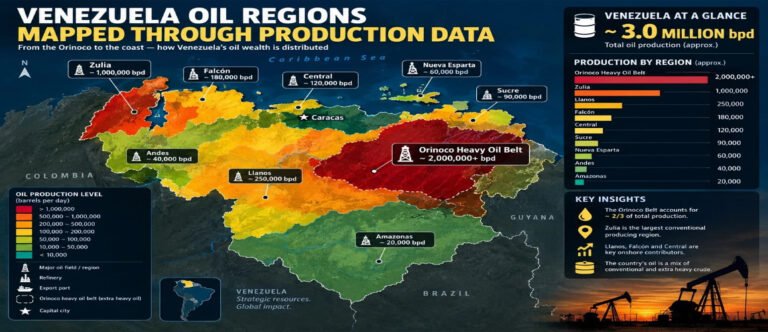

Venezuela oil production is entering a new stage. The country’s oil fields remain the foundation of the industry, but higher output depends on much more than the number of barrels coming from producing wells. Pipelines, storage facilities, refineries, electricity, oilfield services, skilled workers and export terminals all influence how much crude can actually reach the market.
Recent data show why Venezuela oil production is receiving renewed attention. Preliminary figures for May 2026 put crude production from PDVSA and foreign partners at about 1.155 million barrels per day, compared with 1.130 million barrels per day in April. Production from the Orinoco Belt reached about 650,000 barrels per day. Venezuelan crude exports reached 35.3 million barrels in May, compared with 32.6 million barrels in April and 22.1 million barrels in May 2025. The reported production figure excluded condensate. S&P Global’s May 2026 Venezuela oil report
These figures show stronger activity, but they do not answer every question about the future. A production increase is more meaningful when the infrastructure around it can handle additional barrels consistently.
That is why Venezuela oil production should now be viewed as part of a wider energy system. The well matters, but so do everything that happens after the crude reaches the surface.
Why Venezuela Oil Production Matters Again
Venezuela has a large oil resource base and an established petroleum industry. Its fields, pipelines, refineries, storage facilities and export terminals form a network that has supported crude production for decades.
The size of the resource, however, is not the same as current production. An oil field can contain substantial quantities of recoverable crude while producing far less than its potential because wells need work, pumps require repair, pipelines have operating limits or processing facilities are unavailable.
This difference is important when discussing Venezuela oil production. The market is not simply asking how much oil exists underground. It is asking how much crude can be produced reliably, moved efficiently and sold into a suitable market.
That makes infrastructure a central part of the story.
A field may have strong production potential but still face restrictions if its gathering system is limited. A pipeline may have theoretical capacity but move less crude because of maintenance problems. A refinery may have large nameplate capacity but process much less because some units are offline.
For this reason, the next stage of Venezuela oil production is likely to depend on how well the different parts of the energy system work together.
The Oil Well Is Only the Beginning of Venezuela Oil Production
A producing well is the first physical step in the oil supply chain, not the final one.
After crude reaches the surface, it normally enters a gathering system. It may then pass through separation or treatment facilities before moving through larger pipelines. From there, the crude needs a destination. It may go to a refinery, storage facility, blending operation or export terminal.
Every stage has a practical limit.
If gathering equipment cannot handle additional crude, nearby wells may not be able to increase output fully. If a pipeline is unavailable, crude may have difficulty reaching storage or export facilities. If storage tanks are full, operators have less flexibility when shipment schedules change.
This is why Venezuela oil production cannot be judged only at the wellhead.
A barrel has to move through several stages before it becomes an export or a refined petroleum product.
From the Reservoir to the Market
The basic oil chain can be understood in several steps:
- The reservoir contains the crude.
- Wells bring the crude to the surface.
- Gathering systems collect production.
- Processing facilities prepare the crude for transport.
- Pipelines move crude toward storage, refineries or terminals.
- Storage provides flexibility between production and shipping.
- Refineries convert crude into petroleum products.
- Export terminals connect crude with international buyers.
A weakness in any one of these links can affect the wider system.
Higher Venezuela oil production therefore creates additional requirements. More crude means more gathering capacity, more transportation, more storage and more attention to refining and export logistics.
The Orinoco Belt and Venezuela Oil Production

The Orinoco Belt is central to Venezuela oil production because of its large concentration of heavy and extra-heavy crude.
The region is important not only because of its resource base but also because of the infrastructure required to handle its crude. Production has to be gathered, processed, blended where necessary and transported toward refineries or export facilities.
The reported May 2026 Orinoco production level of about 650,000 barrels per day shows the importance of the region to national output.
The increase from the previous month also illustrates the practical side of Venezuela oil production. Additional crude from the Orinoco Belt places more demand on pumps, gathering systems, pipelines, storage facilities and blending operations.
Why Orinoco Output Matters
The Orinoco Belt provides a major source of potential production growth, but that growth depends on more than reservoir resources.
Heavy crude can require specific transportation and refining arrangements. The industry therefore needs suitable equipment and reliable infrastructure around the producing fields.
The long-term opportunity is substantial, but the practical task is to keep existing assets operating while adding capacity where it is needed.
That makes Orinoco production an important number to watch alongside national Venezuela oil production.
Heavy Crude Changes the Venezuela Oil Production Equation
Heavy crude has different transportation and refining requirements from lighter crude.
Its physical characteristics can affect how easily it moves through pipelines and how refineries process it. Blending with lighter material can improve transport characteristics, while refineries need suitable equipment to process heavier feedstocks efficiently.
This makes crude quality an important part of Venezuela oil production.
A production increase is commercially useful only when the resulting crude can move through the system and find a suitable market.
Why Refinery Configuration Matters
Refineries are designed to handle particular combinations of crude grades and products.
A refinery that can efficiently process heavy crude may be better suited to Venezuelan barrels than a refinery designed mainly around lighter feedstocks.
This means the destination of Venezuelan crude matters.
When Venezuela oil production rises, buyers need to consider not just the volume of crude available but also its quality and the processing requirements of their refineries.
Why Diluent Matters to Venezuela Oil Production
Diluent is an important consideration for heavy-oil production.
Extra-heavy crude can be difficult to transport in its raw form. Blending it with lighter material can improve its flow characteristics and make transportation more practical.
This means additional Venezuela oil production can create additional requirements for blending materials.
Those materials need to be sourced, transported and stored. Facilities also need to be available for blending before the crude moves into the wider transportation network.
A Surface Constraint Can Limit Field Output
A field can have sufficient oil underground and still face a surface-level constraint.
For example, wells may be capable of producing more crude, but the gathering system may not have enough capacity. The pipeline may be full, or storage may not have enough room for additional barrels.
This shows why production capacity is not determined only by the reservoir.
The entire surface system has to support the additional volume.
Existing Wells Can Support Venezuela Oil Production
New drilling is not the only way to increase Venezuela oil production.
Existing wells may provide additional output through workovers, pump repairs, artificial-lift improvements and surface equipment restoration. Some wells may be producing below their potential, while others may have stopped producing because of equipment problems.
Restoring an existing well can sometimes be faster than developing an entirely new project.
The opportunity varies from well to well. Some inactive wells may respond well to relatively targeted repairs, while others may require more investment than their expected production can justify.
Workovers and Well Restoration
Potential work can include:
- Well workovers
- Pump replacement
- Artificial-lift improvements
- Surface equipment repairs
- Electrical repairs
- Gathering-line connections
- Wellbore maintenance
- Restoration of selected inactive wells
The cumulative effect can become significant when similar work is carried out across a large production base.
For Venezuela oil production, this can provide a practical way to increase output while using infrastructure that already exists.
Mature Fields Still Matter to Venezuela Oil Production

Mature fields can continue contributing to Venezuela oil production when they are properly maintained and managed.
An older field does not automatically become unproductive. Reservoir conditions, artificial lift, well maintenance and operating practices all influence how long a field can remain productive.
For Venezuela, mature fields are important because they provide an existing industrial footprint.
Small Improvements Can Add Up
The opportunity may not come from one dramatic increase at a single well. Instead, it can come from many smaller improvements across a large group of wells.
Operators can improve production by repairing pumps, restoring inactive wells, improving surface equipment and reducing unplanned downtime.
Existing roads, gathering networks and processing facilities can also reduce the need for completely new infrastructure where those assets remain usable.
This makes mature fields an important part of the Venezuela oil production outlook.
Maintenance Is Part of Venezuela Oil Production
Maintenance is not separate from production. It is one of the conditions that allows production to continue.
A pump failure can stop a well. A valve problem can affect a pipeline. A compressor issue can reduce processing capacity. A refinery unit can remain offline until specialist maintenance is completed.
Each problem can reduce the amount of crude that the wider system can handle.
Why Equipment Reliability Matters
For Venezuela oil production, maintenance becomes increasingly important as activity increases.
More wells mean more pumps and surface equipment. More crude movement means more pipeline equipment. Higher refinery activity means more processing units need regular inspection and repair.
Effective maintenance can help:
- Reduce unplanned outages
- Extend equipment life
- Improve production stability
- Lower the risk of major failures
- Improve operating planning
- Protect existing production capacity
Maintenance also requires spare parts, technical workers, equipment and service companies.
As Venezuela oil production rises, the supporting maintenance system must grow with it.
Refining and Venezuela Oil Production
Crude production and refinery operations are closely connected, but they are not the same activity.
Oil fields produce crude. Refineries convert crude into finished petroleum products such as gasoline, diesel and jet fuel.
This creates an important connection between Venezuela oil production and the downstream energy system.
Higher crude output does not automatically mean more domestic fuel. The crude must reach a functioning refinery, the refinery must have available processing capacity and finished products must then move through storage and distribution networks.
Refinery Throughput Is a Separate Measure
A refinery can have significant nameplate capacity while processing much less crude.
Actual throughput can be affected by:
- Equipment condition
- Maintenance
- Power supply
- Crude availability
- Crude quality
- Operating performance
For this reason, refinery throughput should be tracked separately from Venezuela oil production.
The two numbers are connected, but they measure different parts of the energy system.
Domestic Fuel Supply Depends on Venezuela Oil Production and Refining
Domestic fuel supply depends on more than crude production.
Crude must first be processed.
Finished products then need to be stored and transported.
This creates a chain that includes crude production, refining, storage, transportation and fuel distribution.
Three Numbers That Should Stay Separate
When analyzing the Venezuelan energy system, it helps to distinguish:
- Crude production
- Refinery throughput
- Finished fuel availability
A rise in Venezuela oil production can support domestic fuel supply, but it cannot guarantee it.
Refinery operations and fuel distribution must also work effectively.
Export Infrastructure Supports Venezuela Oil Production
Export infrastructure determines how much crude can move from producing areas to international buyers.
Pipelines connect fields with storage and terminals. Storage provides a buffer between production and shipping. Export terminals load crude onto vessels for delivery to overseas refineries.
Each part needs to operate reliably.
Why Terminal Capacity Matters
A production increase can create additional pressure on export terminals.
More crude needs more storage and more loading capacity. Tanker schedules also need to align with crude availability.
If storage is limited, a shipping delay can create an operational problem for producing fields.
This makes export infrastructure part of the effective capacity of Venezuela oil production.
Exports Give Another View of Venezuela Oil Production
Production and exports are different measurements, but together they provide useful information about the oil system.
Production measures crude coming out of producing fields.
Exports measure crude shipped to international buyers.
The difference can reflect domestic refinery activity, inventory changes, blending and shipment timing.
The reported May 2026 export figure of 35.3 million barrels was higher than the April figure of 32.6 million barrels and the May 2025 figure of 22.1 million barrels.
Why Export Growth Matters
Strong exports show that Venezuelan crude is finding routes into international markets.
The United States and India were significant destinations in the May data.
However, exports should not be treated as identical to Venezuela oil production. Some crude can be processed domestically or placed into storage.
The two measures should therefore be considered together.
Why Refinery Demand Matters to Venezuela Oil Production
International refinery demand can influence the commercial prospects for Venezuelan crude.
Heavy crude is particularly linked to refineries capable of processing heavier feedstocks.
This means Venezuela oil production is connected to refinery economics outside the country as well as domestic production conditions.
Buyers Need Suitable Crude
Refiners consider crude quality, price, transportation costs, expected product yields and their own processing requirements.
A producer that adds more barrels therefore needs sufficient demand for those barrels.
If refineries want additional heavy crude, Venezuelan supply may have more opportunities to reach the market.
If refinery demand weakens, the commercial environment can change.
Oilfield Services Are Important to Venezuela Oil Production
Oil production requires a large supporting service industry.
Drilling contractors, well-service companies, equipment suppliers, inspection teams, engineering firms and maintenance specialists all contribute to field operations.
When Venezuela oil production rises, demand for these services can rise too.
Service Capacity Can Become a Bottleneck
Suppose operators want to repair hundreds of wells.
They need crews, pumps, equipment, spare parts and technical specialists.
If the service sector cannot provide those resources quickly enough, production growth can slow even when the underlying fields have potential.
This makes oilfield service activity an important supporting indicator for Venezuela oil production.
Skilled Workers Support Venezuela Oil Production
Equipment cannot operate an oil industry by itself.
Oil fields, pipelines, refineries and terminals require experienced workers with knowledge of specific systems.
Engineers monitor field performance. Mechanics maintain equipment. Electricians support power systems. Pipeline technicians inspect transportation networks. Refinery operators manage processing units.
Technical Knowledge Is Part of Capacity
For Venezuela oil production, skilled workers are part of productive capacity.
A shortage of experienced personnel can delay repairs, increase downtime and make large maintenance programs more difficult to execute.
Physical infrastructure and technical expertise therefore need to develop together.
Electricity Supports Venezuela Oil Production
Electricity is one of the less visible parts of the oil supply chain.
Pumps require power. Processing equipment requires power. Refineries require power. Storage and export facilities also use electrically powered systems.
A power interruption at an oil facility can therefore affect production even when the reservoir and well are operating normally.
Power Reliability Can Affect Field Output
The problem does not need to be a nationwide outage.
A disruption affecting one producing area can reduce output from that area.
Repeated interruptions can also increase equipment stress and maintenance requirements.
Reliable electricity can therefore support Venezuela oil production without directly adding new wells.
Natural Gas Has a Supporting Role in Venezuela Oil Production
Natural gas is another part of the wider energy system.
Oil fields can produce associated gas along with crude. That gas can be used for field operations, processing, power generation and other industrial activities.
As Venezuela oil production increases, gas handling can become more important.
More Oil Can Mean More Gas Handling Requirements
Additional crude output can bring additional associated gas volumes that need to be collected, processed or used.
A functioning gas system can support industrial energy demand and field operations.
This creates another connection between oil production and the wider energy network.
Pipelines Are Essential to Venezuela Oil Production
Pipelines are among the most important physical links in the Venezuelan oil system.
They move crude from producing areas toward processing facilities, storage sites and export terminals.
Pipeline capacity depends on more than the pipe itself.
Pumps, valves, electricity, inspection, monitoring and maintenance all affect reliability.
Pipeline Reliability Can Limit Production Growth
If production increases without enough transportation capacity, additional crude may not be able to move efficiently.
A pipeline failure can affect several connected facilities.
For Venezuela oil production, pipeline maintenance is therefore a central part of maintaining and expanding output.
Storage Gives Venezuela Oil Production More Flexibility
Storage provides a buffer between continuous production and changing market schedules.
Oil fields can produce every day.
Tankers arrive according to shipping schedules.
Refineries have changing feedstock requirements.
Maintenance can temporarily reduce processing capacity.
Storage helps manage these differences.
Why Storage Matters
Adequate storage can reduce the effect of short-term disruptions.
If a tanker is delayed, crude can remain in storage. If refinery demand changes, inventories can provide additional flexibility.
Storage does not directly increase Venezuela oil production, but it can make higher production easier to manage.
Production Is Not the Same as Capacity
Production is the amount of crude actually being produced.
Capacity refers to what the system may be able to produce under suitable operating conditions.
These terms should not be treated as interchangeable.
Why the Difference Matters
A field may have high theoretical capacity but lower actual output because of equipment problems.
A refinery may have large nameplate capacity but process less crude because some units are offline.
A pipeline may have a maximum flow rate but move less crude because of maintenance or operational restrictions.
For Venezuela oil production, this distinction is essential when discussing future targets.
Measured production should be separated from expectations about future capacity.
Production Is Not the Same as Exports
A second important distinction is between production and exports.
Crude can be produced and then sent to domestic refineries, storage facilities or export terminals.
As a result, exports can differ from production in any particular month.
Why Monthly Data Can Differ
Inventory changes can affect export volumes.
A rise in exports does not necessarily mean production rose by the same amount. Existing inventories may have contributed to shipments.
Likewise, a decline in exports does not automatically mean field production declined.
This is why Venezuela oil production should be analyzed alongside trade and inventory information.
The Role of International Buyers in Venezuela Oil Production
International buyers provide the commercial destination for exported crude.
For Venezuela, refinery demand in countries capable of processing heavy crude is particularly important.
The May 2026 data showed significant Venezuelan crude shipments to the United States and India.
Why Buyers Matter
Buyers provide demand.
Refineries provide processing capacity.
Shipping networks provide transportation.
Together, they determine how easily additional crude can move from Venezuelan fields into global markets.
If Venezuela oil production increases, international buyers will remain an important part of the next stage of the story.
What Could Slow Venezuela Oil Production?
Several factors could limit further growth.
Equipment shortages can delay well repairs. Pipeline problems can restrict crude movement. Limited storage can create operational pressure. Refinery outages can reduce domestic crude demand.
Power interruptions can affect field operations. A shortage of skilled workers can delay maintenance. Oilfield service constraints can slow drilling and workover programs.
International demand for heavy crude can also affect the commercial environment for additional barrels.
Potential Constraints to Watch
The main issues include:
- Equipment availability
- Pipeline reliability
- Storage capacity
- Refinery uptime
- Electricity reliability
- Skilled labor
- Oilfield service capacity
- Heavy-crude demand
- Maintenance requirements
These factors do not necessarily prevent growth.
They can, however, affect the pace, cost and reliability of additional production.
What Could Support Venezuela Oil Production?
Several factors could support continued growth.
Existing well repairs can add production without requiring entirely new fields. Pipeline maintenance can improve crude transportation. Storage improvements can provide more operating flexibility.
Refinery repairs can strengthen domestic crude demand and fuel availability. Oilfield service capacity can make maintenance and drilling programs easier to execute.
The Main Supporting Factors
Potential support can come from:
- Well workovers
- Pump repairs
- Pipeline maintenance
- Storage improvements
- Refinery repairs
- Oilfield service capacity
- Reliable electricity
- Better gas handling
- International refinery demand
These factors reinforce one another.
A well that produces more crude becomes more valuable when the pipeline can move that crude and a refinery or export terminal can receive it.
Why Existing Infrastructure Has Value to Venezuela Oil Production
Existing infrastructure can reduce the amount of new construction required to increase output.
A mature oil field may already have roads, gathering lines, processing equipment and pipeline connections.
If those assets can be repaired and maintained, operators may be able to add production without constructing an entirely new infrastructure network.
Restoration Can Be Faster Than New Construction
Existing assets are not automatically ready for higher volumes.
Equipment condition matters.
Pipeline integrity matters.
Storage capacity matters.
Processing capacity matters.
But where infrastructure remains usable, restoration can provide a practical path for Venezuela oil production growth.
The Importance of Capital Discipline in Venezuela Oil Production
Investment needs to match the production opportunity.
Not every well requires the same level of spending. Not every pipeline needs the same repair. Not every field will provide the same production response.
Operators therefore need to identify where spending can support reliable additional barrels.
Short-Term and Long-Term Investment
Short-term spending can restore existing production.
Long-term spending can create additional capacity.
A pump repair may affect production relatively quickly, while a new development can take years.
Both forms of investment can contribute to Venezuela oil production, but they solve different problems.
Why Oil Prices Still Matter to Venezuela Oil Production
Oil prices affect production economics.
Higher prices can make more expensive projects easier to justify. Lower prices can increase pressure to focus on lower-cost production and maintenance.
Heavy crude can also face different market pricing from lighter crude because refiners consider quality and processing requirements.
The Price of Oil Is Not the Whole Equation
Transportation costs, blending requirements, refinery demand and production costs all affect the economics of an additional barrel.
For Venezuela oil production, the commercial value of new output depends on the full cost and revenue chain.
Cost Matters as Venezuela Oil Production Moves Higher
The first barrels added during a recovery may come from relatively accessible opportunities.
Later barrels can require more expensive work.
Operators may need to repair more difficult wells, restore larger infrastructure systems or add processing capacity.
Incremental Barrels Can Cost More
The cost of the next barrel may be higher than the cost of maintaining existing production.
That distinction matters when evaluating long-term Venezuela oil production.
Production can continue rising, but the economic requirements may change as the industry moves into more difficult projects.
The Orinoco Opportunity Is Long Term
The Orinoco Belt provides a large long-term resource base.
However, developing that resource requires more than drilling.
Heavy crude needs suitable transportation.
Additional production needs pipelines.
Pipelines need storage and terminals.
Refineries need suitable crude-handling capacity.
All of these systems require investment and maintenance.
Infrastructure Will Shape the Long-Term Opportunity
The resource base provides potential.
Infrastructure determines how much of that potential can become commercial production.
This makes infrastructure development a central part of the long-term Venezuela oil production outlook.
Why Refining Could Change the Domestic Picture
Refinery improvements could influence the domestic role of Venezuela oil production.
If more crude can be processed reliably, more petroleum products can be produced domestically.
That can change the relationship between crude output and fuel availability.
Refinery Improvements Have Wider Effects
A refinery needs suitable crude, working equipment, electricity, maintenance and distribution systems.
Improving one part without the others may not produce the expected result.
For that reason, refinery performance should be considered alongside Venezuela oil production rather than separately from it.
How to Track Venezuela Oil Production
A practical monitoring system should combine production, trade and infrastructure data.
Important indicators include:
- Monthly crude production
- Orinoco Belt production
- Export volumes
- Major export destinations
- Refinery throughput
- Pipeline performance
- Storage levels
- Well workover activity
- Oilfield service activity
- Power reliability
- Maintenance activity
- Heavy-crude refinery demand
Why Several Indicators Are Better Than One
Production shows what is coming out of the fields.
Exports show what is reaching international buyers.
Refinery throughput shows how much crude is being processed.
Infrastructure indicators show whether the system can handle additional volumes.
Together, these measures provide a clearer picture of Venezuela oil production.
What the Next 12 Months Could Tell Us About Venezuela Oil Production
The next 12 months can provide important evidence about whether recent gains are becoming more consistent.
Monthly production should remain the first number to watch, but it should not be viewed alone.
If production rises while exports remain strong, more crude appears to be reaching the market.
If refinery throughput rises, more crude is being processed domestically.
If pipelines and storage systems remain reliable, infrastructure is keeping pace with field activity.
If oilfield service activity expands, operators may have more capacity to maintain wells and develop additional production.
Consistency Will Matter
One strong month is useful information.
Several months of stable or rising output provide more evidence of a sustained trend.
This is why Venezuela oil production should be monitored over time rather than judged from a single monthly figure.
A Higher Production Number Is Not Enough
A higher production figure is important, but it does not answer every question.
The quality of the crude matters.
The cost matters.
The reliability matters.
The destination matters.
The infrastructure behind the production matters.
Why the Whole System Matters
If Venezuela oil production rises but pipelines cannot move the additional crude, the commercial impact can be limited.
If production rises while refinery demand and exports remain weak, more pressure can fall on storage.
The strongest production growth is therefore growth that the wider system can absorb.
What Investors and Energy Analysts Should Watch
Anyone following Venezuela oil production should focus on relationships between different data points.
Production
Is monthly crude output continuing to rise, remain stable or decline?
Orinoco Output
Is the country’s major heavy-oil region contributing consistently?
Exports
Are additional barrels reaching international buyers?
Refining
Is refinery throughput improving alongside crude supply?
Infrastructure
Are pipelines, storage facilities and terminals handling higher volumes reliably?
Oilfield Services
Are equipment, crews and technical services available for additional work?
Electricity
Are power conditions supporting field and refinery operations?
Looking at these indicators together provides a more complete view than focusing on production alone.
The Wider Energy System Behind Venezuela Oil Production
The main change in the Venezuela oil production story is that the wider energy system is becoming just as important as the wells.
Oil fields provide the crude.
Infrastructure moves it.
Storage manages timing.
Refineries process it.
Export terminals connect it with international buyers.
Electricity supports equipment.
Natural gas supports industrial operations.
Workers keep facilities running.
Maintenance keeps assets available.
Capital provides the means to repair and expand them.
Every Part of the System Is Connected
A weakness in one part can reduce the value of improvements elsewhere.
More wells are less useful if pipelines cannot carry their crude.
More pipeline capacity is less useful if fields cannot produce enough oil.
More refinery capacity is less useful if crude supply is unreliable.
This is why the next phase of Venezuela oil production should be evaluated as a complete industrial system.
Venezuela Oil Production and the Global Heavy-Crude Market
Venezuela competes with other heavy-crude suppliers for refinery demand.
International refiners compare crude grades based on price, quality, transportation costs and expected refinery performance.
Refinery Demand Shapes the Market
If more Venezuelan barrels enter the market, refiners will evaluate them alongside other available crude grades.
The commercial outcome will depend on global supply and demand conditions.
This means Venezuela oil production cannot be considered entirely separate from the international heavy-crude market.
Why Trade Flows Are Worth Watching
Trade flows show where Venezuelan crude is going.
Changes in export destinations can reflect refinery demand, transportation economics and commercial conditions.
The May 2026 data showed significant Venezuelan crude shipments to the United States and India.
Export Destinations Provide Useful Signals
When production rises, analysts can watch whether additional crude is reaching established buyers or moving toward new destinations.
This can provide useful information about the commercial side of Venezuela oil production.
The Role of Technology in Venezuela Oil Production
Technology can improve production without requiring a completely new field.
Better reservoir monitoring can help operators understand field conditions.
Improved artificial-lift systems can support well performance.
Modern inspection methods can identify pipeline problems earlier.
Digital monitoring can help operators track equipment and production more closely.
Technology Works Best With Reliable Infrastructure
Technology cannot replace basic maintenance, skilled workers or functioning infrastructure.
Its value is greatest when operators have the people and equipment needed to use it effectively.
For Venezuela oil production, practical technology that reduces downtime or improves existing assets may be particularly useful.
Why Reliability May Become More Important Than Speed
Rapid production growth can attract attention, but reliability is more important for a long-term recovery.
A system that produces more barrels for one month and then loses output because of equipment failures is less stable than a system that grows gradually and maintains its output.
Reliable Supply Has Commercial Value
Refineries value predictable crude supply because refinery operations depend on steady feedstock planning.
Export terminals also benefit from predictable production because tanker schedules and storage management become easier.
For Venezuela oil production, consistent supply can therefore have value beyond the headline production number.
The Difference Between Recovery and Expansion
Recovery means restoring production that has been lost or left inactive.
Expansion means creating new production capacity beyond the existing base.
The distinction matters because the two require different levels of investment.
Recovery Can Come First
Existing wells can sometimes be restored with targeted work.
New fields require drilling programs, gathering systems, processing facilities, pipelines and additional export capacity.
The early stage of Venezuela oil production growth may therefore come from recovery, while longer-term growth may depend more on expansion.
Why the Timeline Matters for Venezuela Oil Production
Oil projects operate on different timelines.
A pump repair can affect output relatively quickly.
A well workover can take longer.
A new drilling program requires more planning.
A pipeline project can require substantial engineering and construction.
A refinery upgrade can take even longer.
Near-Term and Long-Term Changes
Some Venezuela oil production gains can appear within months.
Other gains may require years.
Separating these timelines helps analysts understand which improvements are already visible and which remain dependent on future investment.
What a Durable Venezuela Oil Production Recovery Would Look Like
A durable recovery would involve more than a higher production statistic.
Existing wells would remain online more consistently.
Maintenance would become more regular.
Pipelines would move crude reliably.
Storage would provide operating flexibility.
Refineries would process suitable feedstock consistently.
Export terminals would handle larger volumes.
Oilfield service companies would have enough equipment and workers.
Electricity would support industrial operations.
Gas systems would support field and processing activity.
International buyers would continue to provide demand.
Consistency Is the Key Test
A durable recovery is not simply about reaching a higher number.
It is about maintaining that number while the rest of the system continues to function.
That is the central issue for Venezuela oil production in the period ahead.
Frequently Asked Questions About Venezuela Oil Production
What Is Venezuela Oil Production in 2026?
Preliminary data for May 2026 put crude Venezuela oil production from PDVSA and foreign partners at about 1.155 million barrels per day. The figure was higher than the reported April level of 1.130 million barrels per day and excluded condensate.
Why Is the Orinoco Belt Important to Venezuela Oil Production?
The Orinoco Belt contains a major concentration of Venezuela’s heavy and extra-heavy crude resources. Its output therefore has a significant influence on national production. The region also requires supporting infrastructure for blending, transportation, processing and exports.
Can Venezuela Oil Production Increase Through Existing Wells?
Yes. Existing wells may provide additional output through workovers, pump repairs, artificial-lift improvements and surface equipment maintenance. The potential varies by well and depends on the condition of the surrounding infrastructure.
What Makes Venezuelan Crude Different?
Much of Venezuela’s crude is heavy or extra-heavy. Such crude can require specific transportation, blending and refining arrangements. This makes refinery configuration and logistics particularly important to the commercial value of Venezuela oil production.
Why Do Pipelines Matter to Venezuela Oil Production?
Pipelines connect producing areas with refineries, storage facilities and export terminals. If pipeline capacity or reliability is limited, additional crude may not be able to move efficiently even when wells can produce it.
Does Higher Venezuela Oil Production Automatically Mean More Domestic Fuel?
No. Crude must be processed in refineries before becoming finished fuel. Refinery capacity, maintenance, electricity, storage and fuel distribution all affect how much finished product reaches consumers.
What Is the Difference Between Venezuela Oil Production and Exports?
Venezuela oil production measures crude coming out of producing fields. Exports measure crude shipped to international buyers. The difference can include domestic refinery use, inventory changes and shipment timing.
What Could Slow Venezuela Oil Production?
Potential constraints include equipment shortages, pipeline problems, storage limits, refinery outages, power interruptions, limited skilled labor and insufficient oilfield service capacity. International demand for heavy crude can also affect the commercial environment.
What Could Support Venezuela Oil Production?
Well workovers, infrastructure repairs, refinery maintenance, stronger oilfield services, reliable electricity, improved gas handling and continued international refinery demand could all support higher output.
Is Venezuela Oil Production Growth Sustainable?
A single increase does not establish a long-term trend. Sustainable growth would require production to remain higher over time while pipelines, storage, refining, electricity, oilfield services and export infrastructure continue to operate reliably.
What Should Analysts Watch?
Analysts should follow monthly production, Orinoco Belt output, exports, refinery throughput, pipeline performance, storage, oilfield service activity, maintenance and power reliability. Looking at these measures together provides a more complete view of Venezuela oil production.
Venezuela oil production is moving into a stage where the wider energy system matters as much as the wells themselves.
The country has substantial heavy-oil resources and an established industrial base. Recent data show higher crude production and stronger exports, while the Orinoco Belt continues to provide a major share of output.
But additional barrels need somewhere to go.
They need gathering systems, pipelines, storage, blending, refineries and export terminals. Those facilities need electricity, maintenance, spare parts, technical workers and capital.
That is why the next stage of Venezuela oil production should not be measured only by how much crude comes out of the ground.
The stronger measure is whether the entire system can produce, move, process and sell that crude consistently.
The wells remain the foundation.
The wider energy system will determine how much that foundation can support.