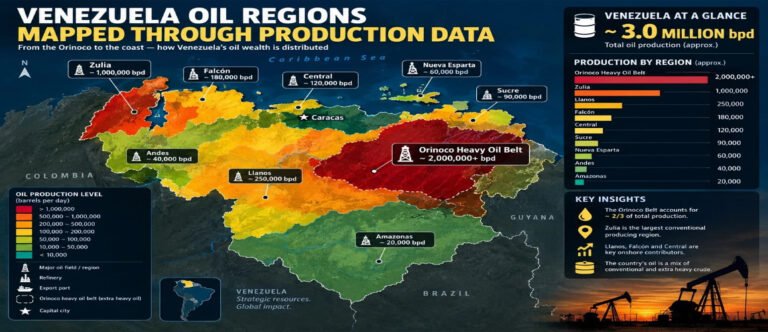

Mature Oil Field redevelopment is becoming one of the most important themes in Venezuela’s oil recovery story in 2026. Instead of depending only on new discoveries, operators are looking at old producing areas, existing wells, installed pipelines and processing systems that can be repaired or upgraded. Recent moves involving Eni, GeoPark, PDVSA and other companies show why older assets are attracting new attention as Venezuela tries to raise oil production and make better use of its large resource base.
The change matters because Venezuela does not simply need oil in the ground. It needs working wells, reliable power, gathering systems, upgraded processing equipment, storage, pipelines, drilling services and steady access to export markets. A field can contain billions of barrels and still produce far below its potential if wells are damaged, infrastructure is old or investment has been delayed.
That is why the Mature Oil Field story is closely tied to Venezuela oil production in 2026. The country has already seen production rise from earlier-year levels, while new contracts are putting more attention on fields that already have a long production history. S&P Global reported average Venezuelan crude production of about 1.155 million barrels per day in May, up from 1.13 million barrels per day in April. The same report said production had risen from about 940,000 barrels per day in January.
The latest developments suggest that the next stage may depend less on finding another giant discovery and more on recovering barrels from known fields.
Why Mature Oil Field Redevelopment Matters to Venezuela
A Mature Oil Field is not simply an old field.
In petroleum engineering, a field is generally considered mature after it has passed its main production peak and entered a period when production is declining or when the original development plan is largely complete. Older wells, higher water production, pressure changes and aging equipment can all become part of the challenge. The Society of Petroleum Engineers has described mature fields as assets where production has often peaked and moved into decline, while noting that existing wells and infrastructure can create redevelopment opportunities.
That definition is important for Venezuela.
Many Venezuelan oil areas have long histories of production. Some have existing wells and surface facilities, but years of limited investment have reduced their operating capacity. In such cases, the opportunity is not necessarily to start from zero.
Operators can examine what is already there.
They may find:
- Existing producing wells
- Shut-in wells that could be repaired
- Old wells suitable for workovers
- Existing gathering systems
- Processing equipment
- Storage tanks
- Pipelines
- Roads and field facilities
- Geological and production data
- Existing reservoir knowledge
- Remaining oil that has not yet been recovered
This can make a redevelopment project different from a greenfield project.
A new field may require major exploration spending before the operator even knows whether commercial oil exists. A Mature Oil Field already has a production history. Engineers can study old well records, pressure data, production trends and reservoir behavior before deciding where new capital should go.
That does not mean redevelopment is easy.
Old equipment can create major costs. Wells may have integrity problems. Reservoir information may be incomplete. Water production may be high. Heavy crude can require special handling. Power supply can be unreliable. Export logistics can also affect the value of each additional barrel.
For Venezuela, all of these issues are part of the same production equation.
Venezuela Oil Production Is Moving Toward Existing Assets
Venezuela entered 2026 with a large gap between its huge resource base and its actual production capacity.
That gap is one reason existing fields are receiving attention.
S&P Global reported that Venezuelan production averaged about 1.155 million barrels per day in May 2026, compared with 1.13 million barrels per day in April. It also reported that May exports reached 35.3 million barrels, up from 32.6 million barrels in April and 22.1 million barrels in May 2025.
Those figures show that production and exports have already moved higher.
But they also show why field redevelopment matters.
If Venezuela wants to keep increasing output, operators need projects that can add barrels without waiting many years for a completely new development cycle.
A redevelopment project can sometimes move faster because:
- The field is already known.
- Existing wells provide geological information.
- Roads and gathering systems may already exist.
- Some production equipment may still be usable.
- Reservoir pressure and decline data are available.
- Operators can identify wells with past production.
- Infrastructure can be repaired instead of built from scratch.
The actual speed will depend on field conditions and capital availability.
That distinction is important. A Mature Oil Field does not automatically mean cheap or fast oil. Some fields may require extensive work before production can rise.
What Is a Mature Oil Field and How Does It Differ From a New Development?
A common search question is what makes an oil field mature.
The answer is based more on the field’s development and production history than simply its age.
A field can be considered mature when it has moved beyond its main development stage and production has begun to decline. Some fields can remain productive for decades after reaching maturity.
The Society of Petroleum Engineers notes that mature fields may still contain significant remaining oil and can offer opportunities through reservoir management, infill drilling, improved recovery methods and facility upgrades.
A new field development usually involves a different sequence.
First, the operator evaluates the resource.
Then it designs wells, facilities and transportation systems.
After that, production is built up.
A Mature Oil Field already has much of that history.
That gives engineers something valuable: data.
Production records can show:
- Which wells produced the most oil
- How quickly individual wells declined
- Where water entered the system
- How reservoir pressure changed
- Which zones were productive
- Which wells stopped producing
- How surface equipment performed
- How the field responded to previous recovery programs
The data is not always complete, especially in old assets. But even incomplete historical information can help engineers build a better redevelopment plan.
Venezuela’s Mature Oil Field Opportunity Is Larger Than One Project
The current Venezuela story is not about a single field.
Several developments in 2026 point toward a wider brownfield and redevelopment trend.
One of the clearest examples is GeoPark’s entry into the Bare Block in the Orinoco Heavy Oil Belt. GeoPark describes Bare as a large-scale brownfield redevelopment opportunity with existing production, installed infrastructure and substantial remaining recovery potential. Its filing says the asset has about 15.7 billion barrels of original oil in place, more than 1,100 existing wells and current gross production of about 11,000 barrels per day.
GeoPark says the redevelopment plan is designed to increase production and raise the field’s recovery factor from roughly 4%–5% to a targeted 8%–9% range. The company also says the field previously reached production above 100,000 barrels per day.
Those numbers help explain why the Mature Oil Field model can be attractive.
The field has already demonstrated that it can produce at a much higher level.
The challenge is turning existing resource potential into reliable future production.
The Bare Block Shows What Brownfield Redevelopment Can Mean
The Bare Block is especially relevant because it combines several features that redevelopment investors look for.
It has:
- A long production history
- Existing wells
- Installed infrastructure
- Heavy oil resources
- Historical production data
- Remaining recovery potential
- An existing operating base
That does not remove risk.
But it changes the type of risk.
An exploration project asks whether commercial hydrocarbons will be found.
A brownfield redevelopment project asks how much of the remaining oil can be recovered economically and safely.
That can make reservoir management a central part of the investment case.
GeoPark said the Bare redevelopment plan includes increased investment, production acceleration, infrastructure rehabilitation and long-term reserves growth.
For Venezuela, this is important because it suggests that future production growth may come from several smaller improvements across established fields rather than from one massive new discovery.
Eni and Junín 5 Add Another Layer to the Story
Eni’s Junín 5 agreement is another major development in Venezuela’s 2026 oil sector.
On September 2, 2026, Eni and PDVSA signed a Production Participation Contract covering development of the Junín 5 field in the Orinoco Belt. The agreement gives Eni exclusive operatorship and responsibility for the field’s technical, financial and commercial management. The contract runs for 25 years, with a possible extension.
Eni says Junín 5 is a heavy oil field with 35 billion barrels of certified oil in place and current production of about 12,000 barrels per day.
Eni’s 2026 capital markets presentation gives an indication of the scale of the planned opportunity. It lists current Junín 5 production at about 12,000 barrels per day and a potential plateau of about 180,000 barrels per day, alongside about 2 billion barrels of total recoverable resources.
Those figures are company projections and should not be treated as guaranteed future production.
Still, they show how a large field can have a very wide gap between current output and a potential future development level.
That gap is exactly where redevelopment and field optimization become important.
Why Existing Wells Matter in a Mature Oil Field
One of the biggest advantages of an established field is its well inventory.
A well that is no longer producing does not always mean the reservoir beneath it is empty.
It may have stopped because of:
- Mechanical failure
- Pump problems
- Water production
- Pressure decline
- Damaged equipment
- Poor completion design
- Pipeline restrictions
- Power problems
- Economic limits
- Lack of maintenance
A workover can sometimes restore production.
In other cases, the well may need a new completion, artificial lift equipment or a different production strategy.
Engineers may also identify locations where new infill wells can drain oil that existing wells did not capture.
This is one reason a Mature Oil Field can become attractive when new technology and better data are available.
Workovers Could Be a Key Part of Venezuela Oil Growth
A workover is one of the more direct ways to improve an existing field.
Instead of drilling an entirely new well, an operator works on an existing well to restore or improve production.
The exact operation depends on the problem.
It could involve:
- Replacing artificial lift equipment
- Repairing downhole equipment
- Re-perforating a productive zone
- Removing restrictions
- Changing completion intervals
- Controlling unwanted water
- Restoring damaged equipment
- Testing another reservoir zone
Workovers are not automatically profitable.
The operator must compare the expected additional oil with the cost of the intervention.
For Venezuela, this calculation can be especially important because many fields have older wells and infrastructure.
If a low-cost intervention can return a well to production, it may provide a faster result than a large new drilling program.
But if the well has serious integrity problems or the reservoir has poor remaining productivity, the economics may not work.
Infill Drilling Could Unlock More Oil From Old Fields
Infill drilling is another common Mature Oil Field strategy.
The basic idea is simple.
Older fields were often developed using spacing and geological assumptions that can later change as engineers gain more data.
A new well may be drilled between existing wells to reach oil that was not efficiently drained.
Modern seismic interpretation, reservoir simulation and improved well placement can help identify these opportunities.
The Society of Petroleum Engineers has highlighted infill drilling, waterflooding, improved reservoir characterization and other methods as possible tools for mature-field redevelopment.
For Venezuela’s heavy oil assets, the value of infill drilling will depend on geology, viscosity, well performance, infrastructure and lifting costs.
It is not simply a matter of drilling more wells.
The goal is to drill the right wells.
Enhanced Oil Recovery Could Extend Mature Oil Field Life
Another question often connected with mature fields is whether enhanced oil recovery can increase production.
The answer is yes, but the right method depends on the reservoir.
Enhanced recovery can include several approaches.
Examples include:
- Water injection
- Gas injection
- Steam-based recovery
- Chemical injection
- Polymer flooding
- Other reservoir-pressure or sweep-improvement methods
The Society of Petroleum Engineers notes that mature-field redevelopment can involve improved oil recovery and enhanced oil recovery, depending on reservoir conditions and project economics.
Heavy crude adds another layer.
Venezuela’s Orinoco resources are dominated by heavy and extra-heavy oil. Such crude can require special production, transport and upgrading systems.
That means a redevelopment plan has to consider the full production chain.
Getting oil out of the reservoir is only the first step.
Why Heavy Crude Makes Venezuela’s Mature Fields Different
Venezuela has one of the world’s largest concentrations of heavy and extra-heavy crude resources.
The Orinoco Belt is central to this resource base.
Heavy crude is more difficult to produce and move than lighter oil in many situations.
It can require:
- Dilution
- Heating
- Specialized handling
- Upgrading
- Additional pumping capacity
- Suitable refinery capacity
This matters for Mature Oil Field redevelopment because production growth can create new surface bottlenecks.
Suppose an operator increases field output by 20,000 barrels per day.
The field now needs enough capacity to collect those barrels.
The processing system must handle them.
Pipelines must move them.
Storage must be available.
Export infrastructure must have room.
The refinery or buyer must be able to process the crude.
If any part of the chain cannot handle the extra volume, the field may not achieve its full production potential.
Infrastructure Could Decide How Fast Venezuela Adds Barrels
Infrastructure is one of the biggest issues in Venezuela’s oil recovery.
A Mature Oil Field often has infrastructure already in place, which is an advantage.
But old infrastructure can also become a major problem.
Pipelines can corrode.
Pumps can fail.
Power systems can become unreliable.
Storage tanks may require repair.
Processing units may need upgrades.
Water-handling systems can become overloaded.
The result is a strange situation.
A field may have plenty of oil underground but still struggle to increase sales.
That is why redevelopment plans increasingly focus on infrastructure as well as wells.
Venezuela’s Oil Production Recovery Depends on More Than Drilling
It is tempting to measure oil recovery only by the number of new wells drilled.
That would miss much of the Venezuelan challenge.
Production can increase through several channels.
For example:
- Restarting idle wells
- Repairing existing wells
- Drilling infill wells
- Improving artificial lift
- Replacing failed equipment
- Increasing water handling
- Repairing gathering systems
- Restoring power
- Improving field pressure management
- Expanding processing capacity
This makes the Mature Oil Field concept important to the national production story.
The largest gains may come from fixing existing bottlenecks before adding large amounts of new capacity.
Repsol Shows How Existing Assets Can Be Expanded
Repsol’s Petroquiriquire agreement provides another example of production growth through an established asset.
In April 2026, Repsol said it had reached an agreement with Venezuela’s government and PDVSA to reassume operational control at the Petroquiriquire oil asset and increase production. The company said it was prepared to raise gross production by 50% within 12 months and potentially triple it over three years, provided the required conditions remained in place.
These are company targets rather than guaranteed outcomes.
Still, the announcement highlights a wider point.
Venezuela does not need every production increase to come from a new field.
Existing joint ventures and established assets can also contribute if operators have the capital, equipment, operating control and commercial framework needed to improve them.
That is one of the strongest reasons to watch mature assets through the rest of 2026.
What Is Driving Interest in Venezuela’s Mature Fields?
Several factors are coming together.
First, Venezuela has a huge resource base.
Second, current production remains far below the country’s historical levels.
Third, many known fields already have infrastructure.
Fourth, companies are entering or expanding projects under new contractual structures.
Fifth, demand for heavy crude from suitable refineries remains relevant.
Sixth, international oil companies and independent producers can bring technical knowledge and capital.
Together, these factors create a new redevelopment discussion.
But the opportunity still depends on execution.
The Economics of Mature Oil Field Redevelopment
A redevelopment project is only useful if the economics work.
The basic question is not simply how much oil remains.
The more important question is how much of that oil can be produced at a cost that makes the project commercially viable.
Engineers and investors may examine:
- Expected production
- Remaining reserves
- Recovery factor
- Capital expenditure
- Operating costs
- Oil prices
- Transport costs
- Fiscal terms
- Taxes
- Royalties
- Infrastructure costs
- Financing costs
- Project duration
- Operational risks
A field with 10 billion barrels of oil in place may be less attractive than a smaller field if the smaller field has better infrastructure and lower production costs.
This is why original oil in place should not be confused with recoverable reserves.
Original Oil in Place Is Not the Same as Recoverable Oil
This distinction matters when reading Venezuela oil headlines.
Original oil in place, or OOIP, refers broadly to the oil that was originally present in a reservoir.
Only part of that oil can normally be recovered.
The recovery factor is the share of the original resource that can ultimately be produced under a given development plan.
A field with a low recovery factor may still have significant remaining potential.
GeoPark’s Bare Block announcement illustrates this idea. The company says the field has approximately 15.7 billion barrels of original oil in place and a redevelopment plan aimed at increasing the recovery factor from about 4%–5% to 8%–9%.
Even a few percentage points can represent a large amount of oil when the original resource base is very large.
But higher recovery requires money, technology and time.
Why Recovery Factor Matters for Venezuela
Recovery factor is one of the most important terms to understand when looking at Venezuela’s mature fields.
If an asset has already recovered a high share of its technically recoverable oil, future gains may be harder.
If the recovery factor is low, there may be more room for improved drilling and reservoir management.
However, a low recovery factor alone does not guarantee an attractive investment.
The remaining oil might be:
- Too deep
- Too viscous
- Too dispersed
- Too expensive to produce
- Difficult to transport
- Located beneath damaged infrastructure
- In zones with poor reservoir connectivity
The field must be evaluated as a complete system.
Venezuela’s Orinoco Belt Remains Central to the Redevelopment Story
The Orinoco Belt is likely to remain at the center of Venezuela’s oil development plans.
The region contains huge heavy oil resources and includes fields that have already been developed to varying degrees.
That makes it a natural area for redevelopment.
Junín 5 is one example.
Bare Block is another.
Other existing projects may also attract attention as operators evaluate production opportunities.
The main challenge is turning geological resources into steady commercial production.
That requires more than reserves.
It requires:
- Wells
- Pumps
- Roads
- Electricity
- Gathering systems
- Diluent
- Processing
- Storage
- Export routes
- Skilled workers
- Capital
- Stable contracts
The Role of Diluent in Heavy Oil Production
Heavy crude can create an unusual problem for Venezuela.
The oil may be valuable underground, but it can be difficult to move without treatment or blending.
Diluent can be used to lower viscosity and make heavy crude easier to transport.
This adds cost to production.
It also means a production increase can increase the need for diluent.
Venezuela has historically imported heavy naphtha for blending and transport requirements. That creates another link between field production and international supply chains.
So when analysts look at Mature Oil Field redevelopment in the Orinoco Belt, they should not focus only on well output.
They should also ask whether the field has access to the materials needed to move the crude.
Venezuela’s Mature Oil Field Growth Could Depend on Infrastructure Repair
Infrastructure rehabilitation may sound less exciting than drilling.
In practice, it can be just as important.
Imagine a field with 500 wells.
If only a fraction can operate because gathering lines are damaged, adding more wells may not solve the problem.
The operator may first need to repair:
- Flow lines
- Gathering stations
- Pumps
- Power systems
- Separation units
- Storage
- Water treatment
- Export pipelines
Once these systems work better, existing wells can become more productive.
This is one reason brownfield projects can create a different investment opportunity from greenfield exploration.
What Makes a Mature Oil Field Attractive to Investors?
Investors usually want evidence that additional capital can generate additional cash flow.
For a mature asset, that evidence can come from several sources.
A field may look attractive when it has:
- Existing production
- Large remaining resources
- A strong well database
- Working infrastructure
- Low-cost workover opportunities
- Clear infill drilling locations
- Stable legal terms
- Access to export markets
- Experienced operators
- A realistic development plan
The absence of these factors can increase risk.
That is why Venezuela’s new contractual framework and operating arrangements are important to the oil industry’s redevelopment plans.
Contract Structure Is Becoming Part of the Oil Recovery Story
The commercial structure under which an operator works can influence investment.
Companies need to know how capital will be recovered, how production will be shared and how revenues will be handled.
In Venezuela, 2026 has brought new contractual developments.
Eni’s Junín 5 agreement is structured under the Production Participation Contract framework. Eni said the arrangement replaces the previous Petrojunín operating model and gives it exclusive operatorship of Junín 5.
GeoPark’s Bare Block transaction also uses a Production Participation Contract framework with PDVSA.
These deals do not prove that every Venezuelan field will attract investment.
But they show that contractual structures are becoming a major part of the industry’s redevelopment story.
The New Investment Model Is Focused on Production
The current wave of interest is different from a simple exploration boom.
The focus is on production.
Companies want assets where they can see a path from investment to additional barrels.
That can favor brownfield projects.
A producing field can offer:
- Historical performance data
- Existing wells
- Known reservoirs
- Existing infrastructure
- Existing workers
- Existing supply chains
But it can also carry legacy problems.
That makes technical due diligence essential.
What Are the Main Risks in Mature Oil Field Redevelopment?
Redevelopment can be attractive, but it is not risk-free.
The major risks include:
- Reservoir uncertainty
- Well integrity problems
- Infrastructure failure
- Heavy oil handling costs
- Water production
- High capital requirements
- Service availability
- Financing constraints
- Regulatory uncertainty
- Export restrictions
- Oil price changes
- Security and logistics
- Delays in equipment delivery
Each project has its own risk profile.
A field with a large resource base can still struggle if capital cannot be deployed efficiently.
Well Integrity Is a Major Issue in Older Fields
Old wells require careful inspection.
A well can remain useful for decades, but aging equipment increases the need for maintenance and integrity management.
Operators may need to inspect:
- Casing
- Tubing
- Cement
- Wellheads
- Pumps
- Completion equipment
- Pressure systems
A well intervention plan must consider safety as well as production.
A production increase is not useful if it creates unacceptable operating risks.
This is why Mature Oil Field redevelopment requires a strong technical program rather than simply more drilling.
Water Production Can Limit Mature Field Growth
As fields age, water production often becomes a bigger part of the operating challenge.
Water can enter producing wells through several mechanisms.
High water production can:
- Reduce oil rates
- Increase lifting costs
- Increase treatment needs
- Use processing capacity
- Increase disposal requirements
Operators may use zonal isolation, workovers, conformance control or other reservoir-management techniques to manage the problem.
The best solution depends on the field.
For Venezuela’s old producing assets, understanding water behavior can be critical before spending heavily on new wells.
Artificial Lift Will Matter in Venezuela’s Mature Fields
Many mature oil wells need artificial lift.
As reservoir pressure declines, natural pressure may no longer be enough to bring oil to the surface at useful rates.
Artificial lift systems can help.
The choice depends on:
- Fluid properties
- Well depth
- Production rate
- Water cut
- Gas behavior
- Power availability
- Maintenance requirements
For heavy oil, artificial lift can become especially important.
But equipment needs reliable electricity and maintenance.
That brings the discussion back to infrastructure.
A pump cannot increase production if the field cannot provide reliable power or if spare parts are unavailable.
Technology Can Improve Mature Oil Field Decisions
Modern technology can help operators understand old reservoirs in new ways.
Reservoir modeling can combine historical production data with geological information.
New logging tools can help identify productive zones.
Seismic data can improve understanding of reservoir structure.
Digital monitoring can help track wells and equipment.
Data analysis can identify patterns that were missed in earlier development periods.
The Society of Petroleum Engineers has highlighted reservoir characterization, modeling, visualization and integrated reservoir management as important parts of mature-field revitalization.
For Venezuela, this could be particularly valuable because many fields have long production histories.
The challenge is turning those historical records into useful decisions.
Why Data Matters More Than Ever
An old field can contain thousands of data points.
Production rates.
Pressure records.
Water cuts.
Well tests.
Workover histories.
Completion records.
Injection data.
These records can help engineers identify where remaining oil may be located.
Data can also show which interventions worked before.
That reduces the chance of repeating unsuccessful approaches.
For a Mature Oil Field, the past is not simply history.
It can be a guide to future development.
Could Mature Oil Field Redevelopment Raise Venezuela Oil Production in 2026?
It could contribute, but the size and timing of the increase remain uncertain.
Venezuela’s production has already risen during 2026.
S&P Global reported 1.155 million barrels per day in May and noted that officials had previously discussed a target of 1.37 million barrels per day by the end of 2026.
The target should be treated as a stated objective, not a guaranteed result.
The actual outcome will depend on investment, field performance, infrastructure, operating conditions and market access.
The important point is that redevelopment can support production growth because it focuses on assets that already have wells and reservoir knowledge.
Venezuela Oil Growth Could Come From Many Small Improvements
Oil production does not always rise because of one giant project.
Sometimes it rises because many field problems are fixed at the same time.
One operator repairs 100 wells.
Another adds artificial lift.
Another expands water handling.
Another drills infill wells.
Another restores a gathering system.
Another increases production from an existing joint venture.
Together, these changes can add meaningful production.
This is one reason the Mature Oil Field theme deserves attention in Venezuela.
The country has a large number of established assets.
Even modest improvements across many fields could add up.
The Difference Between Production Capacity and Actual Production
Another important point is that field capacity is not the same as current output.
A field may have equipment designed to handle a much larger volume than it currently produces.
That can create an opportunity.
If a field has processing capacity of 100,000 barrels per day but produces only 30,000 barrels per day, an operator may not need to build a completely new facility to increase output.
It may need to restore wells and repair bottlenecks.
The gap between existing capacity and actual production can therefore become an important redevelopment target.
Why Brownfield Assets Can Be Faster Than Greenfield Projects
Brownfield development starts with something that greenfield development does not have.
A history.
Engineers can see how the reservoir behaved.
They can see what wells did.
They can see how infrastructure performed.
They can examine historical decline.
That does not eliminate uncertainty.
But it can reduce some forms of exploration risk.
GeoPark’s description of Bare highlights this point by emphasizing its existing wells, infrastructure, historical production and remaining recovery potential.
The company says Bare has more than 1,100 existing wells and a long production history.
That creates a large base of information for redevelopment planning.
Venezuela Oil Investment Is Moving Toward Brownfield Opportunities
The recent deals suggest that investors are looking closely at established assets.
GeoPark entered the Bare Block.
Eni became operator of Junín 5.
Repsol reached new conditions for increased production at Petroquiriquire.
Halliburton announced agreements with Eneva and WESCA related to oil and gas development projects in Venezuela. Reuters reported that the agreements were aimed at expanding production and improving infrastructure.
These developments involve different types of companies and assets.
But they share one theme.
Capital and technical expertise are moving toward existing Venezuelan production opportunities.
The Service Sector Could Benefit From Mature Field Redevelopment
Field redevelopment does not only create opportunities for operators.
It can also create work for oilfield service companies.
More redevelopment can increase demand for:
- Drilling services
- Well testing
- Workovers
- Artificial lift
- Logging
- Seismic services
- Pumps
- Flowline repair
- Pipeline services
- Maintenance
- Power systems
- Water treatment
- Heavy oil handling
That makes service capacity another part of Venezuela’s production recovery.
A field operator may have capital but still need experienced contractors and equipment.
If service capacity is limited, project schedules can slow.
Skilled Workers Will Be Important
A Mature Oil Field depends heavily on experienced workers.
Older assets often require people who understand:
- Reservoir behavior
- Old well designs
- Field equipment
- Production systems
- Heavy crude handling
- Maintenance
- Workover planning
New investment can bring international expertise.
But local knowledge remains valuable.
Workers who have spent years around a field may know which wells have recurring problems, which pipelines need attention and which production zones historically performed well.
A successful redevelopment program can therefore combine local experience with new technology.
Venezuela’s Heavy Oil Requires a Full Chain Approach
It is not enough to increase well production.
Heavy oil must be moved.
That means redevelopment planning needs to connect the reservoir to the final buyer.
The chain may include:
- Reservoir
- Production well
- Artificial lift
- Gathering system
- Separation
- Dilution or upgrading
- Storage
- Pipeline
- Export terminal
- Tanker
- Refinery
If one part of that chain becomes a bottleneck, production growth can lose value.
This is especially important because Venezuela’s oil trade has already faced shipping and port pressures in 2026.
Higher Freight Costs Could Affect Redevelopment Economics
Reuters reported in September that shipping costs for Venezuelan crude had risen sharply, with the cost of chartering an Aframax tanker from Venezuela to the U.S. Gulf Coast reaching about $3.5 million, compared with about $1.35 million earlier in 2026.
That matters for field economics.
An additional barrel is valuable only after transportation and other costs are considered.
If freight costs rise, the net value received by the producer can fall.
That can affect decisions about:
- New wells
- Workovers
- Production targets
- Export destinations
- Crude discounts
- Capital spending
So a redevelopment project must be evaluated using delivered economics, not only the headline crude price.
Venezuela Oil Exports Show Why Production and Trade Must Be Connected
Venezuela exported about 1.17 million barrels per day in August 2026, according to Reuters reporting based on documents and shipping data.
The export level was broadly stable despite changes in destination flows.
This is important for Mature Oil Field redevelopment because production growth eventually needs a market.
If new field output cannot be exported or sold efficiently, the value of the extra production falls.
That makes export infrastructure and tanker availability part of the redevelopment story.
Can Venezuela Export All the Oil It Produces?
Not necessarily at any given time.
Export capacity depends on:
- Port availability
- Tanker availability
- Loading capacity
- Storage
- Pipeline access
- Crude quality
- Buyer demand
- Freight costs
- Commercial terms
Reuters reported that port congestion and tanker waiting times were creating additional challenges for Venezuela’s export growth in September.
That means a production increase can create pressure elsewhere in the system.
The country needs the whole chain to grow together.
Mature Oil Field Redevelopment Could Reduce Decline
One of the simplest goals of redevelopment is not always to create a huge production increase.
Sometimes the goal is to slow decline.
Suppose a field is producing 100,000 barrels per day and naturally declining by 10% each year.
A redevelopment program that reduces the decline rate can preserve production that would otherwise disappear.
That can be valuable.
The operator does not necessarily need to double output.
It may need to protect existing barrels while adding new ones.
For Venezuela, this could be especially important across older producing areas.
What Happens When an Oil Field Is Left Without Investment?
The decline can spread beyond individual wells.
A lack of investment can affect:
- Wells
- Pumps
- Pipelines
- Processing units
- Power systems
- Storage
- Roads
- Water systems
- Maintenance
Eventually, a field can lose productive capacity even if large amounts of oil remain underground.
This is why redevelopment is more than a drilling program.
It is often a restoration program.
Venezuela’s Mature Fields Have a Long Production History
Venezuela has been an oil producer for more than a century.
Some fields have been producing for generations.
That history provides both an advantage and a challenge.
The advantage is extensive geological and production knowledge.
The challenge is aging infrastructure.
Some old fields may have multiple generations of wells, equipment and operating practices.
Redevelopment therefore requires careful asset mapping.
Engineers need to understand what is still useful and what needs replacement.
Lake Maracaibo Remains Important
The Orinoco Belt gets much of the current attention because of its huge heavy oil resources.
But Venezuela’s oil story also includes the Lake Maracaibo region.
The area has a long history of production and extensive infrastructure.
That makes it another possible focus for redevelopment.
Mature assets in older producing regions can offer opportunities for improved recovery if operators can restore infrastructure and improve field management.
The economics will vary by field.
The Orinoco Belt and Lake Maracaibo Offer Different Challenges
The Orinoco Belt is dominated by heavy and extra-heavy oil.
Lake Maracaibo has a long history of conventional oil production and extensive mature infrastructure.
Both regions can contain mature assets.
But the technical approach can differ.
An Orinoco redevelopment project may place greater emphasis on heavy oil handling, dilution, artificial lift and upgrading.
A Maracaibo project may focus more heavily on aging wells, water management, offshore or lake infrastructure and mature reservoir optimization.
This is why Venezuela should not be treated as one single oil field.
Each asset needs its own development plan.
Why Oil Price Still Matters to Mature Field Projects
A redevelopment project needs an economic margin.
Oil prices can change the value of that margin.
Higher prices can make more projects economic.
Lower prices can force operators to focus on lower-cost interventions.
But price is not the only variable.
Heavy crude may trade at a discount to lighter benchmarks.
Freight can change.
Diluent costs can change.
Service costs can change.
Taxes and fiscal terms can change.
The final project economics therefore depend on several moving parts.
What Is the Break-Even Point for a Mature Oil Field?
There is no single break-even price for every Mature Oil Field.
Each asset has its own cost structure.
A field with existing infrastructure may have a different break-even level from one requiring major reconstruction.
A heavy oil project may face different costs from a light oil project.
A field with many existing wells may have lower drilling needs but higher workover costs.
Investors therefore need field-level economic analysis.
A national oil price is not enough to determine whether a specific redevelopment project will succeed.
Existing Infrastructure Can Be Both an Asset and a Liability
Old infrastructure can reduce development costs.
But it can also increase maintenance costs.
That is one of the key contradictions in mature-field redevelopment.
Existing pipelines can save money compared with building new pipelines.
But if the pipeline needs major repair, that advantage may disappear.
Existing processing equipment can reduce construction time.
But old equipment may have lower reliability.
Existing wells can reduce drilling needs.
But they may require expensive workovers.
The value of a Mature Oil Field depends on how much of the existing system can be reused safely and economically.
What Technologies Could Help Venezuela’s Mature Oil Fields?
Several technologies could play a role.
Reservoir modeling can improve field planning.
Modern logging can identify bypassed zones.
Artificial lift can support declining wells.
Water management can improve oil recovery.
Infill drilling can reach undrained areas.
Improved completion designs can increase well performance.
Enhanced recovery can improve sweep in suitable reservoirs.
Digital monitoring can improve operating decisions.
The right combination depends on the reservoir.
There is no universal redevelopment technology.
Data-Driven Redevelopment Could Become More Important
Old fields have large amounts of historical data.
Modern software can combine that information more effectively.
Engineers can compare:
- Production trends
- Pressure
- Water cut
- Well performance
- Reservoir zones
- Completion history
- Workover results
This can help identify wells where a relatively small investment might produce a useful response.
The Society of Petroleum Engineers has emphasized integrated reservoir studies and economic testing before major mature-field redevelopment decisions.
That approach could be important in Venezuela because capital must be directed toward the assets with the strongest production response.
A Phased Approach May Be Better Than a Huge Spending Program
Redevelopment does not have to happen all at once.
An operator can start with a pilot.
For example:
- Select a group of wells
- Repair the highest-potential wells
- Test new artificial lift
- Improve gathering systems
- Monitor production
- Compare results with forecasts
- Expand the program if results are strong
This approach can reduce technical risk.
It also gives operators real field data before committing large amounts of capital.
For a country with many mature assets, phased redevelopment could allow companies to learn from one project and apply lessons elsewhere.
What Investors Will Watch in Venezuela During Late 2026
Several indicators will show whether the redevelopment trend is gaining strength.
Key signals include:
- New field contracts
- Production growth
- Workover activity
- Drilling activity
- Infrastructure repair
- Oilfield service agreements
- Export volumes
- Refinery demand
- Freight costs
- Crude discounts
- Capital commitments
- Production from existing joint ventures
These indicators matter more than headline announcements alone.
A contract can create potential.
Actual production proves execution.
Venezuela’s Oil Growth Story Needs Real Barrels
Announcements can change market expectations quickly.
But oil production ultimately depends on physical operations.
Wells must be drilled or repaired.
Pumps must work.
Pipelines must move crude.
Processing plants must operate.
Workers must be available.
Export terminals must load ships.
Buyers must take the oil.
That is why the next stage of Venezuela’s oil recovery will likely be judged by actual production and export data.
How Much Could Mature Oil Fields Add to Venezuela Production?
There is no reliable single number for all Venezuelan mature fields.
Company targets provide clues, but they should not be added together as if they are guaranteed.
For example, Eni has discussed a potential Junín 5 plateau around 180,000 barrels per day, while GeoPark has outlined significant redevelopment potential at Bare. Repsol has also described production growth targets for Petroquiriquire.
These are different projects with different timelines.
They should be treated separately.
The more useful question is whether multiple projects can deliver sustained production growth at the same time.
That is what could make the Mature Oil Field trend important at the national level.
Why Venezuela May Prefer Existing Fields
There is a practical reason to focus on known assets.
Venezuela needs production.
Existing fields can potentially provide additional barrels faster than completely new exploration projects.
They already have:
- Geological information
- Wells
- Roads
- Facilities
- Production history
- Workers
- Export connections
The country can therefore target assets where the path to production is clearer.
That does not mean exploration will disappear.
It means redevelopment can provide a near- to medium-term production strategy.
Mature Oil Field Redevelopment and New Discoveries Can Work Together
The two strategies are not competitors.
Venezuela can develop existing fields while exploring new resources.
But redevelopment may provide earlier cash flow.
That cash flow can potentially support further investment.
A successful redevelopment program could therefore create a cycle:
Existing field improves.
Production rises.
Cash flow improves.
Infrastructure expands.
New capital enters.
More fields become economic.
Production rises again.
This is only a potential pathway.
It depends on project execution and commercial conditions.
The Role of PDVSA in Venezuela’s Mature Field Recovery
PDVSA remains central to Venezuela’s oil sector.
Many redevelopment projects involve PDVSA directly through contracts, joint ventures or operating arrangements.
The company’s role can include:
- Asset ownership
- Contract participation
- Infrastructure access
- Field coordination
- Production management
- Export arrangements
New operating models can shift more technical and financial responsibility to private or international partners.
Eni’s Junín 5 agreement is one example, with Eni taking exclusive operatorship and responsibility for technical, financial and commercial management.
Why International Operators Matter
International companies can bring capital, technology and experience from other mature basins.
That can be valuable in Venezuela.
Mature-field redevelopment is a specialized business.
It requires people who understand reservoir decline, well intervention, artificial lift, heavy oil and infrastructure rehabilitation.
International operators may also have access to equipment and financing networks that can support larger projects.
But local operating knowledge remains important.
The best results may come from combining both.
Halliburton’s Venezuela Agreements Show Service Interest
Halliburton’s September 2026 agreements with Eneva and WESCA are another sign that the service side of the industry is watching Venezuela’s recovery. Reuters reported that the memorandums were aimed at exploring oil and gas development projects and supporting production and infrastructure improvements.
Service companies can play a major role without becoming field owners.
They provide the tools needed to execute redevelopment.
That includes drilling, completion, production optimization and infrastructure services.
More activity from major service providers can therefore support the wider redevelopment cycle.
What Could Slow Venezuela’s Mature Oil Field Growth?
Several problems could slow the recovery.
The first is infrastructure.
A field can only produce as much as its weakest major system allows.
The second is capital.
Redevelopment can require significant spending before additional oil reaches the market.
The third is equipment.
Specialized heavy oil equipment may not always be available quickly.
The fourth is workforce capacity.
A larger oil industry needs skilled people.
The fifth is market access.
Additional crude needs buyers and transport.
The sixth is economics.
If costs rise faster than oil revenue, some projects may be delayed.
Freight Costs Are an Emerging Risk
The shipping market has become an important part of Venezuela’s oil economics.
Reuters reported that tanker costs had risen sharply in September and that traders were seeking larger discounts on Venezuelan crude to offset higher freight expenses.
This creates a challenge for redevelopment.
A project may look attractive based on the wellhead economics.
But the final value can be lower after transportation.
If freight remains high, operators may prioritize nearby buyers or seek longer-term shipping arrangements.
That could affect future field development decisions.
Why Direct Refinery Sales Could Matter
Selling crude directly to refineries can potentially reduce some layers of trading costs.
It may also provide a clearer destination for production.
This is relevant to Venezuela because heavy crude requires suitable refinery capacity.
U.S. Gulf Coast refineries have historically been important buyers of Venezuelan heavy crude because their systems are designed to process heavier feedstocks.
If refinery demand remains strong, it can support the value of additional Venezuelan production.
But transportation costs and crude discounts remain important.
Venezuela’s Oil Export Market Is Changing
Venezuela’s export flows have shifted during 2026.
S&P Global reported that May exports to the United States reached 17.1 million barrels and exports to India reached 13.5 million barrels. It also reported that China had remained absent from Venezuelan crude exports for a fifth consecutive month at that point.
By August, Reuters reported overall exports around 1.17 million barrels per day, with changes among destination markets.
This changing trade pattern matters for Mature Oil Field projects.
New production needs flexible market access.
India Could Remain an Important Buyer
India has become a major destination for Venezuelan crude in 2026.
Heavy crude can be attractive to refiners that have the right processing systems.
If Indian refiners continue to buy Venezuelan oil, they could provide another market for new production.
But the economics will depend on freight, crude quality and price.
That means field redevelopment and export strategy are connected.
China’s Role Has Changed
China historically played a major role in Venezuelan oil trade.
But S&P Global reported that China had not received Venezuelan crude for five consecutive months as of May 2026.
That does not mean China’s role can never change again.
Oil trade can shift quickly when sanctions, contracts, shipping availability and refinery demand change.
For Venezuelan producers, a diversified buyer base can provide more options.
Why Oil Quality Matters for Mature Field Development
The crude coming from a field affects its commercial value.
Venezuela is strongly associated with heavy and extra-heavy oil.
That means buyers need suitable refinery configurations.
Quality characteristics can affect:
- Refinery compatibility
- Blending needs
- Diluent requirements
- Freight economics
- Price discounts
- Processing costs
A field redevelopment project therefore needs to understand not only how many barrels it can produce, but what type of barrels they are.
Production Growth Does Not Always Mean Revenue Growth
A field can increase production and still face financial pressure.
Suppose output rises by 20,000 barrels per day.
If freight costs increase sharply and the crude discount widens, the additional revenue may be smaller than expected.
This is why operators look at netback economics.
The netback is the value left after key transportation and marketing costs are deducted from the crude sale price.
For Venezuela’s heavy oil, netbacks can be particularly important.
What Could Make a Venezuela Mature Oil Field Project Successful?
There is no single formula.
But successful redevelopment generally requires several pieces to work together.
The field needs remaining recoverable oil.
The wells need workable intervention opportunities.
Infrastructure must be usable or repairable.
Capital must be available.
The contract must support investment.
The operator needs technical capability.
The crude must have a market.
Transportation must be reliable.
And the project must generate acceptable economics.
If several of these conditions fail, redevelopment becomes harder.
A Mature Oil Field Is Not Automatically a Good Investment
This point deserves emphasis.
The phrase “mature field” can sound attractive because it suggests known resources and existing infrastructure.
But maturity also brings problems.
The field may have:
- High water cut
- Declining pressure
- Aging equipment
- Poor well integrity
- High maintenance costs
- Complex reservoir behavior
- Declining production quality
- Expensive infrastructure needs
Investors must examine the actual asset.
The name of the field alone is not enough.
Why Venezuela’s Remaining Oil Could Still Be Valuable
Venezuela has an enormous resource base.
The challenge is converting that resource into economic production.
The current redevelopment trend suggests that companies are looking for ways to improve recovery from existing assets.
The size of the resource base gives Venezuela a long-term advantage.
But resource size does not automatically translate into production.
Capital and technology are needed.
Infrastructure is needed.
Stable operating conditions are needed.
Markets are needed.
The Importance of Long-Term Contracts
Oil field redevelopment can require large upfront spending.
Companies therefore need enough time to recover their investment.
Long-term contracts can help provide that time.
Eni’s Junín 5 agreement runs for 25 years with a possible extension.
GeoPark’s Bare Block arrangement also uses a 25-year Production Participation Contract framework.
Long contract periods can make it easier to plan large redevelopment programs.
But contract duration alone does not guarantee investment.
The wider legal and economic environment still matters.
Why 2026 Could Be a Turning Point for Venezuela’s Oil Fields
Several developments have arrived in the same year.
Production has risen.
New operating agreements have been signed.
International companies have announced new projects.
Service companies are exploring opportunities.
Existing fields are receiving fresh capital attention.
The result is a shift in the way Venezuela’s oil recovery is being discussed.
The focus is moving from resources alone toward execution.
That is exactly where Mature Oil Field redevelopment becomes important.
What Should Readers Watch in the Next Six Months?
The most useful indicators will be physical.
Look for:
- Higher production from existing fields
- More workover activity
- New drilling programs
- Repaired infrastructure
- New oilfield service contracts
- Improved export volumes
- Higher refinery deliveries
- Better field uptime
- Lower production bottlenecks
- More long-term investment agreements
If these indicators improve together, the redevelopment story will have stronger evidence behind it.
Could Mature Oil Field Redevelopment Change Venezuela’s Oil Map?
It could.
For decades, attention has focused heavily on the country’s huge reserves.
The new story is more about which fields can actually produce.
That could shift investment toward assets with:
- Existing infrastructure
- Proven production
- Large remaining resources
- Clear redevelopment plans
Orinoco projects are likely to remain important.
But other mature producing regions may also benefit.
The Importance of Lake Maracaibo Redevelopment
Lake Maracaibo has a long oil history.
Its mature assets have experienced years of production and changing operating conditions.
A redevelopment strategy there could focus on restoring old wells, improving water management, upgrading infrastructure and applying better reservoir models.
The region also has a different production profile from the Orinoco Belt.
That makes it useful as a separate part of Venezuela’s redevelopment strategy.
The Mature Oil Field Strategy Could Reduce Exploration Risk
Exploration always carries geological risk.
Redevelopment starts from a known petroleum system.
The reservoir has already produced.
That gives the operator evidence.
But redevelopment still has technical risk.
The remaining oil may not be in the areas expected.
Old wells may not perform as planned.
Infrastructure may cost more to repair.
Production may decline faster than forecast.
That is why mature-field projects still require detailed technical studies.
What Does Mature Oil Field Redevelopment Actually Involve?
At its simplest, redevelopment means finding ways to recover more oil or extend production from an established field.
That can involve several stages.
First, the operator studies the asset.
Next, engineers identify the highest-value opportunities.
Then the company tests selected interventions.
If the results are strong, the program can expand.
This may include:
- Well workovers
- New wells
- Infill drilling
- Artificial lift
- Water management
- Pressure support
- Facility upgrades
- Pipeline repairs
- Reservoir monitoring
The exact combination depends on the field.
Why Not Just Drill New Wells?
New wells can add production.
But drilling is expensive.
If an existing well can be repaired at a lower cost, that may be a better starting point.
This does not mean workovers are always better.
Sometimes a new well can reach an undrained part of the reservoir.
The operator must compare expected production and cost.
That is the core of field redevelopment economics.
How Can Technology Improve Venezuela’s Mature Fields?
Technology can improve both production and decision-making.
Reservoir simulation can help forecast field behavior.
New logging can identify bypassed oil.
Better artificial lift can improve well performance.
Digital monitoring can identify problems faster.
Modern seismic can improve reservoir mapping.
Improved completion methods can target productive zones.
These technologies do not create oil.
They can help operators recover more of the oil that is already there.
The Role of Enhanced Recovery in Heavy Oil
Heavy oil fields can require special recovery methods.
Steam can reduce viscosity in suitable reservoirs.
Water injection can help maintain pressure or improve sweep in suitable conditions.
Other enhanced recovery methods may be possible depending on reservoir characteristics.
But each method has costs.
The availability of water, power and injection infrastructure matters.
For Venezuela, the technical challenge is therefore linked to surface infrastructure.
Power Supply Is an Often-Overlooked Issue
Oil production needs electricity.
Pumps need electricity.
Processing equipment needs electricity.
Water handling needs electricity.
Field communications need electricity.
If power supply is unreliable, production can fall even when the reservoir is healthy.
That makes power infrastructure an important part of redevelopment.
Repairing a Mature Oil Field may therefore require investment outside the well itself.
Water Management Could Become a Major Investment Area
Mature fields often produce more water as they age.
Water must be separated, treated and managed.
If the water system is too small, oil production may have to be reduced.
That means expanding water-handling capacity can sometimes unlock oil production.
The value of the project is not only in the extra oil from the reservoir.
It can also be in removing the bottleneck above ground.
Venezuela Needs to Measure Recovery, Not Just Production
A short-term production increase can be useful.
But sustainable recovery requires more.
Operators need to know whether the additional production comes from:
- Better reservoir drainage
- Temporary pressure effects
- Workover production
- New wells
- Existing well optimization
They also need to monitor decline afterward.
A strong redevelopment project should aim for durable production rather than a short-lived spike.
Why Recovery Factor Could Become a Key Venezuela Oil Metric
Production rates tell us what a field produces today.
Recovery factor tells us how much of the original resource has been recovered or may eventually be recovered.
For giant heavy oil assets, even a small change in recovery factor can represent a large volume.
GeoPark’s Bare Block plan is a clear example of this type of thinking, with the company targeting an increase in recovery factor from approximately 4%–5% to 8%–9%.
The result will depend on actual field performance.
But the concept shows why redevelopment can be valuable even without a new discovery.
Venezuela’s Oil Sector Needs Capital Discipline
Large resources can create large investment opportunities.
They can also encourage oversized plans.
Capital discipline matters because redevelopment projects often contain uncertainty.
A phased investment approach can help companies avoid spending too much before field performance is proven.
That is especially important when crude prices, freight and operating conditions are changing.
What Does 2026 Mean for Venezuela Oil Investment?
The 2026 developments suggest that Venezuela is becoming more focused on attracting capital into existing production assets.
Eni’s Junín 5 contract and GeoPark’s Bare Block transaction are clear examples of new project structures involving established heavy oil assets.
Repsol’s production expansion plans at Petroquiriquire provide another example of an established asset being targeted for higher output.
These developments do not guarantee a broad investment boom.
They do show that established fields are receiving renewed attention.
Venezuela Oil Growth Could Become a Redevelopment Story
For years, Venezuela’s oil story has often been described through the size of its reserves.
That is changing.
The key question now is how much oil can be produced from existing assets with new capital and better operations.
That is why the Mature Oil Field theme is so important.
The next barrels may come from old wells.
They may come from infill drilling.
They may come from repaired infrastructure.
They may come from better reservoir management.
They may come from fields that were producing strongly decades ago.
What Could Stop the Redevelopment Trend?
Several factors could slow it.
Oil prices could fall.
Freight costs could stay high.
Infrastructure could prove more damaged than expected.
Capital could be delayed.
Service capacity could remain limited.
Legal arrangements could change.
Production targets could take longer to reach.
Heavy crude could remain expensive to handle.
These risks mean that the redevelopment story should be followed through actual field results.
The Difference Between Announced Potential and Real Production
This is one of the most important rules for following Venezuela oil news.
A company can announce a large resource.
It can announce a production target.
It can sign a contract.
But none of those things are the same as producing barrels.
The best evidence comes later.
Watch for:
- Completed wells
- Higher monthly production
- Lower decline rates
- Increased field uptime
- Export cargoes
- Improved facility capacity
These are the numbers that turn potential into measurable output.
What Are the Main Signs of a Successful Mature Oil Field Program?
A successful program should eventually show several results.
Production should rise or decline more slowly.
Well performance should improve.
Infrastructure uptime should increase.
Operating costs should remain controlled.
Recovery estimates may increase.
New reserves may be booked where appropriate.
Exports should become more reliable.
The operator should generate enough value to support further investment.
These outcomes are more important than any single headline.
Could Venezuela Reach Higher Production Through Mature Fields?
The possibility exists.
S&P Global reported that production had already risen during the first part of 2026, while Venezuelan officials had discussed a year-end target of 1.37 million barrels per day.
The country therefore has a measurable production growth objective.
Mature-field redevelopment can contribute to that objective.
But no single field can determine the national result.
Production will depend on the combined performance of many assets.
Why Existing Infrastructure Could Be Venezuela’s Biggest Advantage
The country has already spent decades developing its oil fields.
That means the physical footprint is large.
- There are wells.
- Pipelines.
- Stations.
- Storage.
- Roads.
- Ports.
- Processing facilities.
Some of these systems need repair.
But having them at all can reduce the time and cost needed to restart production compared with building a completely new oil region.
That is a major reason brownfield redevelopment has become a central theme.
Venezuela’s Mature Oil Fields and the Global Oil Market
The effect of Venezuela’s production growth extends beyond the country.
More Venezuelan crude could add heavy barrels to global markets.
That could matter for refiners that are designed for heavier feedstocks.
It could also affect regional crude differentials.
But the impact depends on how quickly production grows and where the barrels are sold.
Higher production does not automatically mean a major global price change.
The market is much larger than Venezuela alone.
The U.S. Gulf Coast Remains Important
The U.S. Gulf Coast has refineries capable of processing heavy crude.
That makes it an important destination for Venezuelan oil.
S&P Global reported strong Venezuelan shipments to the United States in May 2026.
Reuters later reported that traders were facing higher freight costs on the Venezuela to U.S. Gulf route.
This creates a balance.
The U.S. market can provide strong refinery demand.
But transportation costs can reduce the value of those barrels.
How Freight Changes the Value of a New Venezuelan Barrel
Imagine an operator spends money to add a new barrel of heavy crude.
The barrel has a market value.
Then the producer pays for:
- Diluent
- Handling
- Storage
- Pipeline transportation
- Tanker freight
- Other commercial costs
The final netback is lower than the headline oil price.
If freight rises sharply, the difference becomes larger.
That can affect whether a new well is worth drilling.
Mature Oil Field Redevelopment Needs Long-Term Thinking
Oil fields are not short-term projects.
A redevelopment plan may take years.
The operator must invest today to produce more oil tomorrow.
That makes stable contracts and long-term planning important.
Eni’s 25-year Junín 5 contract illustrates the type of time horizon associated with large field development.
GeoPark’s Bare arrangement also has a 25-year framework.
Long-term structures can support major capital programs.
Venezuela Could Become a Major Brownfield Testing Ground
The country has an unusual combination.
It has enormous oil resources.
It has many mature fields.
It has existing infrastructure.
It has experienced oil workers.
It has international companies with technical expertise.
It also has significant infrastructure and investment challenges.
That makes Venezuela an important test of whether large brownfield assets can be redeveloped at scale.
The results of projects such as Bare and Junín 5 will therefore be watched closely.
What Investors Should Watch Instead of Headlines
For anyone following Venezuela oil investment, monthly data may be more useful than headlines.
Look for:
- Field production
- Well count
- Active rigs
- Workover activity
- Capital spending
- Infrastructure uptime
- Export volumes
- Crude discounts
- Freight costs
- Contract progress
These numbers can show whether investment is becoming physical production.
Mature Oil Field Redevelopment Could Support Venezuela’s Energy Recovery
The broader energy recovery depends on more than crude.
Gas production, electricity, refining and petrochemicals also matter.
But oil remains central to Venezuela’s economy.
Improving mature fields can therefore have wider effects.
More production can support exports.
Higher exports can support government revenue.
More activity can create demand for services.
Service demand can support employment.
Infrastructure investment can benefit producing regions.
Again, these are potential effects, not guaranteed outcomes.
The Human Side of Venezuela’s Oil Redevelopment
Oil projects are often discussed in barrels and dollars.
But field redevelopment also affects communities.
Oil-producing regions depend on infrastructure and employment.
When fields decline, local businesses can lose demand.
When production returns, activity can increase.
That can affect:
- Jobs
- Transport
- Services
- Local suppliers
- Housing
- Business activity
The benefits depend on how projects are managed and how much activity stays in local communities.
Why Local Suppliers Could Matter
A large redevelopment program needs many services.
Local businesses can provide:
- Transport
- Maintenance
- Construction
- Catering
- Equipment support
- Logistics
- Skilled labor
International companies may provide specialized technology.
Local companies can provide knowledge of the operating environment.
Combining both can improve project execution.
Venezuela’s Oil Future May Depend on Existing Barrels
The country does not need to prove that oil exists.
The resource base is well established.
The challenge is producing it economically.
That is why the Mature Oil Field theme is more than an industry phrase.
It describes a practical strategy.
Use known reservoirs.
Repair existing wells.
Upgrade infrastructure.
Improve recovery.
Bring in capital.
Increase production.
Repeat the process across multiple assets.
Frequently Asked Questions About Mature Oil Field Redevelopment in Venezuela
What is a Mature Oil Field?
A Mature Oil Field is generally an established producing field that has passed its main production peak and entered a later stage of development. Production may be declining, and operators may look for new ways to recover remaining oil. Mature fields can still contain significant resources and can benefit from workovers, infill drilling, improved reservoir management and enhanced recovery methods.
Why is Mature Oil Field redevelopment important for Venezuela in 2026?
It matters because Venezuela is trying to raise oil production while many of its assets already have wells and infrastructure. Redeveloping known fields can potentially add production without waiting for an entirely new exploration and development cycle.
Can a Mature Oil Field still produce large amounts of oil?
Yes. Field maturity does not mean that production has ended. Some mature fields can produce for decades. Their future output depends on reservoir conditions, remaining oil, technology, investment and operating economics.
How can Venezuela increase production from mature fields?
Operators can use workovers, infill drilling, artificial lift, infrastructure repairs, water management, improved reservoir modeling and enhanced recovery methods. The right combination depends on each field.
Why are Venezuela’s old oil fields attracting investors?
Existing fields can offer known resources, historical production data, existing wells and infrastructure. These features can reduce some exploration uncertainty, although mature fields also have aging-equipment and redevelopment risks.
What is brownfield redevelopment?
Brownfield redevelopment means improving or expanding an existing oil or gas asset rather than developing a completely new field. It can include repairing wells, adding new wells, upgrading facilities and improving recovery.
What is the difference between brownfield and greenfield oil development?
Brownfield development starts with an existing asset. Greenfield development starts with a new project where much of the production and infrastructure system must be built. Brownfield projects can have advantages because existing wells and facilities provide useful information and infrastructure.
What is happening with Junín 5 in Venezuela?
Eni and PDVSA signed a Production Participation Contract for Junín 5 on September 2, 2026. Eni became the exclusive operator under a 25-year contract with a possible extension. Eni says the heavy oil field contains 35 billion barrels of certified oil in place and currently produces about 12,000 barrels per day.
What is the production potential of Junín 5?
Eni’s 2026 capital markets presentation lists current production at about 12,000 barrels per day and a potential plateau of about 180,000 barrels per day. This is a company development target, not a guaranteed production outcome.
What is happening at the Bare Block?
GeoPark entered Venezuela through the Bare Block in the Orinoco Heavy Oil Belt. The company describes it as a large-scale brownfield redevelopment opportunity with more than 1,100 existing wells, about 15.7 billion barrels of original oil in place and current gross production of about 11,000 barrels per day.
Can existing Venezuelan wells be restarted?
Some can potentially be restarted after technical and economic evaluation. A well may be shut in because of mechanical problems, artificial lift failure, water production, infrastructure restrictions or other issues. Operators must assess each well individually.
Does more oil in place mean more recoverable oil?
No. Oil in place is the amount originally present in the reservoir. Recoverable oil is the portion that can be produced using a particular development plan and technology.
Why does recovery factor matter?
Recovery factor shows how much of the original oil in place is recovered. Increasing the recovery factor can add large volumes of production in a giant field, but doing so requires investment and suitable reservoir conditions.
Can enhanced oil recovery help Venezuela?
It can in suitable reservoirs. Water injection, gas injection, steam and chemical methods are among the techniques used in mature fields around the world. The right method depends on reservoir properties and project economics.
Why is heavy crude harder to produce?
Heavy crude has higher viscosity than lighter crude and can require more specialized lifting, transport, blending or upgrading. Venezuela’s Orinoco resources therefore require infrastructure designed for heavy oil.
Why does diluent matter to Venezuela?
Diluent can help make heavy crude easier to transport. If production rises, operators may also need more diluent depending on the crude blend and transportation system.
Can infrastructure limit Venezuela oil production?
Yes. Pipelines, power systems, processing units, storage and water-handling systems can all limit production if they are damaged or lack capacity.
Can mature fields be cheaper to develop than new fields?
They can be, but there is no universal rule. Existing wells and infrastructure can reduce some costs, while aging equipment and complex reservoirs can create significant redevelopment expenses. SPE notes that mature fields can benefit from existing infrastructure while still requiring capital to extend productive life.
What companies are involved in Venezuela’s oil redevelopment in 2026?
Recent developments involve companies including Eni, GeoPark and Repsol, along with PDVSA. Halliburton has also announced agreements connected with oil and gas development and infrastructure.
Could mature fields drive Venezuela oil growth in 2026?
They could contribute significantly, but the size of the contribution is uncertain. Production growth will depend on the performance of many projects, not one field.
What People Searching for Venezuela Oil Are Also Watching
Search interest around Venezuela’s mature assets naturally connects with several related topics.
These include:
- Venezuela oil production
- Venezuela oil investment
- Mature oil fields
- Mature oil field redevelopment
- Orinoco Belt oil fields
- Venezuela oil reserves
- Venezuela heavy crude
- Venezuela oil projects
- Venezuela oil companies
- PDVSA oil fields
- Eni Junín 5
- GeoPark Bare Block
- Venezuela oil investment opportunities
- Venezuela oil restructuring
- Venezuela oil production growth
- Heavy oil redevelopment
- Brownfield oil development
- Oil field recovery factor
- Enhanced oil recovery
- Venezuela oil infrastructure
These topics are closely connected because production, investment, reserves and redevelopment are all parts of the same oil-sector story.
What Google Search Intent Around Mature Oil Fields Suggests
People searching for mature-field topics usually want answers to practical questions.
They may want to know:
- What is a mature oil field?
- How do mature fields increase production?
- Is mature-field redevelopment profitable?
- What technologies improve recovery?
- Why do old oil fields decline?
- How do workovers restore production?
- What is brownfield redevelopment?
- How much oil remains in mature fields?
- What makes an old field attractive to investors?
- Can enhanced recovery increase production?
For Venezuela, these questions connect directly to current developments.
The country’s existing fields are moving back into focus because operators are trying to turn known resources into additional production.
What Comes Next for Venezuela’s Mature Oil Fields
The next stage will be measured through execution.
Contracts have already created new development frameworks.
Companies have announced plans.
Production has increased from earlier 2026 levels.
But the next test is whether investment turns into sustained barrels.
That means watching actual field output.
For Junín 5, the key question will be how quickly Eni can move the asset from its current production level toward its longer-term development target.
For Bare, the important measure will be whether redevelopment can raise production and improve recovery from the existing field.
For Petroquiriquire, attention will remain on whether Repsol can achieve the production increases it has outlined.
These projects will provide useful evidence about the broader Venezuelan redevelopment model.
Mature Oil Field Redevelopment Could Shape the Next Venezuela Oil Cycle
Venezuela’s oil sector is entering a period in which old fields may become as important as new projects.
The reason is simple.
The country already has enormous known resources.
It already has thousands of wells.
It already has extensive infrastructure.
What it needs is investment and execution.
The recent activity around Junín 5, Bare Block and Petroquiriquire shows how companies are approaching this challenge from different directions.
If operators can repair wells, improve infrastructure, increase recovery and maintain reliable exports, mature assets could provide a significant part of Venezuela’s future production growth.
But the process will not happen automatically.
Final Outlook for Venezuela’s Mature Oil Field Redevelopment
Mature Oil Field redevelopment is becoming a central part of Venezuela’s 2026 oil story because it offers a path between the country’s enormous resource base and its current production levels.
The opportunity is not simply about drilling more wells.
It is about using what Venezuela already has.
That means restoring old wells.
Improving artificial lift.
Repairing pipelines.
Upgrading processing systems.
Managing water.
Improving reservoir models.
Adding infill wells where justified.
Testing enhanced recovery methods.
And creating commercial structures that give companies enough time to invest.
The recent Junín 5 agreement gives Eni a long-term role in one of Venezuela’s major heavy oil assets. GeoPark’s entry into the Bare Block places another large brownfield project under a redevelopment strategy. Repsol’s Petroquiriquire plans show how an existing producing asset can also become a target for higher output.
At the same time, Venezuela’s export system faces its own challenges. Reuters reported that August exports were around 1.17 million barrels per day and that rising freight costs and port congestion were putting pressure on the trade.
That makes the next stage more complicated.
A field must produce oil.
The oil must reach a processing system.
It must be transported.
It must find a buyer.
And the final sale must generate enough value to support more investment.
If these pieces work together, Mature Oil Field redevelopment could become one of the main ways Venezuela raises production without relying only on new discoveries.
The country’s oil future will therefore be shaped not only by how much oil lies underground, but by how effectively operators can recover it from fields that have already produced for decades.
In 2026, that may be the most important change in Venezuela’s oil story.