Venezuela has something many oil-producing countries would like to have: an enormous supply of crude oil underground.
But having oil in the ground is only one part of the story.
The harder question is how much of that oil can be produced, processed, transported, and sold on a steady basis.
That is the central issue behind Venezuela oil recovery.
The country has some of the world’s largest proven oil reserves, but its production system has faced years of under investment, equipment shortages, maintenance problems, infrastructure damage, and operational disruption. The result is a large gap between Venezuela’s resource base and the amount of crude it can reliably bring to market.
That gap is what makes the current recovery so interesting.
A rise in output does not necessarily mean that Venezuela has rebuilt its entire oil industry. In many cases, higher production can come from restarting existing wells, repairing equipment, improving field operations, restoring pipelines, securing diluent, and making better use of facilities that are already in place.
This means Venezuela oil recovery is less like starting an entirely new oil industry and more like repairing a large system piece by piece.
Recent investment plans show why the issue is receiving renewed attention. In September 2026, Chevron announced updated agreements covering its Venezuelan joint ventures and said the companies planned to invest more than $7 billion over five years, with a goal of more than doubling production to about 600,000 barrels per day compared with 2026 levels. That is a company target, not a guaranteed result, and reaching it would depend on investment, field performance, infrastructure, logistics, and operating conditions.
The production puzzle therefore has several parts.
A working oil well needs equipment.
Equipment needs maintenance.
Heavy crude needs suitable handling and, in many cases, diluent.
Pipelines need to move crude from fields to processing and export points.
Processing plants need reliable power and working machinery.
Companies need capital.
Workers need tools, training, and safe operating conditions.
And buyers need a reliable supply of crude that matches their refinery needs.
When these pieces work together, production can rise.
When one important piece fails, thousands of barrels per day can become difficult or impossible to produce.
That is why the story of Venezuela oil recovery is not simply about how many barrels the country can produce this year. It is about whether the systems supporting those barrels can become reliable enough to sustain higher output over time.
Why Venezuela oil recovery Is More Complicated Than It Looks
Oil production can appear simple from a distance.
A company drills a well, crude comes out, trucks or pipelines move it, and a refinery processes it.
In reality, a producing oil field is a large network of connected systems.
A single field may depend on:
- Producing wells
- Electric power
- Pumps
- Compressors
- Water-handling equipment
- Gathering pipelines
- Storage tanks
- Roads
- Maintenance crews
- Drilling contractors
- Workover rigs
- Chemical supplies
- Diluent
- Processing facilities
- Export terminals
- Skilled engineers and technicians
A problem in one area can affect another.
For example, a producing well may be technically capable of making oil, but that oil still has to move through gathering lines. If the gathering system is damaged or full, the well may have to reduce output.
The same principle applies to storage.
If storage tanks are full and crude cannot be exported, operators may have to slow production.
This happened in Venezuela during periods when export restrictions caused crude to build up in tanks and on vessels. Reuters reported in January 2026 that PDVSA had begun reversing production cuts after exports resumed, illustrating how closely production and export logistics can be connected.
This relationship is important for understanding Venezuela oil recovery.
Production does not happen in isolation.
The field, pipeline, processing, storage, shipping, and sales systems all need to work together.
Venezuela’s Huge Oil Resource Does Not Equal Easy Production
Venezuela’s oil wealth is enormous, but much of its crude is technically challenging.
A major share of the country’s resource is heavy or extra-heavy crude.
Heavy crude is thicker than lighter oil. It can be harder to move through pipelines and may require additional treatment or blending before it reaches a refinery.
Extra-heavy crude creates an even greater challenge.
The oil can move slowly without the right conditions, which means producers need suitable pumps, pipelines, heating systems, blending materials, and processing facilities.
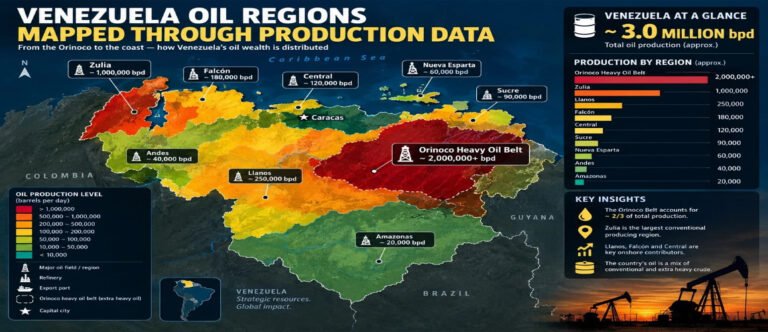
This is one reason the Orinoco Belt is so important to Venezuela oil recovery.
The region contains huge volumes of heavy crude, but producing those barrels requires more than simply drilling holes into the ground.
It requires an entire operating system.
The Orinoco Belt changes the production equation
The Orinoco Belt stretches across a large part of eastern and southern Venezuela.
It is one of the world’s most important heavy oil regions.
The scale of the resource gives Venezuela a major long-term advantage, but scale also creates a challenge.
A large resource requires a large infrastructure network.
Thousands of wells, pipelines, pumping systems, storage facilities, processing units, roads, power systems, and service operations may be needed to support sustained production.
When these systems receive regular investment, production can be maintained or expanded.
When maintenance slows for years, problems accumulate.
That is why Venezuela oil recovery depends heavily on restoring the physical systems around the resource.
The oil itself did not disappear.
The ability to produce it reliably was damaged.
Heavy crude needs more than a working well
Imagine a heavy oil well producing crude successfully.
That sounds like a complete production success.
It is not.
The crude still needs to move from the well to a gathering station.
From there, it may travel through a pipeline to a processing or blending facility.
It may then need diluent.
After processing, the crude has to reach storage.
Finally, it needs to be transported to a refinery or export terminal.
Each step creates another potential bottleneck.
This is why Venezuela oil recovery must be measured across the whole production chain.
A rise in well activity is useful, but long-term production depends on what happens after the crude reaches the surface.
What Caused Venezuela’s Long Production Decline?
Venezuela’s production decline did not come from one single event.
It developed over many years.
Several factors affected the country’s oil sector, including underinvestment, maintenance problems, economic pressure, operational challenges, sanctions, shortages of equipment, and difficulties maintaining aging infrastructure.
The U.S. Energy Information Administration has previously described how underinvestment and deteriorating infrastructure affected Venezuela’s energy sector. It also noted that assistance involving diluent, technical support, and returning oilfield service providers helped support production increases during earlier periods of recovery.
The lesson is important.
Oil production declines are often easier to start than they are to reverse.
When equipment is not maintained, it becomes less reliable.
When wells are not properly serviced, production can fall.
When pipelines are not repaired, transportation becomes harder.
When service companies leave, operators lose access to specialist skills and equipment.
Over time, these problems reinforce each other.
Aging equipment
Oil fields contain thousands of mechanical and electrical components.
Pumps wear out.
Valves fail.
Motors need replacement.
Pipelines corrode.
Compressors require maintenance.
Electrical systems age.
Storage tanks need inspection.
None of these problems is unusual in the oil industry.
The difference is what happens when maintenance is delayed for a long period.
A small maintenance issue can become a major repair.
That is one of the reasons Venezuela oil recovery requires capital spending even before companies can pursue major production expansion.
Some investment simply keeps existing production from falling.
Limited maintenance
Maintenance is often less visible than drilling.
A new drilling rig attracts attention.
Replacing a pump does not.
Yet maintenance can have a large effect on production.
A mature field may contain hundreds or thousands of wells.
Some wells may need minor repairs.
Others may require full workovers.
Some may need new pumps or artificial lift systems.
If maintenance teams can repair these wells efficiently, production can return without building an entirely new field.
That is why maintenance is a key part of Venezuela oil recovery.
Loss of oilfield services
Oil companies do not perform every task themselves.
They rely on specialized service companies for drilling, cementing, logging, well testing, pumping, electrical work, equipment repair, transport, and other technical services.
When these companies reduce operations, the operator may still own the oil field, but its ability to maintain production can weaken.
A return of field-service companies can therefore be an important sign of improving production capacity.
It means operators may once again have access to:
- Workover rigs
- Drilling crews
- Well-testing equipment
- Completion tools
- Pumps
- Electrical services
- Mechanical specialists
- Cementing services
- Well logging
- Transportation
- Spare parts
This makes the return of oilfield services one of the less visible but important pieces of Venezuela oil recovery.
The First Part of the Puzzle: Existing Oil Wells
The fastest production gains do not always come from new discoveries.
They can come from existing wells.
This is particularly important in Venezuela because the country has a large base of existing oil infrastructure.
A well that stopped producing years ago is not necessarily a useless well.
It may have stopped because of equipment failure, lack of maintenance, low prices, transportation problems, power shortages, or other operating conditions.
If the underlying reservoir remains productive, the well may be brought back.
Why mature fields matter
Mature oil fields can still contain large quantities of recoverable oil.
Their main challenge is often declining natural pressure and aging equipment.
Operators use artificial lift, workovers, water management, pressure support, and other methods to maintain output.
The advantage is that much of the basic infrastructure may already exist.
That can make mature-field work faster than building a new development from scratch.
For Venezuela oil recovery, this is important because brownfield projects can potentially produce results sooner than large greenfield developments.
Workovers can bring old wells back
A workover is a major maintenance operation performed on an existing oil well.
It may involve repairing or replacing equipment inside the well.
It can also address mechanical problems or production issues.
A workover may help restore production from a well that has declined or stopped.
This is one reason workover rigs are important.
A drilling rig creates a new well.
A workover rig helps restore an existing one.
Both matter, but their roles are different.
For Venezuela oil recovery, workovers can provide an important bridge between low production and larger development programs.
Artificial lift and pumping systems
Many mature oil wells cannot produce efficiently through natural reservoir pressure alone.
They need artificial lift.
Pumping systems help move crude from underground to the surface.
There are several forms of artificial lift, including rod pumps and other mechanical systems.
The correct system depends on the well and reservoir.
If pumping equipment fails, production can fall even when the reservoir still contains oil.
This creates a simple but important relationship:
Good reservoir + broken equipment = lost production.
Good reservoir + working equipment = production potential.
That is why equipment reliability is central to Venezuela oil recovery.
Infill drilling
Infill drilling means drilling additional wells within an existing field or development area.
The goal is to access oil that existing wells do not efficiently drain.
This can increase production without requiring an entirely new field.
Infill drilling can also benefit from existing infrastructure.
Roads, pipelines, storage facilities, processing systems, and field offices may already be available.
That can reduce the time and cost compared with building an entirely new development.
The Second Part: Heavy Crude and Diluent
Heavy crude creates one of the most important technical challenges for Venezuela.
The oil is thick.
Moving thick crude requires more energy and specialized handling.
Blending can make it easier to transport and process.
Diluent is a material mixed with heavy crude to reduce its viscosity.
Without enough diluent, some Venezuelan heavy crude production can become harder to move.
This makes diluent supply a key part of Venezuela oil recovery.
Why Venezuelan crude requires special handling
Crude oil is not one uniform product.
Different reservoirs produce different types of crude.
Some crude is light.
Some is medium.
Some is heavy.
Some is extra-heavy.
Venezuela is strongly associated with heavy and extra-heavy crude.
That gives the country a large resource base but also creates special operating requirements.
Heavy crude may require:
- Diluent
- Special pumps
- Larger transportation systems
- Blending facilities
- Specialized refinery equipment
- More processing capacity
This means the value of a Venezuelan oil well depends not only on how much crude it can produce.
It also depends on whether the crude can be moved and sold efficiently.
Naphtha and condensate
Different materials can be used as diluents depending on the operating system and available supply.
Naphtha is one example.
Condensate can also play a role in some blending systems.
The exact choice depends on crude properties, transportation needs, refinery requirements, cost, and availability.
This is another reason Venezuela oil recovery is more complicated than simply increasing drilling activity.
More wells can create more crude.
But if the system lacks enough suitable diluent, the additional crude may not be easy to transport.
Blending heavy crude
Blending is a basic but important part of heavy oil logistics.
A producer may mix heavy crude with a lighter material to create a blend with better flow characteristics.
The resulting crude must still meet transportation and refinery specifications.
That means blending operations need accurate measurements, reliable equipment, storage space, and consistent supplies.
If blending systems are unreliable, production growth can be limited even when wells are available.
The Third Part: Oilfield Equipment
Equipment is the physical foundation of production.
A field cannot operate at high output if basic equipment is unavailable.
This includes:
- Drilling rigs
- Workover rigs
- Pumps
- Compressors
- Generators
- Motors
- Valves
- Pipes
- Separators
- Storage tanks
- Electrical equipment
- Control systems
- Safety equipment
For Venezuela oil recovery, equipment availability is particularly important because years of low investment can create large replacement needs.
Drilling rigs
A drilling rig is one of the most visible pieces of oilfield equipment.
It allows operators to drill new wells.
But a rig alone does not create production.
It needs a complete support system.
Drilling requires trained crews, drilling fluids, casing, cement, logging tools, transport, power, spare parts, and other services.
That is why increasing rig activity is only one sign of recovery.
A stronger sign is a complete drilling system operating reliably.
Pumps and compressors
Pumps are essential in heavy oil production.
They help move crude from wells and through gathering systems.
Compressors can support gas handling and other field operations.
If these machines fail, production can fall.
Repairing or replacing them can therefore create immediate production benefits.
Pipes, valves, and replacement parts
Small components can have large effects.
A damaged valve may shut down part of a facility.
A failed section of pipe can interrupt transportation.
A missing replacement motor can leave a production unit idle.
This creates a major challenge for Venezuela oil recovery.
A large production plan may require thousands of individual parts.
The supply chain must be able to deliver them consistently.
The Fourth Part: Oilfield Services
Oilfield services are often overlooked in public discussions about production.
They should not be.
An oil producer may own the reservoir and infrastructure, but specialized service companies provide many of the technical activities required to operate the field.
Why skilled service companies matter
A service company may provide expertise in:
- Drilling
- Well completion
- Workovers
- Cementing
- Logging
- Artificial lift
- Well testing
- Equipment maintenance
- Electrical systems
- Mechanical systems
- Production optimization
When these services become available again, operators can do more with their existing fields.
This makes service-company activity an important indicator for Venezuela oil recovery.
Well maintenance
A producing well is not a machine that can simply be switched on and forgotten.
Wells need monitoring.
They may experience mechanical problems.
Pressure can change.
Water production can rise.
Pumps can fail.
Downhole equipment can wear.
Well maintenance keeps these problems from becoming larger production losses.
Drilling support
New wells require many specialist services.
A drilling program may involve geologists, drilling engineers, mud specialists, cementing crews, directional drilling teams, logging specialists, and completion crews.
The more complex the well, the more important these services become.
This is why rebuilding the oil-service sector can take time.
It is not only about buying equipment.
It is also about rebuilding teams and technical capability.
The Fifth Part: Pipelines and Midstream Infrastructure
Production does not end at the wellhead.
Crude has to travel.
That makes midstream infrastructure one of the most important parts of Venezuela oil recovery.
Aging pipeline networks
Pipelines can remain useful for decades, but they require regular inspection and maintenance.
Corrosion, mechanical damage, leaks, pressure problems, and failed pumping stations can reduce reliability.
When a pipeline is unavailable, operators may need alternative transportation.
That can raise costs and reduce production.
Gathering systems
A gathering system collects crude from multiple wells.
The crude then moves toward a central facility.
If gathering lines are not working, individual wells may not be able to maintain normal output.
This shows how connected oil production really is.
A single well is only one part of a network.
Pumping stations
Heavy crude requires strong transportation systems.
Pumping stations provide the pressure needed to move crude through pipelines.
If pumping equipment fails, flow can slow or stop.
Reliable pumping capacity therefore supports Venezuela oil recovery by keeping field output connected to processing and export facilities.
Storage tanks
Storage is another critical part of the chain.
Tanks provide temporary space for crude before it is processed, transported, or exported.
But storage capacity is not unlimited.
If crude cannot leave the country, storage can fill.
Once storage becomes constrained, production may have to slow.
This is one of the clearest examples of why production and exports are connected.
The Sixth Part: Processing and Upgraders
Venezuela’s heavy crude requires suitable processing.
Some facilities can handle heavier crude better than others.
Upgraders can alter the properties of extra-heavy crude, making it more suitable for transportation and refining.
Why upgrading matters
Heavy oil projects often rely on specialized processing systems.
An upgrader can improve crude quality by removing certain components and changing its properties.
This can make the crude easier to transport and sell.
But upgraders are complex industrial facilities.
They require:
- Reliable power
- Skilled operators
- Maintenance
- Replacement parts
- Feedstock
- Water
- Chemicals
- Mechanical integrity
If an upgrader is operating below capacity, heavy crude production may face another bottleneck.
Processing capacity versus production capacity
This distinction is important.
A country can have enough wells to produce more crude but lack the processing capacity needed to handle it.
In that case, production growth may slow.
The reverse is also possible.
A processing plant may have unused capacity, but field production may be too low to supply it.
A successful recovery brings these systems into balance.
That is another reason Venezuela oil recovery should be viewed as a complete supply-chain problem.
The Seventh Part: Investment
Investment is the fuel behind long-term recovery.
But not all investment does the same job.
Some spending keeps current production alive.
Other spending increases production.
Other capital goes toward infrastructure.
A useful way to think about this is through three categories.
Maintenance investment
This keeps existing equipment working.
Examples include:
- Pump replacement
- Pipeline repairs
- Electrical upgrades
- Tank maintenance
- Compressor repairs
- Well workovers
Production investment
This increases output.
Examples include:
- New wells
- Infill drilling
- Artificial lift
- Well stimulation
- Field expansion
Infrastructure investment
This improves the system around production.
Examples include:
- Pipelines
- Storage
- Processing plants
- Upgraders
- Export terminals
- Power systems
All three are important to Venezuela oil recovery.
Why brownfield investment may come first
Brownfield projects involve existing oil fields and infrastructure.
They can be attractive because much of the basic system is already there.
A company may be able to spend money on wells, pumps, workovers, and pipelines rather than building an entirely new oil complex.
This can shorten the path from investment to production.
It does not mean brownfield projects are easy.
Mature fields can have complex geology and aging infrastructure.
But the existing footprint can still provide an advantage.
International oil companies
International companies can bring capital, technical knowledge, equipment networks, project management, and access to global suppliers.
Their involvement can therefore support Venezuela oil recovery.
However, companies also need commercial terms that justify the investment.
Oil projects can last for decades.
Investors therefore consider:
- Fiscal terms
- Contract structure
- Legal protections
- Export rules
- Access to capital
- Infrastructure
- Oil prices
- Operating costs
- Political and regulatory conditions
The greater the uncertainty, the harder it may be to commit large amounts of long-term capital.
Chevron’s role
Chevron has remained one of the major international oil companies operating in Venezuela. Its joint ventures give the company an existing production base, infrastructure, and experience in the country’s heavy oil fields.
In September 2026, Chevron announced plans to invest more than $7 billion through its Venezuelan joint ventures over five years. The company said the investment is aimed at more than doubling production to about 600,000 barrels per day. The plan also includes expanding its Petroindependencia joint venture into two additional areas in the Carabobo region of the Orinoco Belt.
This is an important example of how new investment could support Venezuela oil recovery. Rather than starting entirely from scratch, the planned expansion will make use of existing infrastructure and production systems. That can include roads, pipelines, processing facilities, and other field infrastructure already connected to the projects. Chevron said the existing infrastructure gives the projects an advantage compared with building a completely new oil development.
The announcement should still be viewed as an investment plan rather than a guarantee of future production. Reaching the stated target will depend on drilling, equipment, field services, infrastructure, project execution, and the ability to maintain production over time.
For readers who want to review the original announcement and the details reported at the time, Reuters covered Chevron’s expanded Venezuelan investment plan here:
The Eighth Part: Venezuela’s Skilled Workforce
Equipment is important.
So are people.
Oil production requires experienced workers who understand wells, pumps, pipelines, electrical systems, processing plants, and safety procedures.
A recovery therefore needs more than capital.
It needs people.
Experienced workers
Many oil workers have years of experience.
Their knowledge can be extremely valuable when restoring mature fields.
They understand local equipment, field conditions, operating problems, and maintenance requirements.
Technical training
New workers need training in modern oilfield practices.
That includes:
- Equipment operation
- Process control
- Electrical systems
- Mechanical maintenance
- Safety
- Environmental management
- Well operations
- Emergency response
Training becomes especially important when new equipment enters an older field.
Workers need to understand both the existing system and the new technology.
Field safety
Oil production involves high pressure, flammable materials, heavy machinery, and complex industrial processes.
Safety cannot be treated as a secondary issue.
A stronger safety culture can reduce accidents, equipment damage, downtime, and worker injuries.
It can also improve long-term reliability.
For Venezuela oil recovery, a safe workforce is therefore part of production capacity.
Why Production Growth May Happen in Stages
It is tempting to imagine a sudden return to high production.
Oil fields rarely work that way.
Recovery usually happens in stages.
Stage one: repair existing production
The first stage focuses on what already exists.
Operators may:
- Restart idle wells
- Repair pumps
- Perform workovers
- Restore pipelines
- Repair processing equipment
- Improve storage
- Restore field services
This stage can produce relatively quick gains because the infrastructure already exists.
Stage two: expand mature fields
The second stage involves more investment.
Companies may drill additional wells.
They may install new artificial lift systems.
They may expand gathering systems.
They may improve processing capacity.
This can create more sustainable growth.
Stage three: develop larger projects
The third stage involves major long-term projects.
These may include:
- Large field expansions
- New processing facilities
- Major pipeline projects
- Upgrader investments
- New export infrastructure
- Large drilling campaigns
These projects take more time and money.
That is why Venezuela oil recovery should not be judged only by short-term production increases.
The quality of the recovery matters.
Production Is Not the Same as Exports
One of the most important distinctions in the Venezuelan oil story is the difference between production and exports.
Production means crude is being extracted.
Exports mean crude is actually reaching international buyers.
A country can produce oil but struggle to export it.
Why?
Because exports require:
- Storage
- Pipelines
- Terminals
- Tankers
- Trading arrangements
- Buyers
- Refinery demand
- Regulatory permissions
This is another reason Venezuela oil recovery depends on more than the oil field itself.
Getting crude out of the ground
The first step is production.
The well produces crude.
That crude moves into a gathering system.
Moving crude to terminals
The crude then travels through pipelines or other transportation systems.
Heavy crude may require special handling.
Finding buyers
The crude must then reach a buyer.
Heavy Venezuelan crude is most suitable for refineries designed to process heavier grades.
This can limit the number of potential buyers compared with lighter crude.
Matching crude quality with refineries
Refineries are designed around certain crude types.
A refinery with heavy-oil processing equipment may be better suited to Venezuelan crude than one designed mainly for light oil.
This relationship can influence trade flows.
What Could Slow Venezuela oil recovery?
The recovery has real opportunities, but it also faces major challenges.
Equipment shortages
A production plan can slow if critical equipment is unavailable.
Diluent supply
Heavy crude needs suitable blending and transportation solutions.
Pipeline problems
A damaged pipeline can affect output across several wells.
Power reliability
Oil fields and processing facilities need dependable electricity.
Processing constraints
More crude production is difficult to sustain if processing capacity cannot keep pace.
Skilled labor shortages
Technical operations require trained workers.
Financing
Oil projects require capital before they generate additional revenue.
Project execution
A project can have strong economics on paper and still face delays.
Regulatory conditions
Long-term investors need clarity about the rules governing their projects.
Crude transportation
Heavy crude can be more difficult and costly to move.
These challenges mean that Venezuela oil recovery will depend on execution as much as resources.
What Could Support Venezuela oil recovery?
Several factors could support higher production.
Existing oil reserves
Venezuela has a very large resource base.
Existing producing fields
Many fields already have wells and infrastructure.
Existing pipelines
Existing transportation networks can reduce the need to build everything from scratch.
Existing processing facilities
Even aging processing systems can provide a foundation for upgrades.
International technical expertise
Global oil companies and service providers can bring specialized knowledge.
New capital
Investment can fund wells, repairs, equipment, and infrastructure.
Better field maintenance
Regular maintenance can reduce downtime.
Higher drilling activity
More drilling can add production from existing fields.
Improved access to diluent
Reliable diluent supply can help heavy crude move through the production and export chain.
Together, these factors can strengthen Venezuela oil recovery.
Why the Orinoco Belt Will Remain Central
The Orinoco Belt will likely remain central to Venezuela’s oil story because of its enormous heavy crude resource.
The region also has existing infrastructure.
That matters.
A company does not need to build an entirely new oil industry if it can improve an existing one.
The challenge is making the existing system reliable.
The Orinoco Belt’s heavy crude also means technology and processing will remain important.
Operators need suitable wells, pumps, gathering systems, diluent, processing equipment, and export routes.
This makes the region both a major opportunity and a major engineering challenge.
For Venezuela oil recovery, the Orinoco Belt is therefore more than a reserve base.
It is the center of a large production system.
Venezuela’s Oil Recovery and the Global Market
Venezuela’s recovery also matters outside the country.
Additional Venezuelan crude could affect regional supply.
But the impact depends on how much production actually returns and how quickly.
Heavy Venezuelan crude is particularly relevant to refineries designed to handle heavier feedstocks.
If more Venezuelan crude reaches the market, refiners with suitable equipment may gain another supply option.
At the same time, Venezuelan production does not exist in isolation.
Global oil prices, OPEC policy, refinery demand, shipping costs, sanctions, trade rules, and competing crude supplies can all affect the economics of Venezuelan production.
That is why Venezuela oil recovery cannot be judged only by reservoir size.
The crude must be competitive in the market.
What to Watch Over the Next Few Years
Several indicators can show whether Venezuela’s recovery is becoming more durable.
1. Well activity
Watch the number of active drilling and workover programs.
More activity can indicate greater investment in existing fields.
2. Production consistency
A single monthly increase is less meaningful than sustained growth.
Stable production over several quarters would provide stronger evidence that field operations are improving.
3. Equipment availability
More rigs, pumps, compressors, and service equipment can support additional output.
4. Oilfield service activity
The return of specialized service companies can show that the wider production ecosystem is improving.
5. Pipeline reliability
Production cannot rise sustainably if transportation remains a major bottleneck.
6. Processing capacity
Heavy crude requires suitable processing.
More reliable processing can support higher field output.
7. Diluent supply
This remains important for the movement and handling of heavy crude.
8. Investment commitments
Announcements matter, but actual spending matters more.
9. New wells
A growing drilling program can support future production.
10. Export volumes
Higher production ultimately needs reliable access to international markets.
These indicators together provide a more complete picture of Venezuela oil recovery than a single production number.
How to Measure Whether the Recovery Is Real
There is a simple mistake people can make when looking at an oil recovery.
They can focus too heavily on the headline number.
For example, if production rises from one month to the next, it is easy to call that a recovery.
But a stronger recovery should show several things at the same time.
Production should remain stable.
Equipment should be operating.
Wells should receive maintenance.
New drilling should occur.
Infrastructure should improve.
Exports should remain reliable.
Investment should continue.
Service companies should remain active.
This is what makes Venezuela oil recovery sustainable rather than temporary.
Short-term recovery
A short-term recovery may come from restarting wells that were temporarily shut.
That can happen quickly.
Medium-term recovery
A medium-term recovery requires workovers, new wells, equipment, infrastructure repairs, and better field management.
Long-term recovery
A long-term recovery requires sustained capital, stable operations, modern technology, trained workers, reliable infrastructure, and commercially workable projects.
These three stages should not be confused.
Why Maintenance May Matter More Than Headlines
The oil industry often focuses on new production.
But maintenance can be just as important.
A field producing one million barrels per day needs constant work to remain productive.
If maintenance stops, production can fall.
This means a portion of new investment may not create additional barrels immediately.
Instead, it protects the barrels already being produced.
This is sometimes called sustaining capital.
It includes spending on:
- Existing wells
- Pumps
- Pipelines
- Processing equipment
- Storage
- Power
- Safety systems
For Venezuela oil recovery, sustaining investment can be one of the most important foundations.
Without it, production growth can be difficult to maintain.
Why Reservoir Management Matters
Oil reservoirs are not simple underground tanks.
They contain different rock layers, pressures, fluids, and flow patterns.
Operators need to understand how the reservoir changes as production continues.
Good reservoir management can help companies decide:
- Where to drill
- Which wells need workovers
- How much a well should produce
- Where artificial lift is needed
- How to manage water
- How to maintain pressure
- Which areas should receive new investment
This technical work can improve recovery from existing fields.
It also helps companies avoid spending money in areas that may produce little additional oil.
The Role of Technology
Technology can support Venezuela oil recovery, but technology alone cannot solve every problem.
A modern digital monitoring system does not help much if a broken pump cannot be replaced.
A new drilling system is less useful if there is no reliable pipeline to move the crude.
Technology works best when it is combined with equipment, workers, capital, and infrastructure.
Useful technologies can include:
- Remote monitoring
- Digital field management
- Advanced well logging
- Reservoir modeling
- Automated controls
- Pump monitoring
- Pipeline inspection
- Predictive maintenance
These tools can help operators make better decisions.
But the physical oil field still needs to work.
The Human Side of Venezuela’s Oil Recovery
Oil production is often discussed in terms of barrels and dollars.
There is another side.
Oil fields support workers, contractors, transportation companies, suppliers, engineers, mechanics, electricians, and local businesses.
When production falls, the effects can spread through the wider economy.
When production rises, activity can return.
That can increase demand for:
- Transport
- Construction
- Maintenance
- Food services
- Equipment
- Housing
- Technical training
- Local suppliers
A sustainable recovery therefore involves more than crude output.
It also involves rebuilding the industrial network around the oil sector.
What a Durable Recovery Would Look Like
A durable recovery would not simply mean that Venezuela produces more barrels for a few months.
It would mean the country can maintain and expand production while keeping the supporting systems healthy.
A durable recovery would likely include:
- Regular well maintenance
- Stable drilling activity
- Reliable oilfield services
- Better equipment supply
- Stronger pipelines
- Working processing facilities
- Adequate diluent
- Skilled workers
- New capital
- Reliable exports
- Long-term project planning
The key word is consistency.
Oil production rewards consistency.
A field that produces strongly for one quarter and then falls sharply because equipment fails has not solved its production problem.
A field that gradually increases output while improving its infrastructure is showing a more durable pattern.
This is the larger goal of Venezuela oil recovery.
Why Venezuela Cannot Rely Only on Its Reserves
Venezuela’s oil reserves are a major national asset.
But reserves are not the same as production capacity.
A country can have enormous reserves and still produce relatively little if the investment and infrastructure needed to develop those reserves are missing.
This distinction is important for readers trying to understand Venezuela.
The question is not:
“Does Venezuela have enough oil?”
The answer to that question is already clear.
The harder questions are:
“Can Venezuela produce it?”
“Can it move it?”
“Can it process it?”
“Can it export it?”
“Can companies earn enough to keep investing?”
Those questions explain the real Venezuela oil recovery puzzle.
The Difference Between Reopening and Rebuilding
Another important distinction is between reopening production and rebuilding the industry.
Reopening can happen relatively quickly.
A well that was shut because of an export bottleneck may restart when exports resume.
A pump can be repaired.
A workover can restore a well.
A pipeline can be brought back into service.
Rebuilding takes much longer.
It may require:
- New infrastructure
- New processing plants
- Large drilling programs
- Major pipeline projects
- Workforce development
- Long-term financing
- New service networks
This is why early production gains should not automatically be treated as proof that the entire industry has been rebuilt.
The first phase of Venezuela oil recovery can be much faster than the later phases.
Why Investment Plans Need Time
Large oil projects take years.
Even when funding is available, companies need to design projects, order equipment, prepare sites, drill wells, install facilities, test systems, and bring production online.
Heavy oil projects can require even more infrastructure.
That is why major investment announcements should be viewed as starting points.
Chevron’s September 2026 announcement provides a useful example. The company outlined more than $7 billion in planned investment over five years and a target of about 600,000 barrels per day from its Venezuelan joint ventures. The plan shows the scale of capital being considered, but the actual production result will depend on how projects are executed over time.
For Venezuela oil recovery, this distinction between planned investment and completed production is essential.
The Production Puzzle in Simple Terms
The entire story can be reduced to a chain.
Step one: Find oil.
Venezuela already has enormous reserves.
Step two: Produce oil.
That requires working wells and artificial lift.
Step three: Maintain production.
That requires workovers, spare parts, workers, and service companies.
Step four: Move the crude.
That requires gathering systems and pipelines.
Step five: Handle heavy crude.
That requires blending, diluent, and suitable equipment.
Step six: Process the crude.
That requires working processing facilities and upgraders.
Step seven: Store and export it.
That requires tanks, terminals, ships, buyers, and trade arrangements.
Step eight: Reinvest.
The revenue from production must support future maintenance and development.
If any major link fails, the entire system can struggle.
That is the heart of Venezuela oil recovery.
Frequently Asked Questions About Venezuela oil recovery
Why is Venezuela oil recovery difficult?
Venezuela oil recovery is difficult because production depends on many connected systems. The country has large oil reserves, but it also needs working wells, equipment, oilfield services, pipelines, processing facilities, diluent, skilled workers, capital, and reliable export routes.
Why is the Orinoco Belt important?
The Orinoco Belt contains enormous quantities of heavy and extra-heavy crude. It is therefore central to Venezuela’s long-term production potential. However, producing this crude requires specialized equipment, blending, transportation, and processing.
Can Venezuela restart old oil wells?
Yes, some older wells can potentially be restarted or improved through workovers, pump repairs, artificial lift, and other field operations. Whether a specific well can return to production depends on its reservoir condition, mechanical condition, economics, and available infrastructure.
Why are oilfield services important?
Oilfield service companies provide specialized equipment and technical skills for drilling, workovers, well testing, maintenance, electrical systems, and other operations. Their return can increase an operator’s ability to repair existing wells and develop new production.
Why does heavy crude need diluent?
Heavy and extra-heavy crude is thicker than lighter oil. Diluent can reduce its viscosity and make it easier to transport and process. Without enough suitable diluent, heavy crude operations can face additional transportation and processing constraints.
Does more drilling automatically mean more production?
No.
Drilling creates additional wells, but those wells still require completion equipment, artificial lift, gathering systems, processing capacity, and transportation.
More drilling can support Venezuela oil recovery, but it is only one part of the larger system.
What is a workover?
A workover is a major maintenance operation on an existing oil well. It can involve repairing or replacing downhole equipment and addressing problems that reduce production.
Workovers are important in mature fields because they can restore production without drilling an entirely new well.
What is brownfield development?
Brownfield development means investing in an existing oil field or production area.
It may involve new wells, workovers, infrastructure upgrades, pumps, pipelines, and processing improvements.
Brownfield projects can be useful during Venezuela oil recovery because existing infrastructure may reduce the time needed to bring additional production online.
Can Venezuela return to very high production levels?
Venezuela has substantial resource potential, but future production depends on investment, infrastructure, field performance, commercial conditions, technical execution, and the wider operating environment.
Production targets should therefore be treated as plans or scenarios rather than guaranteed outcomes.
What should investors and industry watchers monitor?
Useful indicators include:
- Sustained production
- Active drilling rigs
- Workover activity
- Equipment imports
- Oilfield service activity
- Pipeline reliability
- Processing capacity
- Diluent availability
- Capital spending
- Export volumes
- New project development
Looking at these factors together provides a better picture of Venezuela oil recovery than looking at one monthly production figure.
Final Thoughts on Venezuela oil recovery
The most important fact about Venezuela’s oil industry is also the easiest to overlook.
The country does not need to find an entirely new supply of oil.
It needs to make better use of a huge existing resource base.
That requires rebuilding a production system.
The wells must work.
The pumps must work.
The pipelines must work.
The processing plants must work.
The export terminals must work.
The service companies must be available.
The workers must have the tools and training they need.
The crude must have access to diluent and suitable transportation.
And companies must have enough confidence to keep investing.
This is why Venezuela oil recovery is a production puzzle rather than a simple drilling story.
A well can be ready but a pipeline may not be.
A pipeline can be ready but storage may be full.
Storage can be available but exports may be restricted.
Exports can restart but processing equipment may need repairs.
Investment can arrive but skilled workers and service companies must still be available.
Every part is connected.
The early stages of recovery can therefore come from relatively practical actions: restarting wells, repairing equipment, bringing service companies back, restoring pipelines, improving processing, and increasing maintenance.
The next stages are harder.
They require larger capital programs, more drilling, better infrastructure, stronger field management, and long-term planning.
That distinction matters.
A temporary production increase is not the same as a fully rebuilt oil industry.
The real test will be whether Venezuela can turn short-term gains into stable production that can be maintained year after year.
Recent investment plans show that major companies see enough potential to commit substantial capital. Chevron’s announced five-year investment program is one example of the scale now being discussed.
But the result will depend on execution.
For readers watching the global oil market, the biggest question is therefore not simply how much oil Venezuela has.
It is how efficiently the country can reconnect its wells, equipment, workers, pipelines, processing plants, and export system.
That is the real production puzzle behind Venezuela oil recovery.
And it is a puzzle that will likely take years, not months, to fully solve.