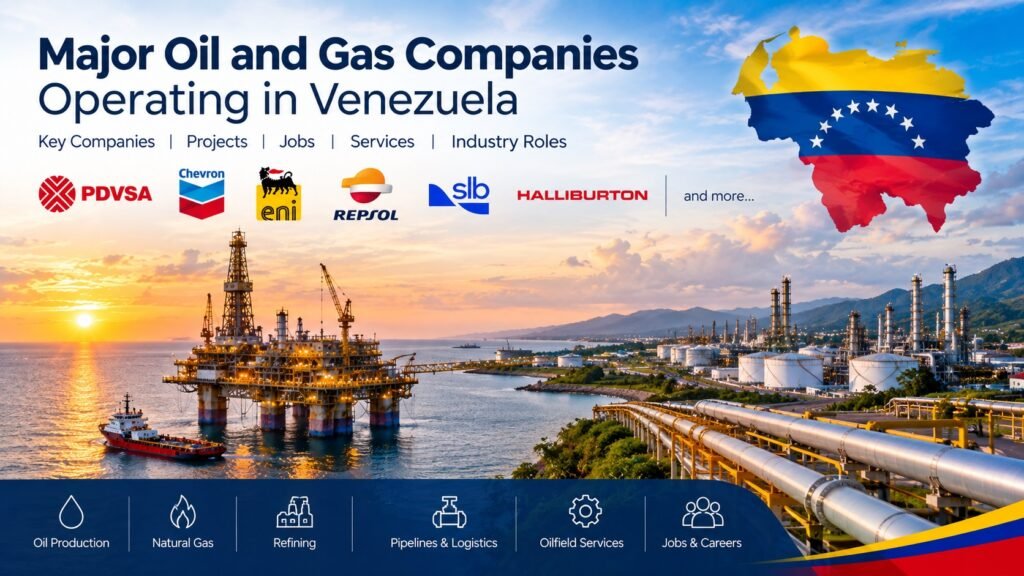
Venezuela has one of the world’s largest petroleum resource bases, and its oil and gas industry includes a mix of state-owned, international, and oilfield service companies. The most important name is PDVSA, the national oil company, but it is not the only company shaping production, natural gas, drilling, refining, technology, and field services.
The Major Oil and Gas Companies Operating in Venezuela also include international companies such as Chevron, Eni, Repsol, SLB, and Halliburton. Other companies have interests in specific oil fields, gas projects, refining activities, equipment, logistics, and technical services.
Understanding the Major Oil and Gas Companies Operating in Venezuela is useful for investors, energy professionals, job seekers, suppliers, students, researchers, and readers who want a simple view of the country’s energy sector. It also helps explain how Venezuela’s state oil company works with international partners and specialist service providers.
This guide explains the main companies, what they do, where they operate, the types of projects they support, and how their activities affect oil and gas jobs in Venezuela.
Major Oil and Gas Companies Operating in Venezuela at a Glance
The Major Oil and Gas Companies Operating in Venezuela can be divided into several groups. PDVSA sits at the center of the traditional industry structure, while international producers and oilfield service companies support different parts of the value chain.
The main names discussed in this guide include:
- PDVSA
- Chevron
- Eni
- Repsol
- SLB
- Halliburton
- Baker Hughes
- Weatherford
- CNPC and Chinese energy partners
- ONGC and other international partners
- Maurel & Prom
- Other local contractors and suppliers
Each company has a different role. Some are focused on producing crude oil. Others work mainly in natural gas, drilling, well services, technology, maintenance, engineering, logistics, or project support.
That difference matters because a person searching for Venezuela oil and gas company jobs may find opportunities with a service company rather than a producer. A supplier may also work on the same project without owning the field.
Why Major Oil and Gas Companies Operating in Venezuela Matter
The Major Oil and Gas Companies Operating in Venezuela are important because Venezuela’s petroleum industry is too large and technically complex to depend on one type of company.
The country has very large crude oil resources, much of them in the Orinoco Belt. A large share of that crude is extra-heavy, which creates special technical needs for production, transportation, blending, upgrading, and refining.
The U.S. Energy Information Administration has described Venezuela as having the world’s largest proven crude oil reserves in its latest country analysis available from that agency, with most of those reserves consisting of extra-heavy crude from the Orinoco Belt. Its analysis also explains the importance of PDVSA, international partners, refining infrastructure, natural gas, pipelines, and export facilities.
This helps explain why the Major Oil and Gas Companies Operating in Venezuela include both large producers and specialized service companies.
A modern oil project may need:
- Reservoir engineers
- Drilling crews
- Completion specialists
- Artificial-lift experts
- Well-testing teams
- Geologists
- Equipment suppliers
- Pipeline operators
- Refinery workers
- Marine logistics providers
- Digital technology teams
- Safety professionals
The industry therefore creates a much wider business network than the names of the biggest oil producers suggest.
PDVSA: The Central Company in Venezuela’s Oil Industry
PDVSA, or Petróleos de Venezuela S.A., is the state-owned oil company and the central organization in Venezuela’s petroleum sector.
When people search for the Major Oil and Gas Companies Operating in Venezuela, PDVSA is the first company they usually need to understand.
PDVSA has historically been involved across the full oil and gas value chain.
Its activities include:
- Exploration
- Oil production
- Natural gas
- Refining
- Pipelines
- Storage
- Terminals
- Petroleum exports
- Domestic fuel supply
- Petrochemicals
- Joint ventures
The company works through a large network of subsidiaries and joint ventures. International companies can therefore participate in projects while PDVSA remains an important partner.
PDVSA and Joint Ventures
Joint ventures are a major part of Venezuela’s oil business.
A joint venture can bring together:
- PDVSA
- An international oil company
- Oilfield technology
- Capital
- Technical expertise
- Local workers
- Equipment
- Project management
This structure allows different companies to contribute different strengths.
For example, an international company may provide project management and technology, while PDVSA provides local infrastructure, licenses, field knowledge, and an existing production base.
PDVSA and Venezuela’s Oil Fields
PDVSA has interests across several major producing regions.
Important areas include:
- Orinoco Belt
- Zulia
- Monagas
- Anzoátegui
- Eastern Venezuela
- Western Venezuela
- Offshore areas
The company also controls major refining and transportation assets.
This means that understanding PDVSA is essential for understanding the Major Oil and Gas Companies Operating in Venezuela.
Chevron in Venezuela
Chevron is one of the most important international companies in the Venezuelan oil industry.
The company has a very long history in Venezuela and has worked with PDVSA through several joint ventures. In 2026, Chevron announced updated agreements that expanded its position in Venezuela and added development rights in the Orinoco Belt. The company said its Venezuelan joint ventures planned more than $7 billion of investment over five years and targeted production of about 600,000 barrels per day compared with 2026 levels. Those figures are company plans, not guaranteed future production.
This makes Chevron a major name among the Major Oil and Gas Companies Operating in Venezuela.
Chevron’s Venezuelan Operations
Chevron’s work in Venezuela has involved heavy oil and joint-venture production.
Its activities have included:
- Oil production
- Field development
- Heavy crude operations
- Reservoir management
- Project planning
- Production optimization
- Technical services
- Supply chain activity
The Orinoco Belt is especially important because of the large amount of extra-heavy crude found there.
Chevron’s updated position includes the Petroindependencia and Petropiar ventures and additional acreage in the Orinoco region. In April 2026, Chevron announced an asset swap that increased its working interest in Petroindependencia to 49% and added development rights around Petropiar.
Chevron and Oil Jobs in Venezuela
Chevron’s operations can support many kinds of jobs.
Potential job areas include:
- Petroleum engineering
- Production engineering
- Mechanical engineering
- Electrical work
- Field operations
- Maintenance
- Logistics
- HSE
- Supply chain
- Finance
- Administration
- Project management
Actual vacancies change over time, so job seekers should check official company career pages before relying on older listings.
Eni in Venezuela
Eni is an Italian energy company with a long presence in Venezuela.
Among the Major Oil and Gas Companies Operating in Venezuela, Eni is especially important because its Venezuelan business includes both oil and natural gas.
Eni has been present in Venezuela since 1998. Its activities include offshore assets in the Gulf of Venezuela and Gulf of Paria as well as interests in the Orinoco region.
Eni and the Perla Gas Field
One of Eni’s best-known Venezuelan assets is the Perla gas field.
The field is operated through Cardón IV, a company jointly owned by Eni and Repsol.
Perla is important because natural gas has a major role in Venezuela’s domestic energy system.
Eni said in September 2026 that Perla production supplies a significant share of Venezuela’s gas consumption and that Cardón IV had signed an agreement intended to support the sustainable continuation and expansion of production.
This makes Eni important not only to oil production but also to Venezuela’s gas industry.
Eni and Junín 5
Eni’s Venezuelan role expanded further in 2026.
In September 2026, Eni announced that it had signed a strategic contract with PDVSA relating to the Junín 5 oil field in the Orinoco Belt and would become operator of the field.
Eni said the project is intended to develop the field toward a much larger production level over time. The company’s announcement also identified interests in the PetroSucre joint venture and the Supermetanol petrochemical business.
This development gives Eni an increasingly important position among the Major Oil and Gas Companies Operating in Venezuela.
Repsol in Venezuela
Repsol is another major European company with a long history in Venezuela.
The company has operated in the country since 1993. Its Venezuelan interests include oil and gas assets such as Cardón IV, Quiriquire Gas, Petroquiriquire, and Petrocarabobo. Repsol reported average net production in Venezuela of 71.3 thousand barrels of oil equivalent per day in 2025.
Repsol and Petroquiriquire
Petroquiriquire is an important part of Repsol’s Venezuelan oil business.
In April 2026, Repsol announced an agreement with Venezuela and PDVSA that would allow it to resume operational control at Petroquiriquire and work toward higher oil production, subject to the conditions of the agreement. The company said it was prepared to increase gross production by 50% within 12 months and potentially triple it over three years if the required conditions remained in place.
Those are company targets rather than guaranteed outcomes.
Repsol and Lake Maracaibo
Repsol also expanded its interest in potential new activity in 2026.
In June 2026, the company announced an agreement with the Venezuelan government and PDVSA to study development of the Horcón area southeast of Lake Maracaibo. The parties also planned feasibility studies for possible offshore opportunities.
Lake Maracaibo is one of Venezuela’s historic petroleum regions, so developments there are relevant to the wider story of the Major Oil and Gas Companies Operating in Venezuela.
SLB in Venezuela
SLB, formerly known as Schlumberger, is one of the world’s largest oilfield service companies.
Unlike an integrated oil producer, SLB generally supports customers with technology, engineering, field services, well construction, production solutions, and digital systems.
This makes SLB one of the most important Major Oil and Gas Companies Operating in Venezuela for people interested in technical careers.
What SLB Does in Venezuela
SLB services can cover many stages of an oil well.
Examples include:
- Drilling
- Wireline
- Well testing
- Completions
- Production
- Artificial lift
- Digital technology
- Reservoir evaluation
- Well intervention
- Field engineering
- Equipment support
In June 2026, SLB announced a long-term framework agreement with PDVSA focused on exploration, field development, production, digital technology, artificial intelligence enablement, and workforce development. SLB also said it had maintained a long presence in Venezuela.
SLB Jobs in Venezuela
For job seekers, SLB is important because oilfield service companies often hire for specialized technical roles.
Possible areas include:
- Field specialists
- Wireline operators
- Well-testing specialists
- Completions engineers
- Maintenance technicians
- Field engineers
- Operations supervisors
- HSE specialists
- Equipment technicians
- Data and digital roles
A service company can therefore offer a different career path from a national oil company.
Halliburton in Venezuela
Halliburton is another major oilfield service company.
The company has operated in Venezuela for decades and provides technical services to oil and gas customers.
In September 2026, Halliburton announced memorandums of understanding with Eneva and WESCA to support energy development opportunities in Venezuela. The company said it has nearly nine decades of experience in the country and maintains operational capabilities and local expertise there.
This recent activity makes Halliburton an important part of the current Major Oil and Gas Companies Operating in Venezuela landscape.
Halliburton’s Role
Halliburton can support projects through:
- Well construction
- Cementing
- Completion services
- Production services
- Logging
- Perforating
- Maintenance
- Reservoir evaluation
- Digital technology
- Field support
The exact service mix depends on customer requirements and project conditions.
Halliburton Jobs
Technical workers may find career opportunities in:
- Electrical engineering
- Electronics
- Mechanical maintenance
- Field operations
- Well services
- Logging
- Perforating
- Equipment maintenance
- HSE
- Project coordination
For Venezuelan workers, technical skills and field experience can be especially useful in service-company careers.
Baker Hughes in Venezuela
Baker Hughes is a global energy technology and oilfield services company.
Its work can include equipment, drilling technology, production solutions, digital systems, and other services used by energy producers.
Baker Hughes has historically been part of the international service-company group connected to Venezuela’s oil industry.
For readers researching the Major Oil and Gas Companies Operating in Venezuela, Baker Hughes is worth including because oil production depends on more than companies that own crude reserves.
Service providers can help customers:
- Improve well performance
- Maintain equipment
- Monitor production
- Manage pressure
- Improve reliability
- Support drilling
- Use digital technology
The scale of activity can change with contracts, project economics, regulation, and operating conditions.
Weatherford in Venezuela
Weatherford is another international oilfield service company with a long history in the country.
Its service areas can include:
- Artificial lift
- Drilling
- Well construction
- Production
- Well intervention
- Completion technology
- Digital solutions
- Field equipment
Artificial lift is especially important in mature oil fields.
As natural reservoir pressure declines, operators may need equipment to help move fluids toward the surface. That creates demand for engineering, installation, monitoring, and maintenance services.
This is why service companies such as Weatherford can remain relevant even when they are not the owners of the oil field.
CNPC and Chinese Energy Companies
China has been an important part of Venezuela’s petroleum relationship for many years.
Chinese companies have participated in Venezuelan projects, financing arrangements, technical cooperation, and oil production.
CNPC, or China National Petroleum Corporation, has been associated with Venezuelan oil projects and technical work.
China has also been an important destination for Venezuelan crude under different commercial arrangements over the years.
For the Major Oil and Gas Companies Operating in Venezuela, Chinese participation matters because the country’s petroleum industry has long depended on international relationships for capital, equipment, technology, and markets.
Chinese Companies and Technical Support
International technical support can be especially useful in Venezuela because many fields require:
- Heavy-oil expertise
- Reservoir management
- Diluent management
- Field maintenance
- Drilling equipment
- Refinery support
- Pipeline services
Chinese companies have therefore been part of the wider network supporting Venezuelan production.
ONGC and Other International Partners
India’s ONGC has also had a long connection with Venezuela.
ONGC has participated in Venezuelan oil projects through joint ventures and partnerships.
Other international companies have held interests or explored opportunities at different points in the country’s history.
These relationships show that the Major Oil and Gas Companies Operating in Venezuela are not limited to companies from one region.
The wider group can include companies from:
- United States
- Italy
- Spain
- China
- India
- France
- Brazil
- Other energy-producing countries
Participation changes over time because companies review assets, contracts, regulations, commercial terms, and investment risks.
Maurel & Prom in Venezuela
Maurel & Prom is a French independent oil company that has also been involved in Venezuela.
The company has participated in oil production and has been part of the group of European companies with Venezuelan interests.
Its presence is smaller than the largest names, but it is still useful to understand when researching the full list of Major Oil and Gas Companies Operating in Venezuela.
Smaller international producers can sometimes focus on specific fields rather than the entire petroleum value chain.
That can make them important to:
- Local contractors
- Field workers
- Equipment suppliers
- Logistics companies
- Engineering firms
- Maintenance businesses
How Major Oil and Gas Companies Operating in Venezuela Work Together
The Major Oil and Gas Companies Operating in Venezuela do not work in isolation.
A single project can involve many companies.
For example:
- PDVSA provides the local operating framework and field relationship.
- An international producer provides investment and project management.
- An oilfield service company provides drilling or completion services.
- Equipment companies provide pumps, valves, controls, or other systems.
- Local contractors provide transport and field support.
- Engineering teams manage technical work.
- Export and logistics companies move the finished crude.
This network is one reason the petroleum sector supports many different occupations.
Major Oil and Gas Companies Operating in Venezuela and the Orinoco Belt
The Orinoco Belt is central to Venezuela’s oil story.
It contains very large quantities of extra-heavy crude.
Extra-heavy oil is more difficult to produce and move than many lighter crude grades.
Companies working in this area may need specialized technology for:
- Well construction
- Artificial lift
- Crude handling
- Dilution
- Transportation
- Upgrading
- Refining
- Reservoir management
Chevron and Eni are among the international companies with major current activity connected to the Orinoco region. Repsol also has interests in Venezuelan oil production and has discussed additional development opportunities.
The technical challenges of the Orinoco Belt help explain the continued role of the Major Oil and Gas Companies Operating in Venezuela.
Major Oil and Gas Companies Operating in Venezuela and Lake Maracaibo
Lake Maracaibo is another historic center of Venezuelan oil production.
The region has a long petroleum history and a large network of fields, wells, pipelines, service companies, and communities.
Companies working around western Venezuela may require:
- Drilling services
- Workover crews
- Production engineers
- Pump specialists
- Pipeline workers
- Environmental teams
- Transportation
- Equipment maintenance
Repsol’s 2026 agreement to study the Horcón area southeast of Lake Maracaibo shows why the region remains relevant to international energy companies.
Major Oil and Gas Companies Operating in Venezuela in Monagas
Monagas is one of Venezuela’s important oil-producing states.
Maturín, the state capital, is a major center for petroleum services and technical work.
The Major Oil and Gas Companies Operating in Venezuela can support activity in Monagas through producers, oilfield service companies, contractors, equipment suppliers, and engineering firms.
Maturín can be relevant for workers seeking:
- Field jobs
- Maintenance jobs
- Engineering positions
- Well services
- Logistics roles
- HSE positions
- Equipment technician work
- Operations management
The local economy is closely connected to petroleum activity.
Major Oil and Gas Companies Operating in Venezuela in Anzoátegui
Anzoátegui is another important energy region.
It includes areas linked to oil production, refining, natural gas, transportation, and industrial services.
Puerto La Cruz is particularly important for the petroleum and refining network.
Companies working in this area may require workers with skills in:
- Refinery operations
- Mechanical maintenance
- Electrical systems
- Instrumentation
- Process engineering
- Pipeline operations
- Logistics
- Safety
The region therefore forms part of the wider employment network around the Major Oil and Gas Companies Operating in Venezuela.
Major Oil and Gas Companies Operating in Venezuela and Natural Gas
Oil receives most of the attention, but natural gas is also important.
Venezuela has very large natural gas resources.
Much of the country’s gas is associated with oil production. That means changes in oil production can affect gas availability.
Natural gas can be used for:
- Electricity
- Industrial activity
- Oil-field operations
- Reinjection
- Petrochemicals
- Domestic consumption
The Perla field is one of the most important international gas projects in Venezuela.
Eni and Repsol’s Cardón IV partnership has therefore become an important part of the country’s gas industry.
Why Gas Companies Matter
Natural gas projects require a different set of technical skills from some traditional oil projects.
Jobs can include:
- Gas processing
- Compression
- Pipeline operations
- Reservoir engineering
- Offshore operations
- Process engineering
- Instrumentation
- Maintenance
- Safety
- Project management
This creates another career path within the Major Oil and Gas Companies Operating in Venezuela.
Major Oil and Gas Companies Operating in Venezuela and Refining
Oil production is only one part of the petroleum business.
Venezuela also has a major refining network.
PDVSA owns and operates the country’s principal refinery system.
Important refining locations include:
- Amuay
- Cardón
- Puerto La Cruz
- El Palito
Refineries turn crude oil into useful products such as:
- Gasoline
- Diesel
- Jet fuel
- Fuel oils
- Petrochemical feedstocks
- Other petroleum products
Refinery work requires a large technical workforce.
Typical positions include:
- Process operators
- Mechanical technicians
- Electrical technicians
- Instrument technicians
- Chemical engineers
- Process engineers
- Maintenance planners
- HSE specialists
This means people looking for Major Oil and Gas Companies Operating in Venezuela should not search only for upstream production companies.
Major Oil and Gas Companies Operating in Venezuela and Oilfield Services
Oilfield service companies are a major part of the petroleum economy.
They support producers without necessarily owning the oil.
Common services include:
- Drilling
- Cementing
- Wireline
- Logging
- Perforating
- Well testing
- Completions
- Coiled tubing
- Artificial lift
- Pressure control
- Equipment maintenance
- Reservoir evaluation
SLB and Halliburton are particularly important names in this group.
Other service companies have also worked in Venezuela at different times.
Drilling Companies and Venezuela’s Oil Industry
Drilling is one of the most visible technical activities in the upstream industry.
A drilling project can involve:
- Drilling rigs
- Directional drilling
- Mud systems
- Logging
- Cementing
- Well control
- Drill pipe
- Mechanical systems
- Electrical systems
- Safety teams
The companies involved may include the operator, drilling contractor, and specialist service providers.
Workers often need formal technical training and field experience.
Well Testing and Completion Companies
After drilling, companies need to understand whether a well can produce and how it should be completed.
Well testing can measure:
- Pressure
- Flow
- Temperature
- Fluid characteristics
- Production potential
Completion work prepares the well for long-term production.
This can include:
- Completion equipment
- Perforation
- Well control
- Production tubing
- Packers
- Downhole tools
Companies such as SLB and Halliburton have technical capabilities in these areas.
Artificial Lift Companies in Venezuela
Artificial lift becomes important when reservoir pressure is not enough to bring fluids to the surface at the desired rate.
Common systems include:
- Electric submersible pumps
- Rod pumps
- Gas lift
- Other mechanical lift systems
Venezuela’s mature fields can create long-term demand for these technologies.
Workers in this area may include:
- Production engineers
- Pump technicians
- Electrical engineers
- Field specialists
- Maintenance technicians
- Data analysts
Artificial lift is therefore an important technical niche within the Major Oil and Gas Companies Operating in Venezuela.
Digital Technology and Venezuela’s Oil Industry
Digital technology is becoming more important across oil and gas.
Companies can use digital systems to:
- Monitor wells
- Track equipment
- Analyze production
- Improve maintenance
- Manage field data
- Study reservoirs
- Reduce downtime
- Support remote operations
SLB’s 2026 agreement with PDVSA specifically included digital enablement, artificial intelligence, and workforce development.
This suggests that future petroleum jobs may increasingly combine traditional field knowledge with digital skills.
Engineering Jobs at Major Oil and Gas Companies Operating in Venezuela
Engineering remains one of the most important professional areas in the industry.
Common disciplines include:
- Petroleum engineering
- Mechanical engineering
- Electrical engineering
- Chemical engineering
- Civil engineering
- Instrumentation engineering
- Process engineering
- Industrial engineering
- Reservoir engineering
Different companies hire engineers for different reasons.
A producer may need engineers to manage reservoirs and production.
A service company may need engineers to design or operate field equipment.
A refinery may need process and mechanical engineers.
An engineering contractor may need project engineers.
Technical Jobs at Major Oil and Gas Companies Operating in Venezuela
Not every oil job requires a university degree.
Technical roles are also important.
Examples include:
- Field technician
- Electrical technician
- Mechanical technician
- Instrument technician
- Welding specialist
- Equipment operator
- Wireline operator
- Well-testing operator
- Maintenance technician
- Crane operator
- HSE technician
Experience and certification can be important for these roles.
Safety training is especially important for anyone working around pressure, heavy machinery, chemicals, electrical equipment, or hydrocarbons.
Office Jobs at Major Oil and Gas Companies Operating in Venezuela
The industry also needs office professionals.
These jobs can include:
- Accounting
- Procurement
- Human resources
- Logistics
- Legal services
- Contracts
- Information technology
- Data management
- Finance
- Communications
- Administration
Large energy projects need strong business systems.
A petroleum company cannot operate successfully with field workers alone.
Local Suppliers Supporting Major Oil and Gas Companies Operating in Venezuela
Local companies are also important.
They can provide:
- Transportation
- Food services
- Accommodation
- Equipment rental
- Welding
- Fabrication
- Electrical work
- Mechanical work
- Safety equipment
- Spare parts
- Warehousing
- Cleaning
- Security
- Environmental services
This creates a wider economic network around the Major Oil and Gas Companies Operating in Venezuela.
For small businesses, becoming an approved supplier can provide access to major projects.
However, supplier requirements can be strict.
Companies may need:
- Registration
- Insurance
- Safety records
- Technical qualifications
- Tax documents
- Financial records
- Quality systems
How Companies Choose Oilfield Suppliers
A large oil company or service provider usually needs reliable suppliers.
Important factors can include:
- Price
- Quality
- Delivery time
- Safety performance
- Technical capability
- Local availability
- Past experience
- Equipment condition
- Financial strength
A low price alone does not guarantee a contract.
Oilfield work can involve expensive equipment and safety risks, so reliability matters.
Major Oil and Gas Companies Operating in Venezuela and Infrastructure
Infrastructure is one of the biggest issues facing the Venezuelan petroleum sector.
Oil needs roads, pipelines, storage tanks, pumping stations, ports, power systems, and processing facilities.
Gas needs gathering systems, processing plants, pipelines, compressors, and distribution networks.
Refineries need reliable feedstock, equipment, utilities, maintenance, and skilled workers.
The EIA has previously identified aging infrastructure, limited investment, and maintenance problems as major challenges for Venezuela’s energy system.
This is one reason the future of the Major Oil and Gas Companies Operating in Venezuela depends on more than drilling new wells.
Pipelines and Major Oil and Gas Companies Operating in Venezuela
Pipelines connect fields to processing and export facilities.
They can transport:
- Crude oil
- Natural gas
- Refined products
- Diluent
- Other petroleum liquids
Venezuela has a large pipeline network, but age and maintenance are important issues.
Pipeline work creates jobs in:
- Inspection
- Maintenance
- Welding
- Corrosion control
- Instrumentation
- Pumping
- Operations
- Safety
- Environmental monitoring
Pipeline reliability is essential because production cannot reach customers if transportation systems fail.
Export Terminals and Venezuela’s Oil Companies
Oil exports require terminals, storage tanks, loading systems, pipelines, ships, and commercial teams.
Puerto José is one of the best-known oil export facilities in Venezuela.
Export operations involve:
- Tank storage
- Pipeline transfer
- Quality testing
- Cargo measurement
- Marine operations
- Ship loading
- Documentation
- Scheduling
International oil companies can therefore be involved in the commercial side of petroleum as well as production.
Heavy Crude and the Role of International Companies
Venezuela’s extra-heavy crude creates special technical requirements.
Heavy crude may require dilution before transportation.
It can also require specialized refining or upgrading systems.
This creates demand for:
- Diluent management
- Blending
- Upgrading
- Specialized pumps
- Heat management
- Pipeline engineering
- Refinery technology
The heavy nature of much Venezuelan crude is one of the strongest reasons international technical companies remain relevant.
Major Oil and Gas Companies Operating in Venezuela and Technology
Technology can improve oil recovery and operating efficiency.
Modern projects may use:
- Reservoir simulation
- 3D seismic
- Digital twins
- Artificial intelligence
- Remote monitoring
- Automated controls
- Predictive maintenance
- Advanced well logging
Not every field uses all of these tools.
Older fields may need basic maintenance before advanced technology can produce major benefits.
That is why Venezuela’s energy development may require both simple repairs and advanced technical systems.
Environmental Work in Venezuela’s Oil Industry
Environmental management is an important part of petroleum operations.
Oil companies may need to manage:
- Oil spills
- Produced water
- Waste
- Gas emissions
- Soil contamination
- Pipeline leaks
- Refinery emissions
- Gas flaring
Environmental teams can include:
- Environmental engineers
- Safety specialists
- Laboratory technicians
- Field inspectors
- Waste-management professionals
- Regulatory specialists
Responsible operations require monitoring and clear procedures.
Natural Gas Flaring in Venezuela
Gas flaring is another major industry issue.
When natural gas cannot be economically captured, transported, or used, some operations may burn it.
Flaring can reduce immediate pressure and safety risks, but it also wastes an energy resource and produces emissions.
The EIA has previously highlighted Venezuela’s large natural gas resources and the underuse and flaring of gas as major features of the country’s energy system.
Reducing flaring can therefore create opportunities for:
- Gas gathering
- Compression
- Processing
- Pipeline construction
- Power generation
- Gas commercialization
Safety at Major Oil and Gas Companies Operating in Venezuela
Safety is a core requirement in oil and gas work.
Workers can face hazards from:
- High pressure
- Fire
- Explosive gases
- Heavy machinery
- Chemicals
- Electrical systems
- Confined spaces
- Working at height
- Offshore operations
Common safety practices include:
- Personal protective equipment
- Permit-to-work systems
- Gas testing
- Emergency training
- Equipment inspections
- Lockout and tagout
- Hazard assessments
- Incident reporting
Workers should always follow the specific safety rules of their employer and work site.
Skills Needed by Major Oil and Gas Companies Operating in Venezuela
The skills employers need depend on the job.
For engineers, useful skills can include:
- Reservoir analysis
- Production engineering
- Process design
- Mechanical systems
- Electrical systems
- Data analysis
- Project management
For technicians:
- Equipment maintenance
- Troubleshooting
- Instrumentation
- Electrical systems
- Mechanical repair
- Field operations
For office workers:
- Excel
- Accounting
- Procurement
- Contract management
- Data systems
- English
- Communication
English can be useful because many international oil and gas companies use English in technical documents and corporate communication.
Finding Jobs at Major Oil and Gas Companies Operating in Venezuela
People searching for oil and gas jobs should separate employers into three groups.
1. National Oil Companies
PDVSA and its related businesses offer roles across production, refining, gas, logistics, and administration.
2. International Producers
Companies such as Chevron, Eni, and Repsol can offer positions in technical, commercial, project, and field functions.
3. Oilfield Service Companies
Companies such as SLB and Halliburton can offer field-based technical positions.
This three-part search is often more useful than searching for “oil jobs” alone.
How to Apply for Venezuela Oil and Gas Jobs
A simple process can help job seekers.
- Choose your technical area.
- Identify companies active in that area.
- Check the company’s official careers page.
- Prepare an updated CV.
- Highlight field experience and certifications.
- Apply only through trusted channels.
- Prepare for technical interviews.
- Keep safety training and certificates current.
Applicants should avoid paying unknown people for supposed guaranteed jobs.
Real employers normally provide clear information about the position, location, qualifications, and hiring process.
Major Oil and Gas Companies Operating in Venezuela for New Graduates
Graduates can enter the industry through several paths.
Useful degrees include:
- Petroleum engineering
- Mechanical engineering
- Electrical engineering
- Chemical engineering
- Geology
- Industrial engineering
- Computer science
- Environmental science
- Business administration
Technical schools can also provide useful preparation for field careers.
New graduates should build practical skills alongside academic knowledge.
Internships, laboratory work, software skills, safety training, and communication skills can improve their readiness.
Experienced Workers and Major Oil and Gas Companies Operating in Venezuela
Experienced workers may find opportunities in specialized areas.
Examples include:
- Drilling supervision
- Production optimization
- Reservoir management
- Well services
- Maintenance management
- Refinery operations
- Project management
- HSE
- Procurement
- Supply chain
Senior workers may also move between operators and service companies.
The skills are often transferable.
For example, an experienced mechanical engineer can work in production, refining, field services, or industrial maintenance.
Why Oilfield Service Companies Matter So Much
Oilfield service companies often provide the tools and expertise that producers do not keep entirely in-house.
A producer may own the field but contract specialists for:
- Wireline
- Cementing
- Logging
- Well testing
- Completions
- Equipment repair
- Artificial lift
- Digital services
This creates a large secondary employment market.
For job seekers, that means there may be more opportunities than a simple list of national oil companies suggests.
Major Oil and Gas Companies Operating in Venezuela and Contractors
Contractors can support large projects with specialized labor and equipment.
Common contractor activities include:
- Civil construction
- Welding
- Electrical installation
- Mechanical installation
- Equipment transport
- Camp services
- Road construction
- Pipeline maintenance
- Environmental services
Contractor work can be temporary or long term.
The availability of contracts depends on project activity, budgets, regulations, and customer demand.
How Investment Affects Major Oil and Gas Companies Operating in Venezuela
Investment is one of the most important factors affecting Venezuela’s energy sector.
New investment can support:
- Drilling
- Workovers
- Equipment
- Pipelines
- Refineries
- Gas systems
- Digital technology
- Training
- Environmental work
But investment decisions depend on many conditions.
Companies look at:
- Legal rules
- Contract terms
- Payment systems
- Infrastructure
- Security
- Export access
- Project economics
- Technical risks
The changing regulatory environment in 2026 has led several international companies to announce new agreements or expanded plans, but individual projects still depend on commercial and operating conditions.
Recent Changes Among Major Oil and Gas Companies Operating in Venezuela
The Venezuelan oil sector has seen important changes in 2026.
Chevron announced updated joint-venture terms and additional acreage.
Eni announced a new strategic contract for Junín 5.
Repsol announced agreements linked to higher Petroquiriquire production and the study of the Horcón area.
SLB announced a technology and workforce-development framework with PDVSA.
Halliburton announced new agreements with Eneva and WESCA.
Together, these developments show that the company landscape is changing.
They do not mean that every proposed project will reach its planned production level.
What Chevron’s 2026 Expansion Means
Chevron’s September 2026 announcement is important because it shows a larger international producer increasing its position in Venezuela.
The company said its Venezuelan joint ventures planned more than $7 billion of investment over five years and targeted approximately 600,000 barrels per day of production compared with 2026. Chevron also received additional acreage in the Orinoco Belt.
For suppliers and workers, larger investment plans can create potential demand for:
- Equipment
- Construction
- Engineering
- Field services
- Logistics
- Maintenance
- Technical labor
Actual hiring depends on individual projects and company decisions.
What Eni’s Junín 5 Agreement Means
Eni’s September 2026 agreement gives the company an operating role at Junín 5.
The field is in the Orinoco Belt and is described by Eni as a giant oil field.
Eni also remains active in the Perla gas project and Corocoro oil field.
This means Eni’s Venezuelan position covers both oil and gas.
For the wider Major Oil and Gas Companies Operating in Venezuela market, the development also demonstrates the growing importance of project operatorship, not only minority participation.
What Repsol’s New Agreements Mean
Repsol’s 2026 agreements focus on production growth and new opportunities.
The Petroquiriquire agreement addresses operational control and production growth.
The Horcón agreement addresses possible development southeast of Lake Maracaibo.
Repsol has also continued its involvement in Cardón IV with Eni.
These activities give the company exposure to several parts of Venezuela’s energy system.
What SLB’s Digital Agreement Means
SLB’s agreement with PDVSA shows how technology is becoming part of the industry’s modernization plans.
The agreement includes:
- Exploration
- Field development
- Production
- Digital technology
- Artificial intelligence
- Workforce development
This could increase the importance of workers who understand both oilfield operations and digital systems.
For younger workers, that combination may become increasingly valuable.
What Halliburton’s New Agreements Mean
Halliburton’s September 2026 agreements show that service companies are also looking at new opportunities.
The company said its agreement with Eneva would focus on development opportunities, while its agreement with WESCA would support field evaluation and development planning.
This highlights the role of service companies in future field development.
It also shows that the Venezuelan market is not only about crude production.
Technical services, reservoir evaluation, digital interpretation, and project planning can all be part of the industry.
Major Oil and Gas Companies Operating in Venezuela and the Future
The future of Venezuela’s oil industry will depend on several factors.
Important issues include:
- Production investment
- Infrastructure repair
- Skilled labor
- Natural gas development
- Refinery performance
- Export systems
- Contract structures
- Technology
- Environmental management
- International participation
No single company can solve all of these issues.
The industry needs producers, service companies, government institutions, workers, contractors, and suppliers.
Why Venezuela Still Attracts Energy Companies
Venezuela’s resource base is the main reason international companies continue to study the country.
The country has:
- Very large oil reserves
- Large extra-heavy oil resources
- Significant natural gas
- Existing oil infrastructure
- Long petroleum experience
- Established producing fields
- Access to major international markets
The challenge is converting resources into reliable and economic production.
That requires capital, technology, skilled labor, maintenance, infrastructure, and workable commercial conditions.
Challenges Facing Major Oil and Gas Companies Operating in Venezuela
The Major Oil and Gas Companies Operating in Venezuela face several challenges.
These can include:
- Aging infrastructure
- Equipment maintenance
- Electricity reliability
- Diluent supply
- Refinery limitations
- Skilled labor gaps
- Financing
- Payment systems
- Regulatory changes
- Sanctions and licensing requirements
- Environmental risks
The exact effect of each issue can change over time.
Companies therefore need to review current conditions before making investment or employment decisions.
Infrastructure Is a Long-Term Challenge
A field can contain large oil resources but still produce below its potential if supporting infrastructure is weak.
A producing field may need:
- Roads
- Electricity
- Water
- Pipelines
- Storage
- Pumps
- Workover equipment
- Processing plants
- Export facilities
Repairing these systems can require large investments.
It can also create jobs for contractors and technical companies.
Skilled Workers Are Important
Oil and gas is a technical industry.
Machines cannot replace all human expertise.
Venezuela needs people who understand:
- Wells
- Reservoirs
- Pumps
- Refineries
- Pipelines
- Electrical systems
- Instrumentation
- Safety
- Gas processing
- Project management
Training and workforce development can therefore be as important as new equipment.
The Role of Local Workers
International companies operating in Venezuela normally depend heavily on local knowledge and labor.
Local workers understand:
- Field conditions
- Geography
- Infrastructure
- Local supply chains
- Operating practices
- Community needs
International technical teams can bring specialized knowledge, while Venezuelan workers provide valuable local experience.
The strongest projects often need both.
Major Oil and Gas Companies Operating in Venezuela and Local Business
Oil activity supports many businesses outside the oil companies themselves.
A production project can create demand for:
- Hotels
- Restaurants
- Transport companies
- Equipment rental
- Warehouses
- Construction firms
- Welding shops
- Electrical contractors
- Training providers
This makes the energy sector important to regional economies.
Maturín, Maracaibo, Puerto La Cruz, Anaco, Cabimas, and other petroleum centers can all be affected by changes in oil activity.
How to Research a Venezuela Oil Company
If you want to research one of the Major Oil and Gas Companies Operating in Venezuela, use a simple process.
Step 1: Identify the Company
Find out whether the company is:
- Producer
- Service company
- Contractor
- Gas company
- Refining company
- Technology provider
Step 2: Identify Its Venezuelan Assets
Look for:
- Oil fields
- Gas fields
- Joint ventures
- Refineries
- Service bases
- Offices
Step 3: Check Recent Company Information
Look for:
- Annual reports
- Company announcements
- Project updates
- Production information
- Partnership announcements
Step 4: Check Current Jobs
Use the company’s official career website.
Job boards can help, but the company itself should be the final source for application details.
Step 5: Check the Operating Region
Knowing the location can help identify local suppliers and job markets.
Common Questions About Major Oil and Gas Companies Operating in Venezuela
Which are the major oil companies operating in Venezuela?
The most important companies include PDVSA, Chevron, Eni, and Repsol, along with other international partners and producers.
The exact list changes over time as companies enter, leave, expand, sell assets, or change operating roles.
Is PDVSA still the main oil company in Venezuela?
Yes. PDVSA remains Venezuela’s national oil company and the central state organization in the petroleum industry.
It participates in production, refining, natural gas, pipelines, exports, and joint ventures.
Does Chevron operate in Venezuela?
Yes. Chevron operates through joint ventures with PDVSA and expanded its Venezuelan position in 2026.
The company announced updated agreements and additional Orinoco Belt acreage in September 2026.
Does Eni operate in Venezuela?
Yes. Eni has operated in Venezuela for many years and is active in oil and natural gas.
Its Venezuelan activities include the Perla gas field, Corocoro, and the Junín 5 oil field.
Does Repsol operate in Venezuela?
Yes. Repsol has a long history in Venezuela and holds interests in oil and gas assets.
In 2026, the company announced agreements involving Petroquiriquire and the possible development of the Horcón area.
Which oilfield service companies operate in Venezuela?
Important international service-company names include SLB and Halliburton. Other service providers have also participated in Venezuela at different times.
Their work can include drilling, well testing, completions, logging, maintenance, production, digital technology, and other field services.
Is SLB active in Venezuela?
Yes. SLB announced a 2026 framework agreement with PDVSA covering technology, exploration, production, digital solutions, artificial intelligence, and workforce development.
Is Halliburton active in Venezuela?
Yes. Halliburton announced new agreements in September 2026 to support energy development opportunities in Venezuela and said it has nearly nine decades of experience in the country.
Where are most oil jobs in Venezuela?
Oil jobs can be found in several regions, including the Orinoco Belt, Zulia, Monagas, Anzoátegui, and other petroleum-producing areas.
Maturín is an important center for oilfield service and technical work.
What qualifications are needed for oil jobs in Venezuela?
Requirements depend on the job.
Engineering positions often require a relevant degree.
Technical jobs may require vocational training, certifications, and field experience.
Service-company jobs can also require safety training and technical specialization.
Are there oil and gas jobs for graduates?
Yes. Graduates can look for entry-level positions in engineering, geology, operations, HSE, administration, digital technology, and other fields.
Internships and technical training can help build experience.
What does an oilfield service company do?
An oilfield service company provides specialized tools, equipment, technology, and technical workers to support oil and gas producers.
It may work on drilling, completions, wireline, well testing, production, maintenance, or digital services.
Why is the Orinoco Belt important?
The Orinoco Belt contains a very large amount of Venezuela’s extra-heavy crude resources.
Producing this type of crude requires specialized technology and infrastructure.
Why is natural gas important in Venezuela?
Natural gas supports electricity generation, industry, oil production, and domestic energy needs.
Projects such as Perla are important because they help supply the domestic gas market.
People Also Ask About Major Oil and Gas Companies Operating in Venezuela
Searchers commonly want quick answers to questions such as:
What are the largest oil companies in Venezuela?
PDVSA is the country’s national oil company. Major international companies with important Venezuelan interests include Chevron, Eni, and Repsol.
Which foreign companies are investing in Venezuela oil?
Recent company announcements show activity from Chevron, Eni, Repsol, and oilfield service companies such as SLB and Halliburton. Investment plans and operating rights can change as commercial and regulatory conditions change.
What international companies work with PDVSA?
PDVSA has worked with several international companies through joint ventures and service agreements.
The partners have included oil producers, gas companies, oilfield service companies, and technology providers.
What companies provide oilfield services in Venezuela?
SLB and Halliburton are major international oilfield service names associated with Venezuela. Service activities can include drilling, well services, completion, logging, production, technology, and maintenance.
Which Venezuelan city is important for oil jobs?
Maturín is one of the important centers for oilfield work, especially in Monagas.
Other important petroleum locations include Maracaibo, Puerto La Cruz, Anaco, Cabimas, and areas around the Orinoco Belt.
People Also Search For Related to Venezuela Oil Companies
People researching this subject often also look for:
- Venezuela oil company jobs
- PDVSA jobs
- Chevron Venezuela jobs
- SLB Venezuela jobs
- Halliburton Venezuela jobs
- Eni Venezuela
- Repsol Venezuela
- Venezuela oilfield services
- Maturín oil jobs
- Orinoco Belt companies
- Venezuela natural gas companies
- Venezuela oil projects
- Venezuela drilling companies
- Venezuela petroleum industry
- Venezuela energy companies
These searches are closely connected because company research often leads to questions about jobs, projects, locations, and services.
Major Oil and Gas Companies Operating in Venezuela: Company Roles Explained
A simple way to understand the market is to separate companies by role.
| Company type | Main role |
|---|---|
| National oil company | Owns or manages major national petroleum interests |
| International producer | Invests in and develops oil or gas assets |
| Oilfield service company | Provides specialist equipment and field services |
| Engineering company | Designs and manages technical projects |
| Equipment supplier | Provides machinery and industrial systems |
| Contractor | Provides labor and project support |
| Logistics company | Moves people, equipment, and materials |
| Refining company | Processes crude into petroleum products |
| Gas company | Produces, processes, transports, or sells natural gas |
This structure explains why a company does not need to own an oil field to be an important part of the petroleum industry.
Major Oil and Gas Companies Operating in Venezuela and the Supply Chain
The petroleum supply chain starts long before crude reaches a refinery.
A typical chain can look like this:
Exploration → Drilling → Completion → Production → Processing → Pipeline → Storage → Export or Refining
Every stage can involve different companies.
For example:
- Geologists study the reservoir.
- Drilling companies drill the well.
- Service companies evaluate the formation.
- Completion teams prepare the well.
- Production teams operate the field.
- Pipeline companies move crude.
- Refineries process crude.
- Marine companies support exports.
This creates a large network of employment.
Major Oil and Gas Companies Operating in Venezuela and Training
Training is increasingly important as companies introduce new technology.
Useful training areas include:
- HSE
- Well control
- Electrical systems
- Mechanical maintenance
- Instrumentation
- Welding
- Industrial automation
- Petroleum engineering
- Data analysis
- Digital oilfield systems
Companies may also provide internal training.
SLB’s 2026 agreement with PDVSA specifically includes workforce development, showing that skills are part of the sector’s modernization plans.
Women in Venezuela’s Oil and Gas Industry
Oil and gas work is not limited to one type of worker.
Women can work in:
- Engineering
- Geology
- HSE
- Finance
- Procurement
- Operations
- Data
- Laboratory work
- Project management
- Human resources
- Communications
Modern energy companies need a wide range of technical and business skills.
Digital Jobs in Venezuela’s Energy Sector
Digital transformation may create new career paths.
Potential roles include:
- Data analyst
- Digital field specialist
- Automation engineer
- Systems engineer
- Software specialist
- Cybersecurity professional
- Database administrator
- Remote operations specialist
These jobs connect technology with traditional energy work.
Workers who understand both areas may become more useful as digital systems expand.
Major Oil and Gas Companies Operating in Venezuela and Petrochemicals
Petrochemicals are another part of Venezuela’s energy economy.
Petroleum and natural gas can be used as feedstocks for:
- Methanol
- Fertilizers
- Plastics
- Chemicals
- Industrial materials
Eni’s Venezuelan activities include an interest in Supermetanol, which produces methanol.
This shows that the country’s energy sector extends beyond crude oil exports.
What Makes Venezuela Different From Other Oil Markets?
Venezuela has an unusual combination of very large resources and major operating challenges.
Its crude reserves are huge, but much of the resource is extra-heavy.
That means the country needs:
- Advanced technology
- Diluent
- Heavy-oil expertise
- Specialized refining
- Strong infrastructure
- Skilled labor
- Long-term investment
The Major Oil and Gas Companies Operating in Venezuela therefore need to manage technical complexity as well as commercial conditions.
What Investors Watch in Venezuela
Investors and energy companies usually pay attention to several factors.
These include:
- Production growth
- Contract terms
- Legal rules
- Payment mechanisms
- Export access
- Infrastructure
- Oil prices
- Refinery performance
- Workforce availability
- Environmental requirements
A large resource base alone does not determine whether a project will succeed.
Projects also need reliable operations and a workable commercial structure.
What Job Seekers Should Watch
Workers should focus on real hiring signals.
Useful signals include:
- New project announcements
- New contracts
- Expansion plans
- New field development
- Service agreements
- Training programs
- New equipment
- Increased drilling
- Production increases
When companies announce new projects, supporting jobs may appear later in engineering, services, maintenance, logistics, and construction.
How to Keep a Venezuela Oil Company Article Updated
A company article should not remain unchanged for years.
The industry changes quickly.
A good update process is:
- Review major company announcements.
- Check new projects.
- Check production changes.
- Review job openings.
- Update company profiles.
- Remove outdated claims.
- Check regulatory information.
- Review links.
- Add new technology developments.
- Update the publication date when appropriate.
This is especially important for a page targeting the Major Oil and Gas Companies Operating in Venezuela search.
Final Takeaway on Major Oil and Gas Companies Operating in Venezuela
The Major Oil and Gas Companies Operating in Venezuela form a large network rather than a simple list of oil producers.
PDVSA remains the central national oil company. Chevron has expanded its Venezuelan position and announced major future investment plans. Eni has strengthened its role through Junín 5 and continues to operate the Perla gas project. Repsol remains active in oil and gas and has announced new production and exploration-related agreements.
Oilfield service companies are equally important.
SLB is supporting technology, production, digital transformation, and workforce development. Halliburton continues to support energy development and has announced new agreements in 2026. Other international companies and local contractors add expertise in drilling, equipment, engineering, maintenance, logistics, refining, and gas operations.
The future of Venezuela’s energy industry will depend on how these companies work with PDVSA, local workers, contractors, suppliers, and infrastructure providers.
For job seekers, the most useful approach is to look beyond the largest oil producers. Service companies, engineering firms, contractors, technology providers, and local suppliers can all provide valuable career paths.
For businesses, the opportunity is broader than crude production. Oilfield services, equipment, logistics, maintenance, digital technology, environmental work, and training can all support the industry’s development.
For readers and researchers, the key point is simple: Venezuela’s oil and gas industry is a connected system. The Major Oil and Gas Companies Operating in Venezuela are part of that system, but so are the thousands of workers, contractors, suppliers, engineers, technicians, and local businesses that keep the energy sector moving.